
Most Sydney homeowners never think about their switchboard until something goes wrong, but by the time a fuse blows or a breaker trips repeatedly, the board has often been struggling for months. Knowing what a switchboard actually does, which warning signs mean it’s time for an upgrade, and whether you genuinely need a repair or a full replacement helps you act before a minor inconvenience becomes a genuine safety risk. This guide from Top Electricians Sydney covers exactly that.
What is a Switchboard?
A switchboard is the central point where electricity from the street supply enters your property and is distributed across every circuit in your home, from lighting and power points to appliances and air conditioning. It houses the main switch, the fuses or circuit breakers protecting each circuit, and, in a modern board, the RCD safety switches that cut power the moment a fault is detected.
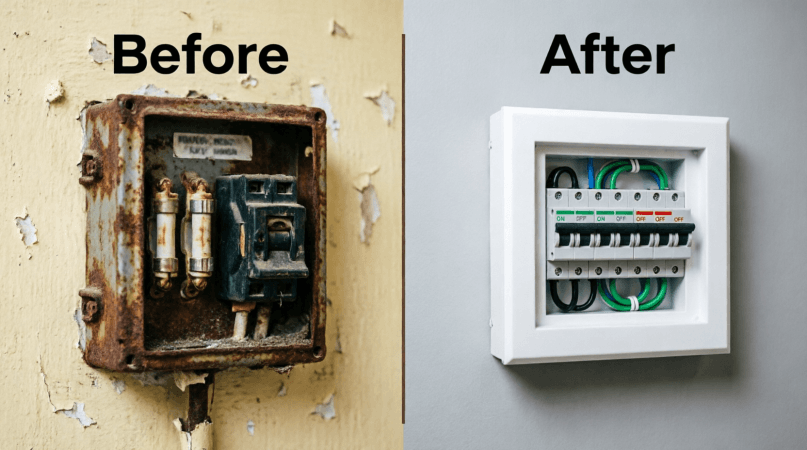
Older Sydney switchboards, particularly those installed before 1990, often use rewirable porcelain fuses instead of circuit breakers. These rely on an exposed fuse wire that melts when overdrawn, offer zero protection against earth leakage, and require manual rewiring when blown, which leaves room for dangerous human error if the wrong wire gauge is installed. A modern switchboard replaces these with circuit breakers and RCDs on every circuit, built to current AS/NZS 3000 Wiring Rules.
Signs You Might Need A Switchboard Upgrade
Overloaded circuits and aging components give off clear warning signals before complete failure occurs. Your switchboard doesn’t usually fail without warning, and recognising these signs early is what keeps a routine upgrade from turning into an emergency call-out.
These are the signs that might mean that you need a new switchboard upgrade
- The switchboard is overcrowded. Modern households run far more devices than older boards were ever designed for, including air conditioning, EV chargers, and multiple kitchen appliances. If your switchboard has circuits doubled up or no visible room for additional protection, it has outgrown your property’s power needs.
- Your appliances trip (or drop) the circuit. Occasional tripping after a storm is normal. Appliances repeatedly tripping the same circuit, or circuits dropping out when multiple devices run at once, means the panel has reached its maximum current capacity.
- Flickering lights. Lights that dim when high-draw appliances switch on, sometimes alongside an audible buzzing from loose busbars, indicate deteriorating connections that need urgent professional inspection.
- An old fuse. A switchboard still running ceramic or porcelain fuses instead of circuit breakers predates current safety standards. Without RCD protection on every circuit, your home has no active protection against severe electric shock.
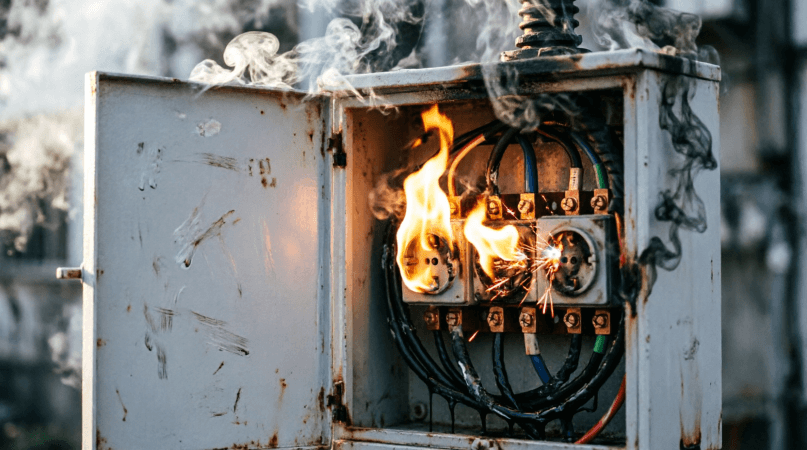
- A burning smell. A burning, plastic, or rubber smell near your switchboard is never normal and should never be ignored. It typically indicates overheating or arcing inside the panel, and the power should be switched off at the main switch immediately while you call a licensed electrician.
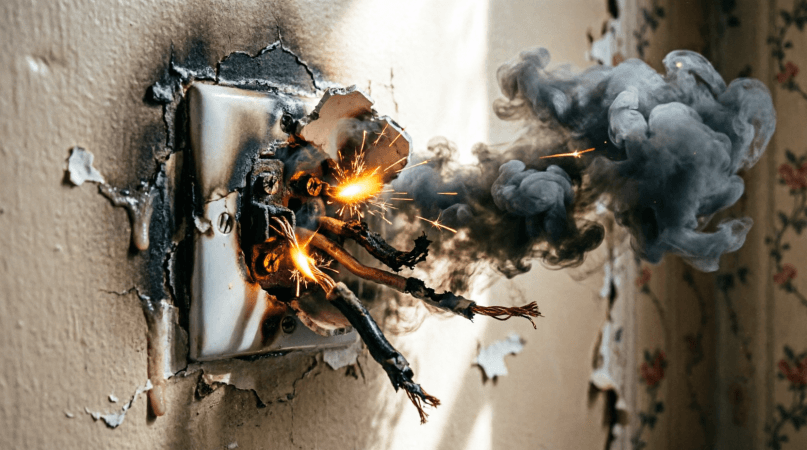
- Sparks. Visible sparking from the switchboard, an outlet, or a switch is an active electrical fault, not something to monitor over time. Switch off the main power if it’s safe to do so and treat this as an emergency.
- Melted or blackened fuses. Thermal discolouration or melted plastic around a fuse holder is a sign of sustained overheating that has already been happening, often for longer than you’d expect. A board showing any of these signs needs to be assessed urgently, not just repaired at the single faulty point.
If you’ve noticed any of these signs, don’t wait for the next one to appear. Our electrical fault finding team can confirm exactly what’s happening before it escalates, and our full electrical safety inspection covers your whole system, not just the switchboard.
If your switchboard is older than 1990
A dark, heavy backing panel behind an old fuse board can contain asbestos, and this needs to be handled separately from the electrical upgrade itself. See our guide on switchboard asbestos removal if your property falls into this category.
Repair, retrofit, or full replacement?
A common concern for property owners is whether an upgrade is genuinely needed or simply being upsold. Under AS/NZS 3000:2018, existing, untouched switchboards are not legally required to be retrofitted with safety switches. An upgrade becomes necessary when you’re adding new circuits, undertaking major alterations, or resolving a defect notice, or when the board itself is already showing the warning signs above. Use this framework as a general guide:
| Situation | Board Condition | Likely Path |
| A single circuit trips occasionally | Modern board with breakers and RCDs | Targeted repair of the specific fault |
| Adding a minor circuit, such as extra power points | Modern board with available space | Partial retrofit, adding an RCD module |
| Porcelain fuses or a dark asbestos-style backing panel | Pre-1990 board, no RCD protection | Full switchboard replacement |
| Installing solar, an EV charger, or ducted air conditioning | Board fully populated, main switch undersized | Full upgrade with increased capacity |
Why modern electrification often forces an upgrade
Even panels installed in the late 1990s or early 2000s can struggle to keep up with today’s energy demands. A standard single-phase EV charger draws a significant continuous load on its own, taking up a large share of an older main switch’s total capacity. Solar inverters need dedicated circuit breakers and modern metering setups, and switching from gas to induction cooking or adding ducted air conditioning adds substantial continuous load to legacy busbars. Installers for solar and EV equipment will often refuse to connect new systems until the board is upgraded to handle the additional load safely.
Switchboard Upgrades & Repairs in Sydney
Top Electricians Sydney provides licensed switchboard upgrades and repairs across every region of Sydney, replacing outdated ceramic fuse boards with modern switchboards fitted with circuit breakers and RCDs on every circuit.
What’s included in a switchboard upgrade
- Removal and disposal of the old fuse box or switchboard
- A new switchboard enclosure fitted with circuit breakers and RCD safety switches
- Correct labelling of every circuit
- Testing of all circuits before power is restored
- A Certificate of Compliance for Electrical Work (CCEW) on completion
What a full replacement involves beyond the enclosure itself
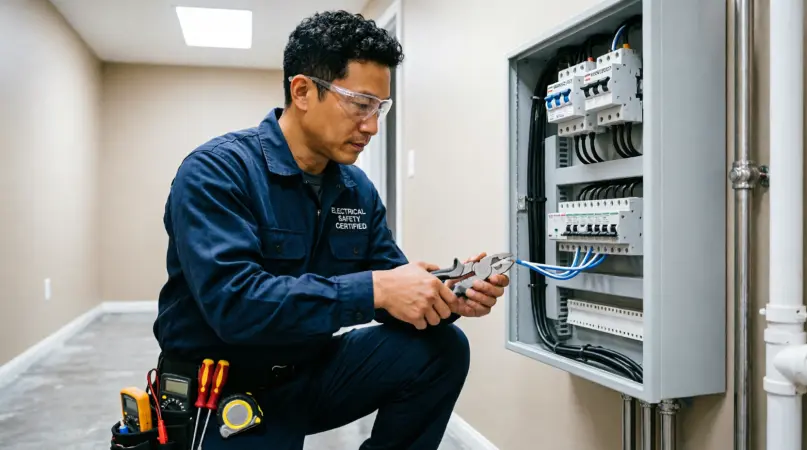
Replacing a full switchboard isn’t just swapping components inside the box. A Level 2 ASP electrician is required to isolate consumer mains at the network connection point, since standard electricians aren’t authorised to do this. Older properties can also hide brittle VIR (vulcanised Indian rubber) or cloth-braided wiring behind the panel, which can require localised rewiring if disturbed during the replacement. Once installed, earth continuity and circuit insulation are tested, and a CCEW is lodged to complete the job.
Areas we service
We handle switchboard upgrades and repairs across Central Sydney, Eastern Suburbs, Northern Suburbs, Southern Suburbs, and Western Suburbs.
If your switchboard shows any of the warning signs above, book an inspection before it becomes an emergency call-out.
Call Now – 0431 460 141
Frequently Asked Questions
Is a switchboard upgrade legally mandatory in NSW for existing homes?
No. NSW does not require retrofitting safety switches on an existing, untouched switchboard. An upgrade becomes necessary under AS/NZS 3000:2018 if you install new circuits, add equipment like solar or an EV charger, or carry out significant electrical alterations.
Can I just swap old fuses for plug-in circuit breakers without a full upgrade?
Plug-in breakers are more convenient than replacing fuse wire, but they don’t fully resolve the issue on their own. They still don’t provide RCD earth leakage protection and don’t address undersized consumer mains or an asbestos backing panel if one is present.
How do I know if I need a repair or a full upgrade?
If the fault is isolated to a single fuse or connection and the rest of the board is in good condition, a repair may be enough. If the board is running ceramic fuses, lacks RCD protection, or shows multiple warning signs at once, a full upgrade is the safer long-term option.
How long does a switchboard upgrade take?
A standard single-phase upgrade typically takes between 4 and 6 hours. Jobs involving three-phase conversion, mains isolation, or asbestos removal can take 6 to 8 hours.
Will an outdated switchboard affect my home insurance?
Potentially. Insurers may reject a claim related to an electrical fire if the switchboard was poorly maintained, modified without a CCEW, or operating with a known, unresolved defect. Check your specific policy for details.
How do I know if my switchboard’s backing panel contains asbestos?
Switchboards installed before 1990 frequently have a dark, heavy backing panel, often with a bituminous smell or a manufacturer stamp such as Zelemite or Lebah. Confirmation requires assessment by a qualified professional rather than a visual check alone.