
Is your pre-1990 Sydney switchboard hiding a silent asbestos hazard?
Discovering a pitch-black backing panel behind your home’s meter box can be unsettling, but it doesn’t have to be an emergency. If your switchboard was installed before 2004, it may contain asbestos, with the likelihood increasing significantly for boards installed before 1990. Across Greater Sydney, many older homes still have asbestos-containing material inside their electrical switchboards, and knowing how to respond calmly and correctly protects both your health and your wallet.
If the backing board is completely intact and undisturbed, it generally presents low immediate risk. Keep the enclosure closed, avoid touching it, and plan for safe removal during your next electrical upgrade. If the board is cracked, drilled, or already disturbed, stop any further work immediately, isolate the area, and contact a qualified professional. This guide from Top Electricians Sydney explains what switchboard asbestos actually is, how to identify it without touching it, what the removal process involves, and how to get it handled safely and compliantly.
What Is Asbestos in Electrical Switchboards?
The asbestos found in older Sydney switchboards is usually a backing panel made from asbestos cement or asbestos resin composite, installed behind the fuses and wiring as a fire-resistant, non-conductive base. It was standard material in electrical installations across Australia until asbestos was fully banned at the end of 2003, which is why it still appears behind so many ceramic fuse boards today, particularly in homes built or rewired before 1990.
Why it matters for your property
A switchboard backing panel in good, undisturbed condition is generally considered low risk. The danger arises the moment any electrical work, such as installing safety switches, upgrading a switchboard, or connecting a solar or EV charger system, requires drilling into or disturbing the panel, because this is exactly when fibres can become airborne. It also matters if you’re selling your property, since identified asbestos should be disclosed as part of the sale process.
How to visually identify an asbestos backing board without touching it
You don’t need to unscrew, touch, or dismantle anything to form a reasonable assessment. Stand at a comfortable distance with the enclosure door open and compare what you see against the following:
| Feature | Likely Asbestos Panel | Modern Non-Asbestos Panel |
| Surface colour | Dark pitch-black, dark brown, or dull charcoal grey | Bright orange, white, or smooth grey plastic |
| Texture | Matte, slightly chalky finish, visible fibre structure on edges | Polished, uniform plastic or painted metal |
| Brand markings | Zelemite, Lebah, Miscolite, or Ausbestos stamped on the panel | Modern brands such as Clipsal, Hager, ABB, or Schneider |
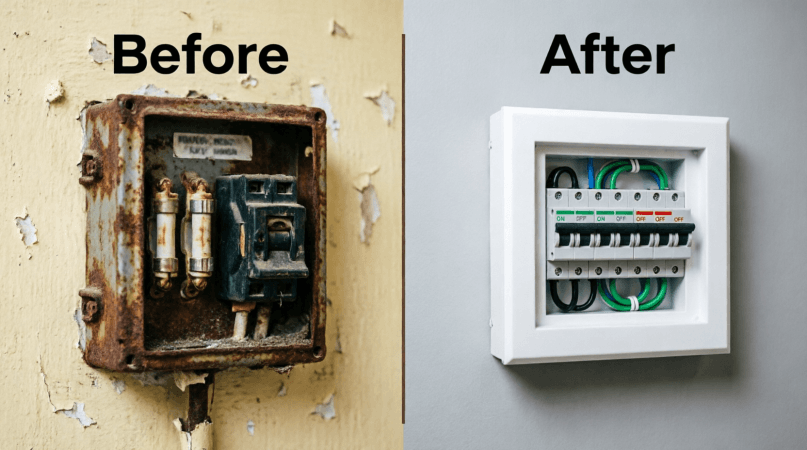
| Associated fuses | Porcelain rewirable ceramic fuses on open copper busbars | Sealed modern circuit breakers with test switches |
If in doubt, take a clear photo from at least one metre away using your phone’s flash, then zoom in on the image to check for texture or brand markings rather than inspecting it up close.
Friable versus non-friable asbestos
Non-friable (bonded) asbestos, such as a Zelemite-style panel, has fibres bound densely within pitch or resin, so fibre release is unlikely unless it’s cut, drilled, sanded, or broken. Friable asbestos, occasionally found as a soft, chalky heat shield behind old ceramic fuses, crumbles easily and releases fibres into the air with minimal contact. A bonded panel can also become friable once it is damaged or aged.
What Happens When You Work on an Asbestos Switchboard?
Any electrical work that requires removing, drilling, or disturbing an asbestos switchboard panel must stop until the asbestos itself has been safely managed, because continuing with standard tools on a damaged panel risks releasing fibres into the property. This is why a routine switchboard upgrade on an older home often becomes a multi-stage job.
Why electrical work alone isn’t enough
A licensed electrician is trained in electrical safety, not asbestos handling, and standard electrical work does not permit cutting, drilling, or forcibly removing an asbestos-containing panel. If a switchboard upgrade, safety switch installation, or solar and EV charger connection is needed and the backing panel contains asbestos, the asbestos must be addressed as its own controlled task first. Accredited solar and EV installers will generally stop work on site altogether if they identify a suspected asbestos panel, since they are not licensed to drill into it.
The health risk behind the caution
Asbestos fibres are too small to see or smell once airborne, and inhaling them is linked to serious, irreversible conditions including asbestosis, lung cancer, and mesothelioma, often with a delay of decades between exposure and diagnosis. Standard household vacuums cannot safely capture these fibres; attempting a DIY removal with ordinary power tools and a household vacuum can scatter respirable dust through the garage and surrounding living areas instead of containing it.
What a safe removal process involves
Testing is carried out first to determine how much asbestos is present and the likelihood of fibres becoming airborne, which shapes exactly what controls are used. Typical controls include:
- Wearing a P2 rated respirator, disposable coveralls, and gloves at all times during the work
- Using wet-suppression techniques to prevent fibres becoming airborne while the panel is unbolted, never broken or sawed
- Sealing vents in the work area so dust cannot spread into adjacent rooms
- Barricading the immediate job site to keep anyone without protective equipment away
- Cleaning the enclosure interior with a certified HEPA vacuuming system
- Double-wrapping removed material in sealed polyethylene and labelling it for transport
Decontaminating and disposing of the waste
Once the panel is removed, the work area is vacuumed and surfaces cleaned to collect any remaining dust, and all protective equipment is cleaned or safely disposed of. Waste is tracked and disposed of through NSW’s WasteLocate system at a licensed facility, in line with the NSW Work Health and Safety Regulation 2017. On larger or higher-risk jobs, an independent assessor carries out a clearance inspection, and sometimes air monitoring, to confirm the area is safe before anyone re-enters.
What you should never do yourself
Never attempt to remove, drill, sand, or break a suspected asbestos switchboard panel yourself. Even small amounts of disturbed asbestos can release fibres that are invisible and odourless, and the health risks are serious and irreversible, as outlined above. Unlicensed or non-compliant removal and disposal also carries real penalties under NSW work health and safety law, on top of the health risk.
Why Switchboard Asbestos Removal Must Be Done by Licensed Professionals
Asbestos removal in NSW is regulated separately from electrical work, and the licence required depends on the type and amount of asbestos involved, which is why your switchboard job may need more than one qualified trade working together.
NSW asbestos removal licensing
A Class A asbestos removal licence is required to remove friable asbestos in any quantity. A Class B asbestos removal licence covers non-friable (bonded) asbestos removal over 10 square metres. Non-friable asbestos under 10 square metres can technically be removed without a dedicated removal licence by a suitably competent tradesperson under NSW rules, but given how easily a switchboard panel can become friable once disturbed, engaging a licensed asbestos removalist is strongly recommended rather than left to chance.
The three-stage trade workflow
A compliant switchboard asbestos job is typically completed as three coordinated stages, often across a single visit:
- Mains isolation. A Level 2 ASP electrician disconnects the consumer mains at the network connection point, removing the service fuse to fully de-energise the enclosure before anyone touches the panel.
- Asbestos abatement. A licensed asbestos removalist applies wet-suppression techniques, carefully unbolts and removes the backing panel, cleans the enclosure with a HEPA vacuum, and double-wraps the waste for compliant disposal.
- Switchboard rebuild and certification. The electrician installs a new enclosure with modern circuit breakers and RCDs to AS/NZS 3000 Wiring Rules, the Level 2 ASP re-energises the connection with the network operator, and a Certificate of Compliance for Electrical Work (CCEW) is issued to close out the job.
What this means for your timeline
A complete single-day job, including mains isolation, abatement, rebuild, and re-energisation, typically takes between 4 and 8 hours, so you should plan to be without mains power for the working day. Coordinating all three stages through one experienced team, rather than separate subcontractors booked on different days, is what keeps this to a single visit instead of a multi-day outage.
For more on asbestos regulations
For broader guidance on identification, handling, and your obligations as a property owner, the SafeWork NSW asbestos hub and the Asbestos Safety and Eradication Agency are useful independent references.
Trusted Experts in Switchboard Asbestos Removal
Top Electricians Sydney coordinates safe asbestos switchboard removal alongside licensed electrical upgrades, so your job is managed as one process instead of several disconnected trades. Every job follows a clear, documented sequence from inspection through to final certification, and we’ll always confirm exactly which licensed trades are involved in your specific job before work begins.
Higher-risk areas we commonly work in
Pre-1990 properties across Sydney can carry this risk, but certain pockets see it more often due to their construction era, including the Inner West (Marrickville, Newtown, Leichhardt, Stanmore), the Northern Beaches (Manly, Dee Why, Mona Vale, Brookvale), the Eastern Suburbs (Randwick, Bondi, Paddington, Coogee), and Greater Western Sydney (Parramatta, Penrith, Blacktown). We service all of these areas, along with Central Sydney, Eastern Suburbs, Northern Suburbs, Southern Suburbs, and Western Suburbs.
Why Sydney homeowners trust us with this work
- Over 10 years of experience and 2,500+ completed electrical projects across Sydney
- Licensed electricians coordinating directly with accredited asbestos removal specialists, so you’re not left managing separate trades yourself
- Transparent, upfront pricing before any work begins
- Full documentation, including compliance and clearance paperwork, provided on completion
If your home was built before 1990 and your switchboard has never been upgraded, it’s worth having it assessed before any electrical work begins. Book a full electrical safety inspection with Top Electricians Sydney today.
Call Now – 0431 460 141
Frequently Asked Questions
Can a licensed electrician remove an asbestos switchboard panel themselves?
It depends on the type and area of asbestos involved. Non-friable panels under 10 square metres may be handled by a suitably competent, certified tradesperson, while friable material always requires a Class A licensed asbestos removalist. We’ll confirm exactly which licence applies to your job during inspection.
What’s the difference between non-friable Zelemite and friable asbestos millboard?
Non-friable Zelemite has fibres bound densely in pitch or resin, so release is unlikely unless disturbed. The friable millboard occasionally found as a heat shield behind old ceramic fuses is soft and chalky, and can release fibres with minimal contact.
Do I need an independent clearance certificate for a switchboard removal?
Air monitoring and clearance certificates are mandatory for friable (Class A) removal jobs. For smaller non-friable jobs it isn’t always mandatory, but it’s recommended, since it gives you documented proof of safe decontamination for future buyers, insurers, or council records.
How long will my power be off during the work?
A complete single-day job, including mains isolation, abatement, rebuild, and re-energisation, typically takes 4 to 8 hours, so plan to be without power for the working day.
Will my home insurance cover asbestos removal costs?
Generally no. Standard policies treat routine maintenance and gradual material degradation as the owner’s responsibility, and usually only cover abatement if the panel was suddenly damaged by an insured event such as a storm or fire. Check your specific policy to confirm.
Do I need to disclose switchboard asbestos if I sell my property?
If asbestos has been identified on your property, including in a switchboard, it’s good practice to record it and disclose it as part of the sale process. Your conveyancer or solicitor can advise on your specific obligations.