
Introduction: The Device That Quietly Keeps Your Property Safe
Most Australian and Greater Sydney homeowners never give their switchboard a second thought, and that is how it should be. But then a breaker trips at the worst time, lights start flickering for no reason, or you catch a faint burning smell near the meter box, and suddenly that grey box on the wall becomes very important very fast.
The switchboard is the backbone of your entire electrical system, yet it is one of the most overlooked parts of a property. Making things worse, a large number of Australian homes are still running on boards that were never built to handle today’s loads like solar systems, EV chargers, ducted air conditioning, and home offices.
This guide covers what a switchboard does, the types found across Australian properties, warning signs to watch for, and when an upgrade becomes something you cannot put off any longer.
What Is an Electrical Switchboard, and What Does It Actually Do?
An electrical switchboard is the main hub of your property’s electrical system. It takes the incoming power supply from the network, delivered by your local distributor whether that is Ausgrid in NSW, Powercor in Victoria, or SA Power Networks in South Australia, and splits it across individual circuits that run to different parts of your home or building.
Each circuit covers a specific area or function: lighting, power points, kitchen appliances, air conditioning, the garage, outdoor areas. Every one of those circuits has its own protective device that cuts power if something goes wrong.
In plain terms, the switchboard decides where electricity goes and it acts as the first line of defence when a fault occurs.
The Core Components Inside a Modern Australian Switchboard
Open up a modern, compliant switchboard in Australia and you will find:
Main switch (main isolator): Shuts off all power to the property in a single action. This is required under AS/NZS 3000:2018, the Australian Wiring Rules.
Circuit breakers (MCBs): Each one protects a single circuit. When current exceeds a safe level, the breaker trips and cuts power to that circuit only.
Residual Current Devices (RCDs or safety switches): These detect current leaking to earth, the kind of fault that causes electrocution, and cut power within milliseconds. Learn more about RCD safety switch installation and testing on our services page.
Surge protection devices (SPDs): Not always present in older installations but increasingly standard in new builds. They protect your appliances from voltage spikes caused by lightning strikes or grid disturbances.
Neutral and earth bars: The termination points that complete the circuit safely back to the source.
Under AS/NZS 3000:2018, all new residential installations must have RCD protection across power and lighting circuits. Older properties are not forced to retrofit unless they are being upgraded or renovated, but many of them are running with protection levels that would not pass a current inspection.
The Service Entrance Switchboard: Where Your Power Supply Begins
The service entrance switchboard is the first control point after electricity crosses from the street network onto your property. It is the handover line where your network distributor’s responsibility ends and yours begins.
This board sits close to your meter and handles the consumer mains, which are the cables that run from the street connection or overhead supply down to your metering equipment. From there, power flows into your internal distribution.
Why the Service Entrance Switchboard Requires a Level 2 Electrician
Work that touches the service entrance, including consumer mains, metering connections, the main service fuse, or any part of the network side of your installation, must be carried out by a licensed Level 2 Accredited Service Provider (ASP).
This is not just a recommendation. It is a legal requirement.
A Level 2 ASP holds additional accreditation from your network distributor, whether that is Ausgrid, Endeavour Energy, or Essential Energy in NSW, or the equivalent body in your state. A standard licensed electrician, no matter how experienced, is not authorised to perform this work. If someone quotes you for service entrance work without Level 2 accreditation, walk away.
Switchboards vs Panelboards: Understanding the Difference
In everyday conversation around Australian homes, switchboard and panelboard get used to mean the same thing. In technical and commercial contexts, they carry different meanings.
Feature | Switchboard | Panelboard |
Position in system | Main distribution point | Downstream sub-distribution |
Typical load | Higher, handles main supply | Lower, feeds branch circuits |
Common location | Entry point of property | Individual floors, zones, outbuildings |
Who works on it | May require Level 2 ASP | Licensed electrician |
Typical application | Residential mains, commercial main boards | Sub-boards in large homes, multi-storey buildings |
For most residential jobs the distinction does not change much practically. What matters is knowing where your main supply is controlled and whether your protection devices are current.
Types of Electrical Switchboards in Australian Properties
1. Residential Main Switchboard
The standard board in most Australian homes. It connects to the consumer mains and distributes power to every circuit in the house.
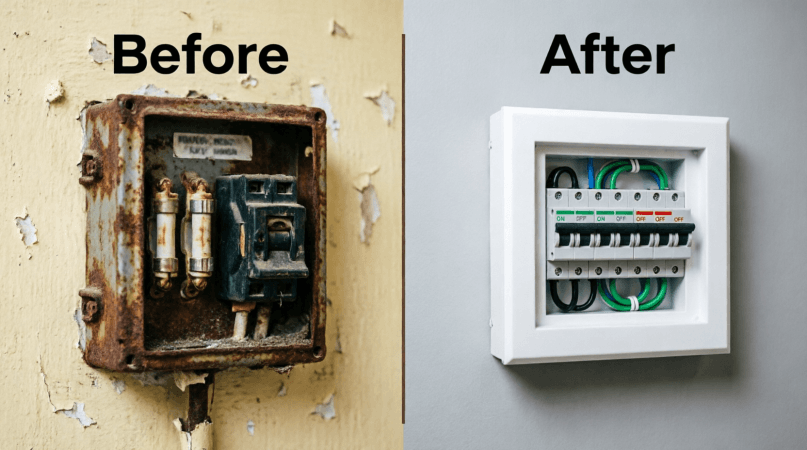
A properly upgraded residential board will have a main isolator, individual MCBs for each circuit, and RCDs covering both power and lighting. Many current installations use dual RCDs so that if one develops a fault, you are not left without protection across the whole board. If you are unsure what is inside your current board, a home electrical inspection is the quickest way to find out.
Typical location: exterior or interior wall, often near the front of the property or in the garage.
2. Service Entrance / Meter-Adjacent Switchboard
This sits at the point where the supply enters your property. In older homes this is often where you will still find ceramic fuses or first-generation breakers that have long been superseded. Any significant work here requires a licensed Level 2 electrician in Sydney.
3. Sub-Boards (Sub-Distribution Boards)
Bigger homes, granny flats, commercial tenancies, and renovated properties often have sub-boards managing power in specific zones. Common setups include:
- A dedicated board for an upstairs floor in a two-storey home
- A sub-board for a detached garage, workshop, or studio
- A board for outdoor entertaining areas or pool equipment
- A commercial sub-board serving a specific tenancy in a multi-unit building
Sub-boards reduce voltage drop over long cable runs and make fault-finding a lot more straightforward. Each one should have its own isolator and RCD protection.
4. Commercial and Industrial Switchboards
Built for heavier loads and more complex distribution needs. These boards can include high-capacity moulded case circuit breakers (MCCBs), power factor correction equipment, motor control centres, three-phase distribution, and advanced metering systems.
They must comply with AS/NZS 3000:2018 as well as commercial-grade standards under AS/NZS 61439, and must also meet state-level requirements enforced by bodies like SafeWork NSW, Energy Safe Victoria, or the Electrical Safety Office Queensland.
How to Tell If Your Switchboard Has a Problem
Switchboard problems rarely show up as one dramatic event. They tend to build quietly over time, small signs that are easy to dismiss until they are not.
Warning Signs You Should Never Ignore
Electrical behaviour:
- Breakers that trip regularly even when you are not running anything unusual
- Lights that flicker or dim without an obvious cause
- Power points that feel warm or spark when something is plugged in
- Appliances behaving strangely or underperforming
Physical signs at the board:
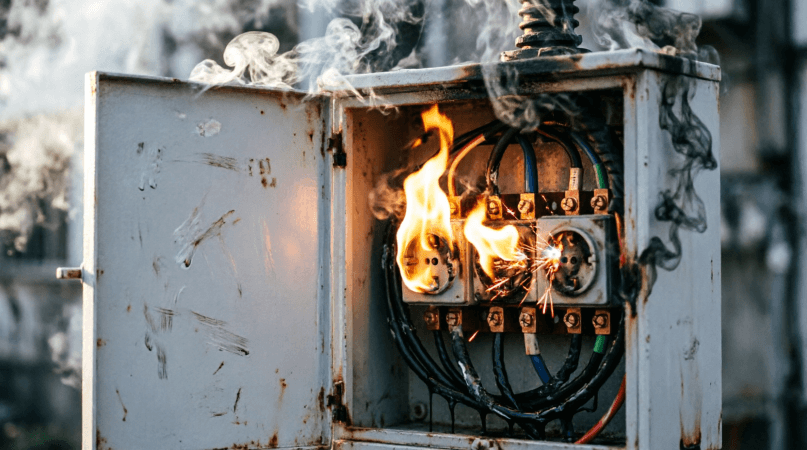
- A burning smell, even faint or occasional
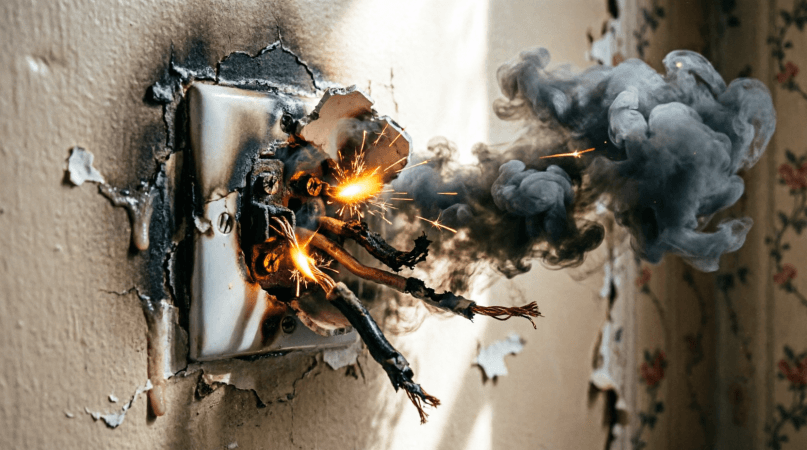
- Heat discolouration, melted plastic, or scorch marks near switches
- Buzzing, crackling, or humming sounds from inside the enclosure
- Rust, moisture, or evidence that pests have been inside
- Cracked or broken cover panels
Signs the board is outdated:
- Ceramic or rewirable fuses instead of circuit breakers
- Only one RCD covering everything or none at all
- No main switch that isolates the whole property
What Happens If You Leave It Alone?
A loose connection that causes intermittent tripping today can develop into an arcing fault inside a wall cavity. An absent or slow RCD means a ground fault could deliver a lethal shock before power is cut. Insurers are also paying closer attention to electrical compliance when claims are lodged. A non-compliant board at the time of a fire-related claim can create serious problems with your payout.
Do not keep resetting the breaker and hoping it sorts itself out. If something feels wrong, book an electrical inspection before it becomes an emergency..
When Should You Upgrade Your Electrical Switchboard?
A lot of Australian homes are running on boards installed when the average household used a fraction of today’s power. That gap between what the board was designed for and what is actually being demanded of it is exactly where problems start.
Clear Indicators That an Upgrade Is Overdue
- The board still uses fuses rather than circuit breakers
- There are no safety switches or coverage is incomplete
- You are adding major new loads such as ducted air conditioning, an EV charger installation, solar and battery storage, an induction cooktop, or a significant renovation
- Your electrician has told you the board is undersized or non-compliant
- The board is 25 to 30 years old with no upgrades
- An inspection has flagged it as defective
What a Switchboard Upgrade Actually Involves
A full residential upgrade in Australia typically covers:
- Removing old fuses or outdated breakers
- Installing a new enclosure with enough capacity for current and future circuits
- Fitting compliant MCBs across all circuits
- Installing RCDs in line with AS/NZS 3000:2018
- Adding surge protection if required
- Issuing a Certificate of Compliance for Electrical Work (CCEW), required under state electrical safety legislation
What Does a Switchboard Upgrade Cost in Australia?
Costs vary by state, board complexity, number of circuits, and whether Level 2 work is required. As a general guide for 2025 to 2026:
- Basic upgrade (small home, few circuits): $800 to $1,500
- Standard residential upgrade: $1,500 to $2,500
- Large home or complex upgrade: $2,500 to $4,000+
- Commercial switchboard upgrade: $3,000 to $10,000+
- Level 2 work (service entrance / mains): Additional $500 to $1,500+
Prices are indicative. Always get a written quote from a licensed electrician before any work starts.
Getting the upgrade done properly costs far less than dealing with repeated callouts, damaged appliances, emergency work, or a fire-related insurance dispute down the track.
Transparent Local Pricing: No Hidden Fees
You should never have to guess what electrical work is going to cost. Before anything starts on your property, you will have clear, fixed pricing confirmed in writing.
Standard Electrician Services at $80 to $100 per hour: Covers power point installations, LED lighting upgrades, circuit additions, and general fault finding.
Level 2 Electrician Services at $150 to $200 per hour: Required for live street-mains upgrades, underground consumer mains, private pillar installations, and service entrance work. See our full Level 2 electrician services page for more detail.
Emergency Call-Out from $200: 24/7 priority response for burning smells, complete blackouts, storm damage, or any fault that cannot safely wait until morning. Call our emergency electrician line any time.
Let’s get started!
Australian Standards and Regulations for Switchboards
All switchboard work in Australia must comply with:
AS/NZS 3000:2018 is the Australian and New Zealand Wiring Rules and the base standard for every electrical installation in the country.
AS/NZS 61439 covers low-voltage switchgear and controlgear assemblies and is relevant for commercial and industrial boards.
State electrical safety legislation applies in every state. Key examples include the Electrical Safety Act 2002 in Queensland, the Electricity Safety Act 1998 in Victoria, and NSW Fair Trading electrical licensing requirements.
For service entrance work, your network distributor also has its own technical requirements on top of the national standards. The Ausgrid service and installation rules page is a useful reference point for NSW properties.
Every completed job must come with a Certificate of Compliance for Electrical Work (CCEW) from the electrician who performed the work. In some states a separate inspection by an independent electrical inspector is also required. Energy Networks Australia is a useful national resource for understanding how network connections work across different states.
Frequently Asked Questions About Electrical Switchboards in Australia
What is the difference between a switchboard and a fuse box?
A fuse box is an older switchboard that uses ceramic or rewirable fuses instead of modern circuit breakers and RCDs. They were standard in Australian homes built before the 1980s. The issue is not just that they look dated. They are genuinely less safe. Fuses do not trip as precisely as MCBs and they offer no protection against electric shock the way a safety switch does. If your home still has a fuse box, a switchboard upgrade should be a priority.
Do I legally need RCDs on my switchboard in Australia?
Under AS/NZS 3000:2018, RCD protection is mandatory on all power and lighting circuits in new residential installations. Existing properties are not automatically required to retrofit unless they are undergoing a significant upgrade or renovation, but the absence of RCDs is a real safety gap. The Electrical Safety Office Queensland and Energy Safe Victoria both publish guidance on current obligations in their respective states.
How long does a switchboard upgrade take?
Most standard residential upgrades take between three and six hours. Jobs that involve Level 2 service entrance work or properties with complex wiring and multiple sub-boards can take a full day or more. A good electrician will give you a realistic timeframe before starting.
Can any electrician upgrade my switchboard, or do I need a specialist?
A licensed electrician can handle a standard residential upgrade without issue. But if the work touches the service entrance, consumer mains, or the network connection side of your installation, you need a licensed Level 2 ASP. You can verify a contractor’s licence through NSW Fair Trading or the equivalent body in your state.
How often should a switchboard be inspected?
There is no fixed legal requirement for residential inspections, but every five to ten years is a sensible baseline for most homes. Properties with older wiring, heavy electrical loads, or any visible signs of wear should be looked at sooner. Rental properties may have additional obligations under the Residential Tenancies Act in NSW or equivalent legislation in your state.
Is it safe to reset a tripped circuit breaker myself?
Resetting a tripped breaker once is fine, that is what they are designed for. The issue is when a breaker trips repeatedly or trips again shortly after being reset. That is the board telling you there is a fault that needs to be found and fixed. Resetting it over and over does not solve anything. It just gives the problem more time to get worse. If it keeps tripping, stop and call a licensed electrician.
Conclusion: Don't Wait for an Emergency to Think About Your Switchboard
The switchboard is not something most people think about until it fails, but by the time it fails the options get a lot more stressful and expensive. A board installed in the 1990s was not designed for solar inverters, EV chargers, and ducted reverse-cycle systems running at the same time. That gap between what the board was built for and what you are actually asking it to do is exactly where faults develop.
An inspection catches problems early. An upgrade where it is needed gives you a system that is safe, compliant, and built to handle whatever you add to it down the track.
For Sydney property owners, Top Electrician provides switchboard inspections, upgrades, and 24/7 emergency electrical services. Our team includes licensed Level 2 ASPs for service entrance and consumer mains work, and every installation is completed to AS/NZS 3000:2018 with a Certificate of Compliance issued on completion.
Call us today for a free quote and find out exactly where your switchboard stands.