

Many Balmain homeowners experience frustration when receiving electrical quotes. You might expect a simple price for a simple job, but your final invoice often reflects costs you did not anticipate. This happens because most pricing guides fail to account for the unique demands of inner-west housing. You are not just paying for a technician. You are paying for the specialized knowledge required to navigate historic building materials and the specific logistical challenges of the Balmain peninsula.
The Reality of Electrical Costs in Balmain Terraces
Electrical pricing in Sydney is not a flat commodity. It is a service structured around professional licensing, safety compliance, and operational overheads. A call-out fee represents the baseline cost for a contractor to mobilize their vehicle, tools, and expertise to your property. In the current 2026 market, professional technicians must cover rising insurance premiums and specialized testing equipment costs. When you see variance in pricing, it often reflects the difference between a contractor who is fully compliant and one who cuts corners. You must view these costs as a form of risk management. Professional work protects your home from fire hazards and ensures your insurance policy remains valid.
Standard Sydney Pricing vs. The Balmain Heritage Premium
Pricing in the Inner West differs from the rest of Sydney. A technician working on a modern apartment in a newer suburb faces different challenges than one working on a Victorian terrace. You should anticipate a premium for heritage properties due to the difficulty of accessing cabling and the care required to preserve original surfaces.
| Pricing Factor | Standard Sydney Rate | Balmain Heritage Factor |
| Hourly Labour Rate | $90 – $130 | $140 – $170 |
| Call-out Fee | $80 – $120 | $130 – $170 |
| Access Difficulty | Minimal (Easy parking) | High (Narrow streets/No parking) |
| Wall Material | Standard stud walls | Lath-and-plaster/Double brick |
The heritage access surcharge is a standard industry response to the physical constraints of our local area. Narrow streets and limited parking increase the time a technician spends just arriving at your door. Furthermore, the specialized labour required to drill into fragile or historic wall structures increases the time required for even basic installations.
Let’s get started!
Calculating Your Specific Job Cost: A Balmain Breakdown
To budget effectively, you must understand how different job types are structured. Simple repairs or installations often follow predictable pricing models. However, larger upgrades require a more detailed assessment.
- Power point installation: A typical installation in a standard wall ranges from $150 to $200. In a lath-and-plaster terrace wall, you should budget $200 to $250 per outlet to account for the extra care required.
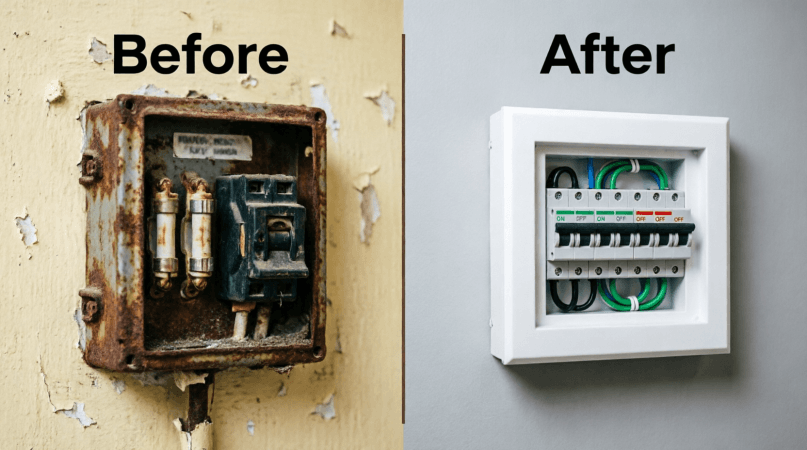
- Switchboard upgrade: This is a major infrastructure project. Modernizing an old ceramic fuse board to a compliant system with safety switches typically costs between $900 and $3,000 depending on the number of circuits.
- RCD installation cost: If you need to add individual safety switches to an existing board, expect to pay between $200 and $400 per circuit.
These figures cover materials, labour, and the vital documentation process that follows every project.
The Missing Link: Choosing Between Hourly and Fixed-Price Quotes
The decision to request an hourly or fixed-price quote depends entirely on the nature of your project. An hourly labour rate is the industry standard for diagnostic tasks. If you have an intermittent fault or a flickering light, the technician must spend time investigating the cause. It is difficult to predict how long this takes, so hourly billing provides the most transparency. Conversely, a fixed-price quote is the superior choice for defined installations. When the scope is clear, such as a switchboard upgrade or adding specific outlets, a fixed price protects you from budget blowouts. Top Electricians recommend asking for a fixed price whenever the scope of work is fully defined. This eliminates uncertainty and ensures that your budget remains predictable from start to finish.
How to Avoid Price Blowouts in Historic Properties
Budget overruns in heritage homes usually stem from invisible conditions. When a technician opens a wall or a ceiling rose, they may discover wiring that is out of code or damaged beyond repair. This necessitates an immediate adjustment to the project scope. To manage this risk, you must ensure that every quote includes an allowance for unexpected repairs. Furthermore, always demand a Certificate of compliance for every stage of the project. This document is not just a receipt. It is a legal record that certifies the work meets the AS/NZS 3000 safety standards. If a contractor hesitates to provide this, or if they omit this cost from your quote, view it as a warning sign.
Vetting Your Quote for Compliance and Value
Your quote should act as a clear roadmap for the work ahead. If you receive a document that is vague or lacks detail, you have no way to verify the quality of what you are paying for. Use this checklist to vet your next estimate before you authorize any work.
- Does the quote clearly list the materials markup as part of the total, or is it hidden?
- Is the call-out fee and the expected travel time explicitly stated as a separate line item?
- Does the document include a warranty for both materials and the labour provided?
- Has the contractor confirmed their NSW Fair Trading license number on the document?
If a quote appears significantly cheaper than the market average, it often signals that the technician is excluding necessary compliance costs or using inferior materials. You must decide if the potential savings justify the risk to your property safety.
Final Thoughts on Securing Fair Electrical Pricing
Navigating electrical pricing requires an understanding of the local market and the physical realities of your home. You need to balance the need for affordability with the absolute requirement for professional safety. By focusing on fixed-price agreements for known tasks and demanding proper documentation for all work, you secure both the value of your project and the safety of your property. Top Electricians remain committed to transparency, ensuring you understand every cost before we begin.
Expert FAQ: Electrical Pricing in Balmain
What is a standard call-out fee in Balmain for 2026?
Expect a call-out fee between $80 and $170. This fee typically covers the technician’s travel, vehicle costs, and the first 30 to 60 minutes of on-site diagnostic time.
Should I choose an hourly rate or a fixed-price quote?
Choose hourly rates for diagnostic tasks where the fault is unknown. Choose a fixed-price quote for defined installations like power points or switchboard upgrades to ensure your budget is protected.
What is the average cost to upgrade an old fuse board?
A compliant switchboard upgrade, including the installation of modern circuit breakers and RCD safety switches, typically ranges from $900 to $3,000 depending on the number of existing circuits.
Is the Certificate of Compliance included in the price?
It should be. A reputable contractor includes the cost of issuing a CCEW in the total project quote. Always confirm that this document is provided upon completion, as it is required for your property records and insurance.
Why does the price for a power point change based on the wall type?
Installing an outlet in a stud wall is straightforward. In a Balmain terrace with double-brick or lath-and-plaster walls, the technician must use specialised tools and take extra care to prevent structural damage, which increases labour time and the total price.