
You receive a quote to move your meter. It looks reasonable. Then the electrician opens the wall and the price suddenly doubles. This happens daily across Sydney. The culprit is rarely the meter itself. It is the hidden structural and regulatory traps waiting behind your existing setup.
At Top Electricians, we constantly help homeowners navigate these exact budget blowouts. The frustration comes from vague online estimates that ignore the physical reality of older Sydney homes. To protect your wallet, you must understand the three most common hidden traps that inflate your final invoice:
- Asbestos backing board removal in pre-1990 homes, which requires certified safe handling and disposal.
- Upgrading outdated consumer mains cables that no longer meet modern load requirements.
- Strata approval delays in apartment complexes that force project re-quotes and timeline extensions.
The Compliance Trigger: When a Simple Move Becomes a Full Upgrade
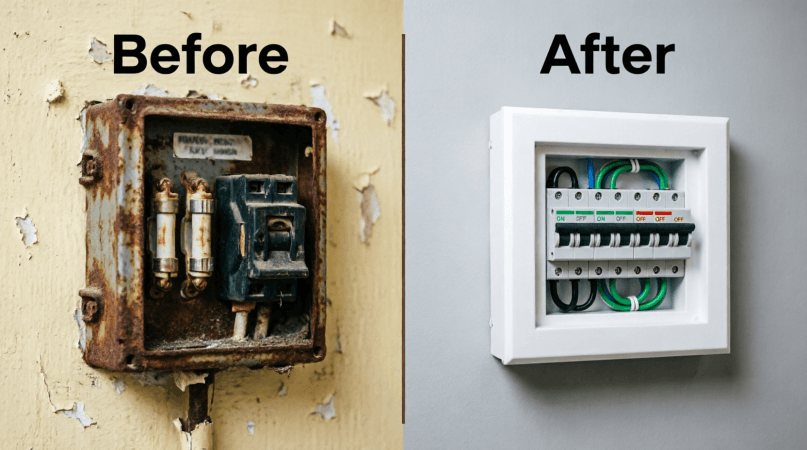
A compliance trigger occurs when existing electrical infrastructure fails current safety standards. While energy retailers cover the physical Type 4 smart meter device, property owners are legally responsible for funding any necessary switchboard remediation or asbestos removal to meet current AS/NZS 3000 Wiring Rules before a Certificate of Compliance (CCEW) can be issued.
Many homeowners assume a simple meter swap is just a direct exchange. The reality is much stricter. If your existing board is non-compliant, the network will not allow the new meter to be connected until you fix the underlying defects. You cannot just move the meter. You must bring the entire connection point up to modern safety standards. Ignoring this distinction is the fastest way to blow your renovation budget.
The 2026 Sydney Meter Relocation Cost Breakdown
To give you a realistic baseline, here is what you should expect to pay for a Level 2 ASP to handle your relocation in the current Sydney market. These prices include labor, materials, and standard network coordination. Keep in mind that complex jobs will push toward the higher end of these brackets.
| Scenario | Estimated Cost Range | Key Variables |
| Standard Same-Wall Move | $1,800 to $3,000 | Easy access, no asbestos, existing mains are fully compliant. |
| Extended Mains Relocation | $3,500 to $5,000 | Requires a consumer mains extension, new wall penetrations, or internal rerouting. |
| Complex External Move | $4,500 to $6,500+ | Involves trenching and reinstatement, concrete cutting, or three-phase upgrades. |
The Cost Responsibility Matrix: Who Actually Pays for What?
Most Sydney quotes are confusing because they bundle three separate bills into one number. Your retailer supplies the meter. Your network operator charges for access and outages. You pay the contractor for the physical move and any required upgrades. Understanding retailer versus ASP responsibility lets you question an inflated line item instead of accepting it.
This is the breakdown we use when reviewing relocation quotes for Sydney property owners.
| Retailer Covers | Retailer and Distributor Charges | Owner Pays via Level 2 ASP |
| The smart meter (Type 4) device itself | Meter works administration fee, often around $13.00 inc. GST | Relocation labour, new enclosure, and mounting hardware |
| A standard meter swap at the existing position | Initial assessment for a distributor-arranged outage | Consumer mains extension, trenching, and reinstatement |
| Routine meter replacement arranged by the retailer | Outage arrangement and network isolation fees | Switchboard upgrades, asbestos removal, and compliance certification |
The distinction that changes your bill is simple. A standard meter swap at its existing position is often covered by your retailer. A relocation is a customer-requested alteration to the connection. You fund the labour, the cable, and the new enclosure. The retailer does not pay to move your meter because you are renovating.
Real Distributor Fees You Need to Anticipate
Your electrician does not keep every dollar on your invoice. A portion goes straight to the network operator, and these charges rarely appear in generic online price guides.
According to the published 2025 to 2026 fee schedules:
- Endeavour Energy lists an initial assessment for a distributor-arranged meter outage at $420.66 inc. GST, outage arrangements at $812.08, and isolation that cannot be completed at $567.44.
- Ausgrid lists a basic connection offer for an existing urban alteration at $23.30, rising to $583.03 for a technical assessment where the service exceeds 50 metres or sits off a pole top.
- Retailer-side administration can add a small separate charge. One major NSW retailer lists its meter works administration fee at $13.00 inc. GST.
Always confirm which network services your address. Sydney properties fall under either Ausgrid or Endeavour Energy, and the two operators price the same task differently. Request these figures as separate lines on your quote. A single lump sum hides which part is labour and which part is a pass-through charge you would pay regardless of who does the job.
The 4-Step Level 2 ASP Relocation Process
A compliant relocation follows a fixed sequence. Skipping a step is how homeowners end up with an unconnected meter and a renovation that has stopped dead.
- Site assessment and scope definition. The electrician checks your meter type, consumer mains size, enclosure condition, and access. This is also where CT metering gets flagged. Properties drawing more than 80 amps per phase need current transformer metering, which costs materially more than a direct-connected setup.
- Approvals and coordination. If your meter sits on common property, strata coordination comes first. Your owners corporation must approve the works before anyone scopes them. Properties inside a heritage overlay may also need council consent for changes to the street-facing enclosure. The accredited provider then lodges an electrical work request with your distributor.
- Isolation and physical relocation. The provider arranges network isolation, disconnects the supply, extends the mains, and installs the new enclosure. Position, clearance, and enclosure type must satisfy the Metering Annexure. This is the stage where unexpected asbestos or undersized mains turn a half-day job into a multi-day one.
- Reconnection, testing, and certification. The meter is commissioned, circuits are tested, and a Certificate of Compliance Electrical Work is lodged with NSW Fair Trading. Under the NSW Service and Installation Rules, that certificate is your proof the connection is legal and insurable.
Allow two to four weeks for distributor scheduling on top of the physical work. Book the assessment before your builder locks in a demolition date, not after.
Secure Your Compliance and Avoid Budget Blowouts
The cheapest meter relocation quote in Sydney is rarely the cheapest finished job. The difference sits in what the quote leaves out. Ask for the distributor fees in writing. Ask whether your board is non-compliant or simply too small for the new meter. Ask whether the enclosure needs replacing before the meter arrives.
A fixed price only protects you when the scope behind it is complete.
At Top Electricians, we start with an on-site assessment of your consumer mains, switchboard, and proposed meter position. You receive an itemised scope that separates our labour from network charges. You know exactly what you are funding before any work starts, including whether a meter box upgrade or asbestos removal is required.
Book that assessment before demolition begins. The same relocation planned in week one costs less than the same relocation demanded in week six, when your builder is waiting and your options have narrowed.
Frequently Asked Questions
How much does it cost to relocate an electricity meter in Sydney?
A standard same-wall relocation costs $1,800 to $3,000. Moving the meter further along the property with an extended consumer mains run costs $3,500 to $5,000. Complex work involving trenching, three-phase supply, or asbestos removal ranges from $4,500 to $6,500 or more. Distributor outage fees may be additional.
Who pays for the meter relocation, the owner or the electricity retailer?
The property owner pays for a requested relocation, including labour, cable, enclosure, and any compliance upgrades. The retailer typically covers the meter device and a standard swap at the existing position. Distributor outage and assessment fees are charged to the customer as pass-through costs, regardless of which contractor you appoint.
Can a standard licensed electrician move my electricity meter?
No. Only a Level 2 Accredited Service Provider can alter a connection on the network side of the meter in NSW. A standard electrical licence does not authorise work on the service line, the cutout, or the distributor’s connection point. Using an unaccredited provider risks an invalid compliance certificate and a refused reconnection.
Do I need strata or council approval to relocate a meter?
Strata approval is required wherever the meter, meter room, or consumer mains sit on common property. Your owners corporation must authorise the works before they are scoped. Council approval depends on your property. Heritage overlays and changes to a street-facing enclosure can trigger a development application, so confirm this during the site assessment.
How long does a meter relocation take from quote to power reconnection?
The physical relocation usually takes a few hours to one day. Total lead time is typically two to four weeks because the distributor must schedule disconnection and reconnection. Strata approvals, heritage assessments, asbestos removal, and switchboard upgrades can extend this further. Confirm the power-off duration in writing before you book trades around the job.