
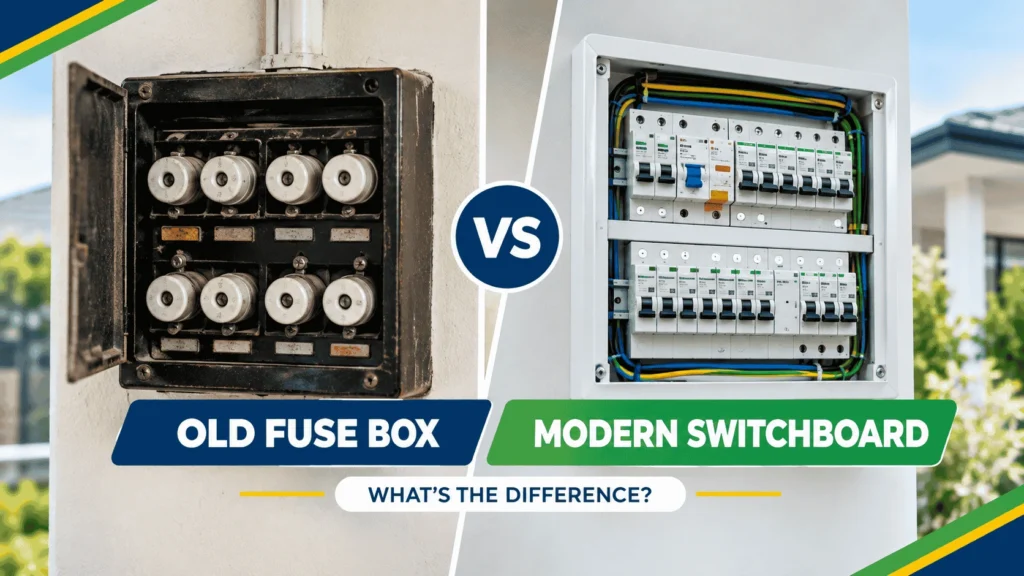
We provide professional Old Fuse Box Inspection and Modern Switchboard Upgrade services all across Sydney, helping homeowners improve electrical safety and meet current Australian standards. Older ceramic fuse boxes were not designed for today’s high-power appliances, solar systems, and EV chargers, creating potential safety risks.
Understanding the difference between outdated fuse systems and modern compliant switchboards is the first step toward protecting your property, family, and electrical system. Our licensed electricians assess your switchboard condition and recommend the right upgrade solution based on your needs.
Hidden Hazards of Old Ceramic Fuse Boxes
Old ceramic fuse boxes were designed for older electrical systems and cannot handle many modern household demands, including high-power appliances, solar systems, and EV chargers.
Common risks of outdated fuse boxes include:
- Electrical Fire Risk: Ageing components and loose connections can create overheating and electrical faults.
- No Electric Shock Protection: Ceramic fuses protect against overloads but cannot detect dangerous electrical leakage like modern RCD safety switches.
- Unsafe DIY Repairs: Incorrect fuse wire replacement can remove essential protection and increase fire risks.
- Old Wiring Problems: Ageing cables such as VIR wiring may deteriorate over time, creating hidden electrical hazards.
Upgrading to a modern switchboard with RCD and RCBO protection improves electrical safety, compliance, and protection for your home.
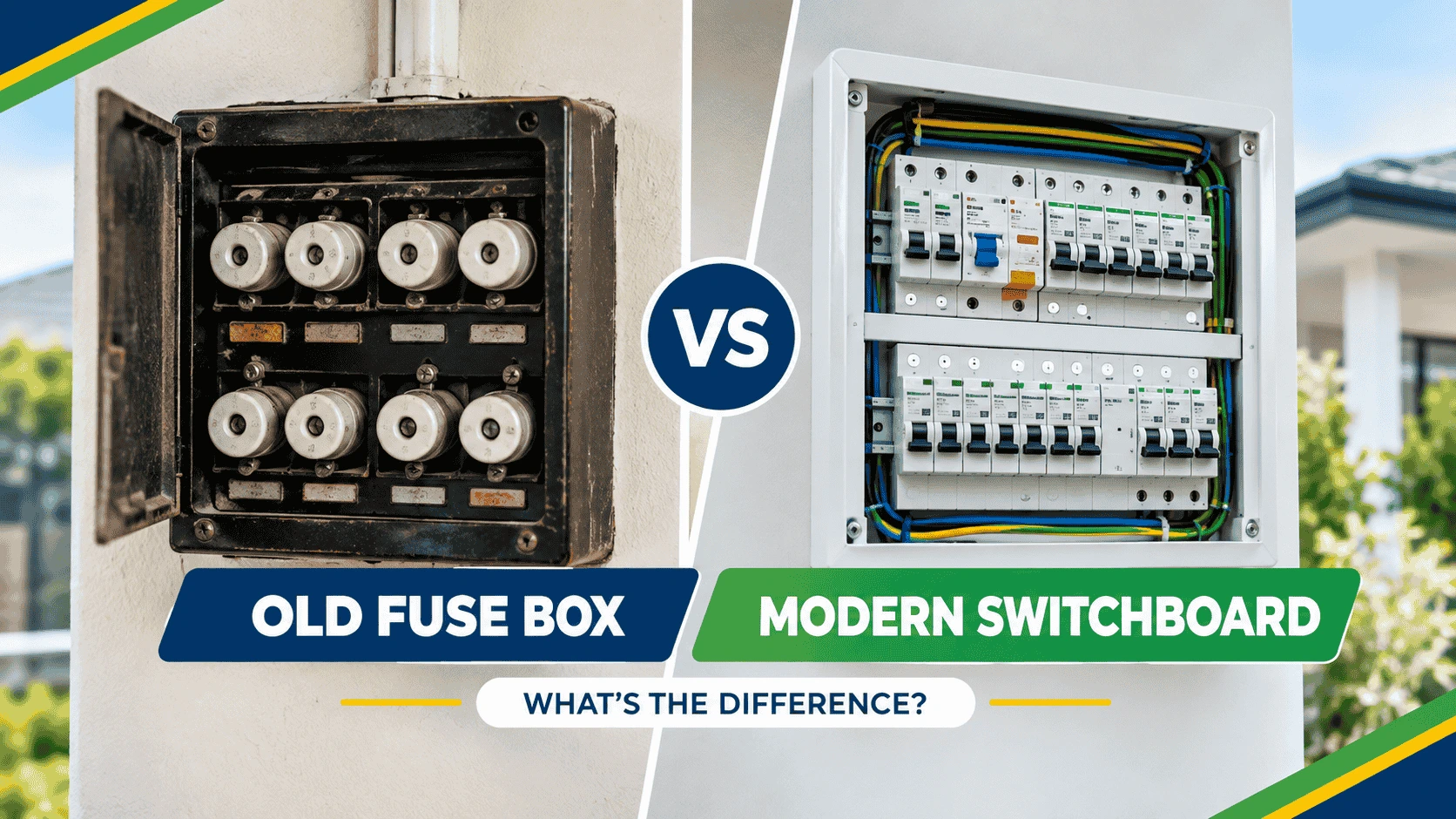
Core Technical Differences: Old Fuse Box vs Modern Switchboard
An Old Fuse Box uses manually wired ceramic wedges that melt under severe thermal overload to protect wall cables. A Modern Switchboard utilizes electronic Residual Current Breaker with Overcurrent (RCBO) modules that continuously monitor live and neutral electrical balance, instantly tripping in under 30 milliseconds to eliminate lethal shocks and fire hazards.
| Feature / Dimension | Old Ceramic Fuse Box | Modern Switchboard (RCBO) |
| Primary Protection Type | Thermal Overload & Short Circuit Only | Thermal Overload, Short Circuit & Earth Leakage |
| Human Shock Protection | None (Does not protect against electrocution) | Full Protection (Detects tiny milliamp ground faults) |
| Disconnection Speed | Slow (Requires seconds or minutes for wire to melt) | Instantaneous (<30 milliseconds magnetic/electronic trip) |
| Fault Recovery Method | Manual, hazardous rewiring with fuse wire | Instant, safe flip of an isolated toggle switch |
| Current Amperage Capacity | Very Low (Typically restricted to 30A to 60A) | High (Standard 80A to 100A single phase or 3 phase) |
| Regulatory Compliance | Non compliant for new work under AS/NZS 3000 | Fully compliant with current Australian Wiring Rules |
Fire vs. Electrocution: Why Circuit Breakers and RCDs Are Not the Same Thing
One of the most dangerous misconceptions held by homeowners is grouping all modern panel switches under the generic banner of “safety switches.” A traditional Circuit Breaker and a true Residual Current Device (RCD) perform two completely different safety jobs:
- Circuit Breakers Protect Property: Standard circuit breakers monitor current volume (Amps). If you plug in too many high draw devices, the internal bimetallic strip heats up and trips the circuit to prevent the copper wire in your walls from melting into a fire hazard. They do not save lives from electric shock.
- RCD Safety Switches Protect Human Lives: An RCD continuously measures the exact balance of current flowing through the active wire against the current returning on the neutral wire. If as little as 30 milliamperes of current leaks out, for example, passing through a person touching a live appliance, the RCD detects the current imbalance and cuts power in less than 0.03 seconds.
Key Takeaway: A standard circuit breaker protects your cables from burning down your house. An RCD or combined RCBO protects your heart from stopping if you touch a live circuit.
Why Plug-In Breakers Are Not a Safe Alternative
Some homeowners try to replace old ceramic fuse wires with plug-in circuit breakers as a quick solution. While these devices may provide basic overload protection, they are not a replacement for modern RCD safety switches.
Plug-in breakers cannot detect dangerous electrical leakage or protect against electric shock because they do not include RCD protection or a test button.
For proper safety, old fuse boxes should be upgraded to a modern switchboard with RCD and RCBO protection that meets current Australian electrical standards.
Modern Switchboard Compliance and Upgrade Considerations
Upgrading an old switchboard is not always a simple replacement. Several factors can affect the final upgrade requirements, including safety standards, existing equipment, and the condition of your current electrical system.
Type A RCD Requirements
Modern homes often use equipment such as:
- Solar systems
- EV chargers
- Inverter appliances
- Battery storage
These technologies require suitable RCD protection. Modern switchboard upgrades generally use Type A RCDs or RCBOs to provide better protection against electrical faults and meet current Australian standards.
Asbestos Switchboard Panels
Older switchboards installed before the mid-1980s may contain asbestos backing materials. If asbestos is present, specialist removal and safe disposal may be required before upgrading the switchboard.
Typical additional cost: $300 to $800
A professional electrician can inspect your switchboard and advise whether asbestos removal or other compliance work is required.
Professional Switchboard Assessment
Every property has different electrical requirements. A licensed electrician will assess your existing fuse box, wiring condition, and safety requirements before recommending the correct upgrade solution.
This ensures your new switchboard is safe, compliant, and ready for modern electrical demands.
Real-World Australian Cost Breakdown & State Compliance Matrix
Upgrading an old ceramic fuse panel to a modern, AS/NZS 3000 compliant switchboard involves clear, predictable price factors. While exact job pricing depends on total circuit count and physical accessibility, realistic cost ranges apply across Australian capital cities:
| State / Territory | Typical Switchboard Upgrade Cost Range (AUD) | Key Regulatory & Local Compliance Factor |
| New South Wales (NSW) | $1,200 to $2,800+ | Must be performed by a licensed electrician who must lodge a Certificate of Compliance for Electrical Work (CCEW) with NSW Fair Trading within 7 days. |
| Victoria (VIC) | $900 to $2,200+ | Victoria’s Residential Tenancies Regulations mandate modern RCD shock protection across all circuit lines in rental properties. Works require a Certificate of Electrical Safety. |
| Queensland (QLD) | $1,500 to $3,500+ | Governed strictly by the Queensland Electricity Connection Manual (QECM). Panel modifications often force the meter box to be relocated to the front boundary line. |
| Western Australia (WA) | $1,100 to $2,600+ | Strict RCD compliance regulations require dual RCD protection on all lighting and power circuits prior to the sale or lease of any residential property. |
Let’s get started!
Will a New Switchboard Fix Frequent Power Trips?
A switchboard upgrade improves your electrical safety, but it does not repair damaged wiring inside your walls, ceilings, or floors.
If your home has old or damaged wiring, such as VIR (Vulcanised Indian Rubber) or degraded TPS cables, a new RCBO switchboard may detect electrical leakage and trip more often. This is not a fault with the new switchboard, it is an early warning that hidden wiring issues need attention.
A professional electrician can perform insulation resistance testing to identify damaged circuits and recommend the correct solution, such as electrical repairs or partial rewiring.
Remember: A modern switchboard protects your home better, but the entire electrical system must be safe and compliant for reliable performance.
The Verdict: Is It Time to Upgrade Your Switchboard?
Continuing to run high draw modern appliances through an outdated ceramic fuse box is a serious fire risk and shock hazard. Modernizing your switchboard replaces outdated fuse wire with intelligent RCBO technology that disconnects power in milliseconds, bringing your property into full alignment with AS/NZS 3000 wiring standards.
Upgrading your panel safeguards your household from lethal electric shocks, prevents accidental fires, ensures your home insurance policy remains valid, and unlocks your property’s capacity for solar panels, battery storage, and EV charging.
About Top Electricians: Servicing Sydney & Surrounding Suburbs
When it comes to essential home safety upgrades, precision and compliance are non-negotiable. Top Electricians is a trusted team of fully licensed Level 2 electrical contractors dedicated to delivering fast, safe, and fully certified switchboard upgrades across Sydney.
Whether you need an urgent safety inspection, an asbestos panel replacement, or a complete consumer mains upgrade, Top Electricians provides fully itemized, fixed price quotes and handles all mandatory compliance filings with Ausgrid and Endeavour Energy.
Top Electricians provides comprehensive electrical services across all Central, Inner West, Eastern, Western, Northern, and Southern suburbs throughout Greater Sydney. No matter where you are located in Sydney, our licensed team is ready to help with switchboard upgrades, safety inspections, and general electrical solutions.
Frequently Asked Questions
How much does a switchboard upgrade cost in Australia?
A residential switchboard upgrade typically costs $900 to $3,500 AUD. The final price depends on factors such as RCBO installation, asbestos removal ($300 to $800), consumer mains upgrades, and additional compliance work.
Is an old ceramic fuse box illegal in Australia?
An old ceramic fuse box is not automatically illegal. However, when adding new circuits, solar panels, EV chargers, or major electrical upgrades, the system may need to be upgraded to modern RCD safety standards.
Can I replace ceramic fuses with plug-in circuit breakers myself?
No. Plug-in breakers do not provide RCD protection and cannot prevent electric shocks. Electrical work must be completed by a licensed electrician to ensure safety and compliance.
How do I know if my switchboard contains asbestos?
Switchboards installed before 1985 with dark backing panels may contain asbestos. Do not drill or modify these panels yourself. A licensed electrician should inspect and handle removal safely.
How long does a switchboard upgrade take?
A standard residential switchboard upgrade usually takes 3 to 6 hours. The electrician will install new protection devices, complete safety testing, and issue a Certificate of Compliance after completion.