
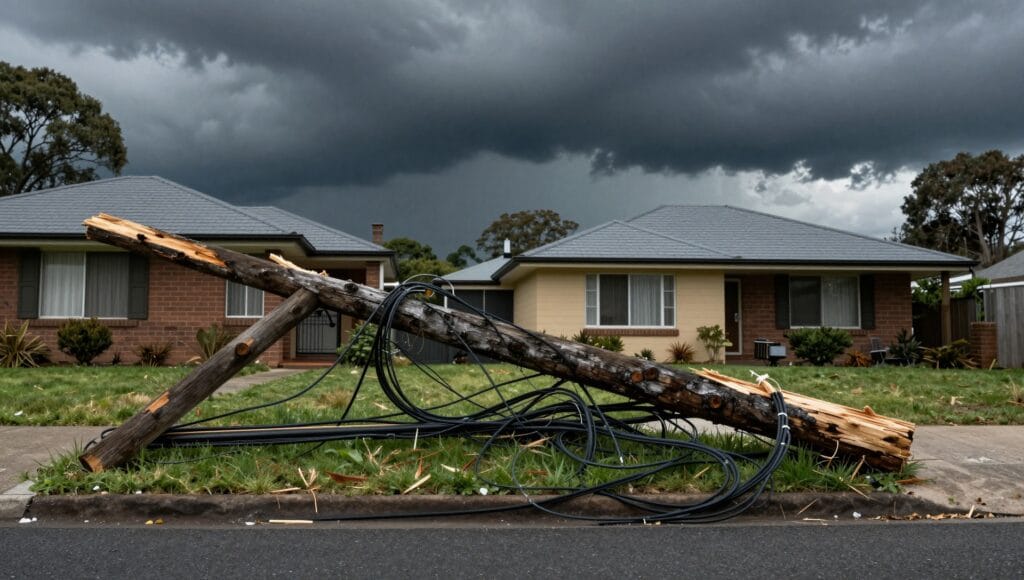
Sydney homeowners are legally responsible for the private power pole on their property, not the network provider. If it rots, rusts, or collapses in a storm, the repair bill and the legal liability both land on you.
Picture this: a stormy morning, the power cuts out, and you assume it’s a network-wide fault. Then you spot the real problem. The timber pole in your front yard has come down, dragging the service line with it. You call your energy distributor expecting help. Instead, you’re told the pole is yours to fix.
This comes down to a single legal line called the Point of Attachment (POA). Everything on the street side of that bracket belongs to the network. Everything past it, down to your switchboard, belongs to you. That’s set out in the Electricity Supply Act 1995, and it covers full ownership, cost, and maintenance.
Ignore it, and the risks stack up fast: bushfire liability, property damage, and a forced disconnection if the network flags it unsafe.
This is exactly where Top Electricians steps in, helping Sydney property owners stay ahead of these rules instead of getting caught out by them.
Decoding Sydney Network Standards: Ausgrid vs. Endeavour Energy Jurisdictions
Your geographic location within Greater Sydney determines which Distribution Network Service Provider sets your structural compliance framework, and the two networks enforce the same rules with noticeably different inspection styles.
Sydney is split between two utility giants. Ausgrid covers the City of Sydney, Inner West, Eastern Suburbs, Northern Beaches, and up to the Central Coast. Endeavour Energy covers Western Sydney, the Blue Mountains, and the South Coast.
Both networks enforce the same NSW Service and Installation Rules, but the way they inspect and enforce those rules differs. Here’s how the two compare:
| Compliance Category | Ausgrid Network Footprint | Endeavour Energy Footprint |
| Primary Urban Areas | Sydney CBD, Inner West, North Shore, Northern Beaches | Parramatta, Blacktown, Penrith, South West Growth Centre |
| Inspection Trigger | Regular aerial patrols, contractor sweeps, bushfire danger periods | Ground-based mapping, rapid urban development checks |
| Enforcement Protocol | Multi-stage notice tracking with regulatory database logging | Strict clearance demands with rapid local field assessments |
The Anatomy of an Electrical Defect Notice
A defect notice is a legally binding order from a network inspector, and you get 30 days to respond plus 60 days to fix the problem before your power gets cut off.
Inspectors issue these notices when they spot a genuine safety risk. The most common reasons are:
- Rot or splitting in an aging timber pole
- Rust flaking off an older steel pole
- Tree branches growing into the clearance zone around live wires
- Sagging or loose cables that aren’t properly tensioned
- Cracked or worn fittings at the top of the pole or at the attachment point
Once you get a notice, the clock starts. Within 30 days, you need to confirm a certified specialist is on the job. Within 60 days, the repair needs to be finished and certified. Miss either deadline, and the network can disconnect your power until everything’s fixed.
The Engineering Blind spots: Structural Depth & The 250 mm Concrete Trap
New private power poles must be buried at a depth of 10% of the pole’s length plus 600mm, and this is one of the most common places contractors cut corners.
Most guides skip this part entirely, which leaves homeowners exposed to expensive mistakes. Here’s the rule, straight from the NSW Service and Installation Rules and AS/NZS 3000: dig deep enough, or the pole fails.
The math is simple. For a standard 7.2-metre pole, 10% of the pole length is 720mm, and adding the required 600mm brings the minimum burial depth to 1,320mm.
A contractor who only digs down a metre to save time has broken the rule. The pole won’t pass inspection, and it has to come out and go back in properly, at your cost.
There’s a second trap: pouring concrete right up to ground level. It feels sturdy, but it actually causes an automatic fail.
Inspectors need to check a 250 mm zone just below the surface, because that’s where rot and rust start first. Solid concrete blocks that check entirely. To stay compliant, keep concrete at least 300mm below ground, or use a removable inspection sleeve so inspectors can clear the soil and check the pole without hitting solid concrete.
Planned Replacement vs. Emergency Callout: What It Actually Costs

Replacing a pole on your own schedule is far cheaper than waiting for it to fail, and only a certified Level 2 ASP electrician is legally allowed to do the work.
This work is classified as contestable work, meaning a regular domestic electrician can’t touch it. Here’s how the two main pole materials compare on cost:
| Project Component | Hardwood Timber | Galvanised Steel |
| Material Lifespan | 15–25 years | 30+ years |
| Base Material Cost | $7,500 – $14,500 | $3,000 – $5,000 |
| Termite / Rot Risk | High, needs ongoing treatment | None |
| With Integrated Meter Box | $9,500 – $16,000 | $3,500 – $5,500 |
Plan ahead, and you can shop around for quotes, schedule the power shutdown, and budget properly. Wait for a storm to take the pole down instead, and you’re stuck with emergency rates: after-hours labour, crane hire on short notice, and rush reconnection fees.
One more cost that catches people off guard: clearing a vegetation notice. Trees near live wires need certified specialists, not your regular tree lopper, and that certification comes at a premium.
Scams, Landlord Disputes, and Insurance: What You Need to Know
Cash-only emergency pole repairs are almost always a scam, and skipping proper paperwork can void your home insurance.
After a storm, dodgy contractors sometimes target homeowners with the power out, offering a fast cash job to skip the queue. Don’t take the offer. A legitimate replacement needs your Level 2 ASP electrician to lodge a Certificate of Compliance for Electrical Work (CCEW) and a Notification of Service Work (NOSW) with the network.
Skip that paperwork, and the installation is technically illegal. Worse, if there’s ever a fire or damage claim, your insurer can refuse to pay out because the work was never certified. Always get an itemised invoice and make sure the CCEW is lodged.
For rental properties, this gets messier. The tenant might be the one who receives the notice in the mail, but the property owner is on the hook for the cost and the legal responsibility. Landlords and property managers need to move fast once notified, or risk the whole property losing power.
Your Step-by-Step Checklist for Power Pole Compliance
Five steps take you from a defect notice to full compliance: check your network, hire a Level 2 ASP, get the base installed correctly, clear any vegetation, and confirm the paperwork is filed.
- Check your network provider. Look at your latest utility bill to see whether you’re with Ausgrid or Endeavour Energy.
- Hire a certified Level 2 ASP. A team like Top Electricians can run a full structural and earthing assessment.
- Get the base done right. Make sure concrete doesn’t cover the 250mm inspection zone below ground.
- Clear any vegetation. If branches are in the clearance zone, book certified line-clearing professionals, not a regular tree service.
- Confirm the paperwork is lodged. Your electrician needs to file both the CCEW and NOSW before your defect file is closed.
Frequently Asked Questions
Who pays to clear trees near private power lines?
The property owner covers the full cost. Because it’s dangerous work, only a certified vegetation contractor or ASP Level 1 electrician can do it safely.
Can I run my cables underground instead of replacing the pole?
Yes. This is called a pillar connection. A Level 2 ASP can remove the overhead line and trench a new one underground, removing the need for a pole entirely.
How long do I have before my power gets disconnected?
You get 30 days to respond with a repair plan, and 60 days total to finish and certify the work.
Does home insurance cover a collapsed pole?
Only if it failed from a sudden event like a storm or a vehicle impact. Claims are usually denied if the cause was neglect, poor maintenance, or termite damage.
Why do people still use timber poles if steel lasts longer?
Timber handles long spans and extra height well, which makes it popular in rural or coastal properties. For standard urban blocks, steel wins out for its termite resistance and lower cost.
Final Thoughts
A private power pole is a legal and financial responsibility the moment it crosses your boundary line, and staying ahead of it costs far less than reacting to a failure.
The rules here aren’t complicated once you know them: know your network, respond to a defect notice inside 30 days, keep the base clear for inspection, and never let cost-cutting shortcuts like shallow depths or flush concrete decide how the job gets done. Those small details are exactly what separate a pole that passes an audit from one that gets rejected, and what separates an insured claim from a denied one.
The real cost of neglect isn’t just the pole itself. It’s the disconnection, the voided insurance, and the scramble to find a certified contractor when you’re already without power. A planned assessment, done before a problem shows up, avoids all of that.
If you’re unsure which network you fall under, whether your pole meets depth requirements, or you’ve already received a notice, get a Level 2 ASP electrician like Top Electricians to check it properly rather than guessing or waiting for the next storm to decide for you.
Let’s get started!