
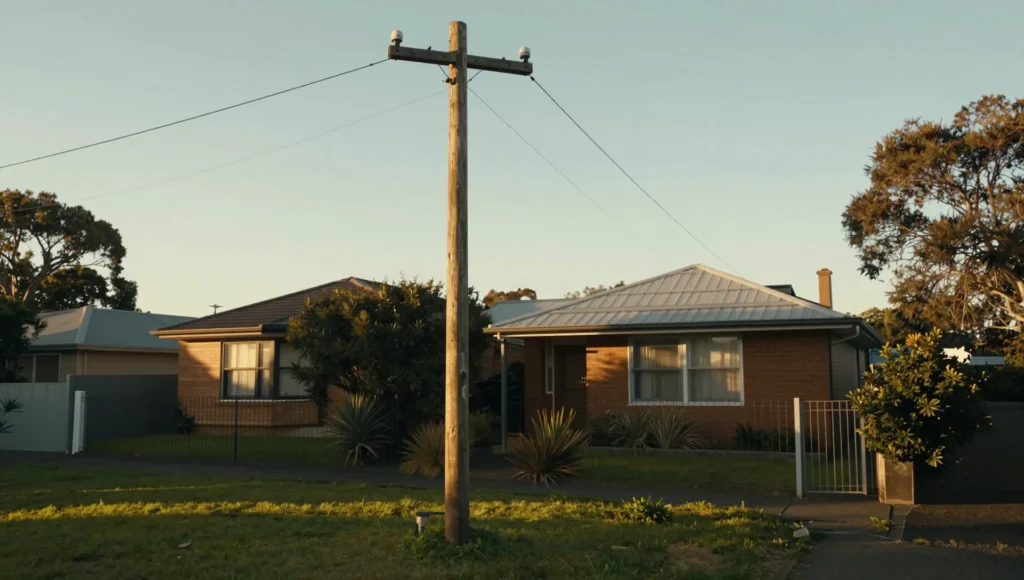
Every Sydney home needs a steady connection to the grid, but most property owners have no idea that the pole standing on their own lawn is actually theirs to look after. The moment the overhead cable crosses your front boundary, responsibility for it shifts from the network straight to you.
That can be an unwelcome surprise. Ignore the pole’s condition for too long, and you’re looking at possible electrical fires, structural collapse, or an unexpected disconnection when a network inspector flags it as unsafe.
This guide from Top Electricians walks through the different pole types available, what each one is actually good for, and how to figure out which material makes sense for your property.
Where Your Responsibility Starts: The Point of Attachment
The point of attachment marks the line between network-owned infrastructure and your private property, and any pole set back from the street to feed your home alone belongs to you.
Up to that point, Ausgrid or Endeavour Energy manages the lines. Past it, any pole that runs power exclusively to your switchboard is your asset, and your liability, under New South Wales law. If a storm, termite damage, or corrosion brings it down, you cover the repair and any damage it causes.
Knowing the strengths and weaknesses of each pole material now, before something fails, is what lets you make a sound decision instead of a rushed one.
The Rules Behind Every Installation
Every private power pole in Australia has to meet AS/NZS 4676 for structural design and AS/NZS 7000 for overhead line clearances, and only a certified Level 2 ASP electrician is allowed to install or certify one.
These standards exist to make sure a pole can handle the pull of heavy cables and the force of a serious storm without failing. A regular electrician isn’t authorised to touch this kind of work. It has to go through a Level 2 ASP electrician, who holds the network credentials to work on live connections and lodge the compliance paperwork once the job is done.
Hardwood, Steel, and Composite: The Three Main Options
Most Sydney properties use one of three materials for their power pole. Here’s how they stack up.
Hardwood Timber
Timber poles are made from treated eucalyptus and typically last 15 to 25 years. They’re strong, flexible in high winds, and usually the cheapest option upfront.
The catch is moisture. Timber is prone to rot at the base and vulnerable to termites, which means it needs regular chemical treatment to hold up over time.
Galvanised Steel
Steel poles are the go-to choice in denser urban areas where a slimmer, cleaner look matters, and they typically last 10 to 15 years.
Termites and rot aren’t a concern with steel, but corrosion is. Buried in damp soil, the base can rust through over time, and because steel conducts electricity, it needs proper grounding. It also isn’t a great fit for high bushfire-risk areas, since extreme heat can weaken it.
Titan Composite
Made from fibreglass-reinforced polymer, composite poles are the newest option on the market, with a lifespan of more than 50 years and long factory warranties behind them.
They don’t rust, rot, or attract termites, and they hold up exceptionally well in bushfire conditions. Being non-conductive, they also lower the risk of electrocution if a cable comes loose. The main downside is cost: composite poles carry a higher upfront price than timber or steel.
Matching the Pole to Your Suburb
Sydney’s suburbs don’t share the same soil or climate, so the right pole material depends heavily on where your property actually sits.
A pole that thrives in a coastal suburb can fail fast further west, and the reverse is just as true. Here’s how each material holds up across Sydney’s main environmental zones.
| Environmental Zone | Hardwood Timber | Galvanised Steel | Titan Composite | Spun Concrete |
| Coastal salt air (Northern Beaches, Cronulla) | Handles salt air well | Rusts and flakes quickly | Fully resistant | Fully resistant |
| Acidic clay soils (Western Sydney, Hills District) | Rots faster in constant moisture | High rust risk | Unaffected | Very durable |
| Termite-prone areas (Hawkesbury, Northern Suburbs) | High risk of hidden damage | Immune | Immune | Immune |
| High bushfire risk (Sutherland Shire, Ku-ring-gai) | Ignites easily, a real hazard | Weakens under extreme heat | Self-extinguishes, holds up well | Holds up well |
Why Composite Poles Are Gaining Ground
Composite poles were developed in response to the Victorian Bushfires Royal Commission, after traditional timber poles failed catastrophically during major fire events, and they’ve since become a serious alternative for fire-prone properties.
In fire testing, these poles absorb intense heat but cool to under 50°C within 45 minutes of a flame front passing, which means the line stays up instead of dropping onto dry grass mid-fire.
Their durability isn’t limited to bushfire zones either. Composite poles are also used to support camera equipment at high-security facilities and to hold up marine structures like jetties and navigation markers, environments where rust and rot would destroy a timber or steel pole far faster.
Other Pole Types Worth Knowing About
Beyond the three main materials, a few specialised options come up in specific situations. An enumerating look at where each one fits:
- Spun concrete poles are built by spinning high-density concrete around a steel core. They’re essentially maintenance-free and fireproof, but their weight makes them expensive to transport and install, so they’re rarely used on standard residential blocks.
- Stobie poles pair two steel joists with a solid concrete centre. They’re common in Adelaide but rarely seen in Sydney, mostly because of their industrial look.
- Rebutted poles are a repair option, not a new installation. When an old timber pole rots at the base but the upper section is still sound, a steel or concrete sleeve is driven in next to the base and bolted to the healthy timber above, extending the pole’s life by up to 15 years without a full replacement.
- Glulam timber poles are built by bonding layers of treated timber together, which removes the knots and grain flaws found in a single log and produces a more uniform, predictable pole.
Warning Signs Your Pole Needs Attention
Waiting for a network inspector to flag your pole is risky, since a formal defect notice only leaves 60 days to complete repairs before disconnection, so it pays to run your own safety check using these four warning signs.
- A lean past 5 degrees from vertical usually means the foundation is failing or the ground underneath has shifted.
- Rust flaking at the base of a steel pole, especially scale you can scrape off with a screwdriver, means the wall thickness has already been compromised.
- Hidden termite damage can hollow out a timber pole from the inside while it looks fine on the outside. This is why Level 2 ASP crews use ultrasound testing or core drilling rather than relying on a visual check.
- Cracked or UV-damaged conduits on a timber pole can let rain into the wiring, creating a fire risk that will fail an inspection immediately.
Frequently Asked Questions
What’s the minimum height a private power pole needs to clear?
Poles need to sit at least 4.5 metres above driveways and pedestrian areas. Where a line crosses a public road or a driveway used by heavy vehicles, that clearance jumps to 5.5 metres.
Can a regular electrician certify a new power pole?
No. Only a Level 2 ASP, registered with the network distributor, is authorised to install and certify a power pole connected to the public grid.
Are composite poles really safe from lightning strikes?
Yes. Because the material is non-conductive, it won’t carry a lightning strike down through the pole into the ground or nearby property, unlike steel.
How deep does a pole footing need to go?
Under AS/NZS 4676, a standard footing needs to reach at least 1.2 metres into solid ground. In sandy or wet soil, the hole needs to be larger and backfilled with engineered concrete to hold firm in a storm.
Choosing the Right Pole for the Long Term
Delaying a repair, ignoring early warning signs, or letting uncertified labour touch this kind of work puts your property at risk of fire, a voided insurance claim, and a sudden disconnection.
If you’ve spotted deep splits in an old timber pole, heavy rust at a steel base, or you’ve received a written notice from your network provider, it’s worth reaching out to a team like Top Electricians for a proper assessment before it becomes an emergency.
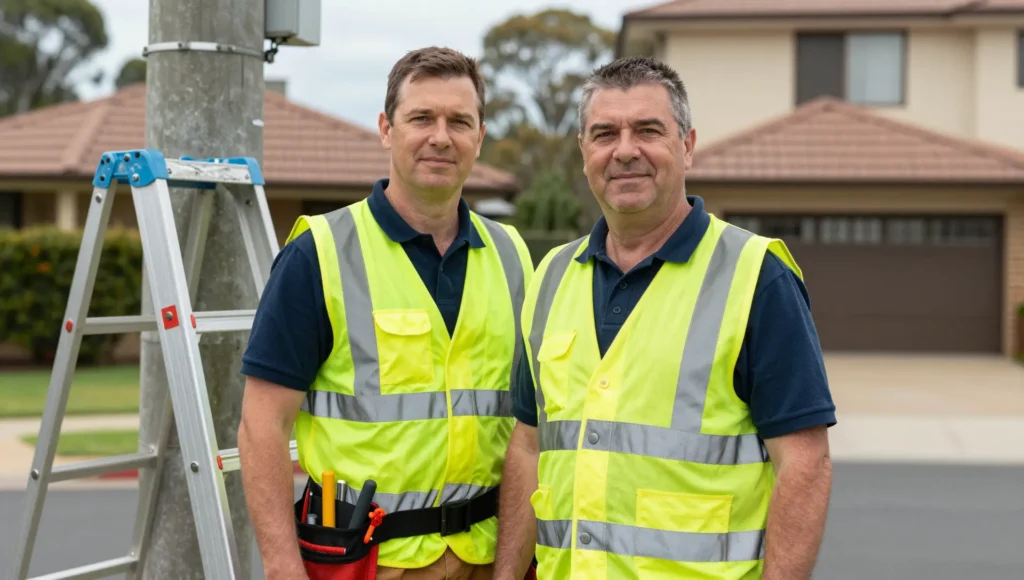
Top Electricians can carry out a full structural safety assessment of your private pole, matched to your suburb’s specific conditions. Our Level 2 ASP technicians handle everything from material selection through to excavation, line migration, and the compliance paperwork that closes out the job, so your connection stays safe and fully documented for years to come.
Let’s get started!