
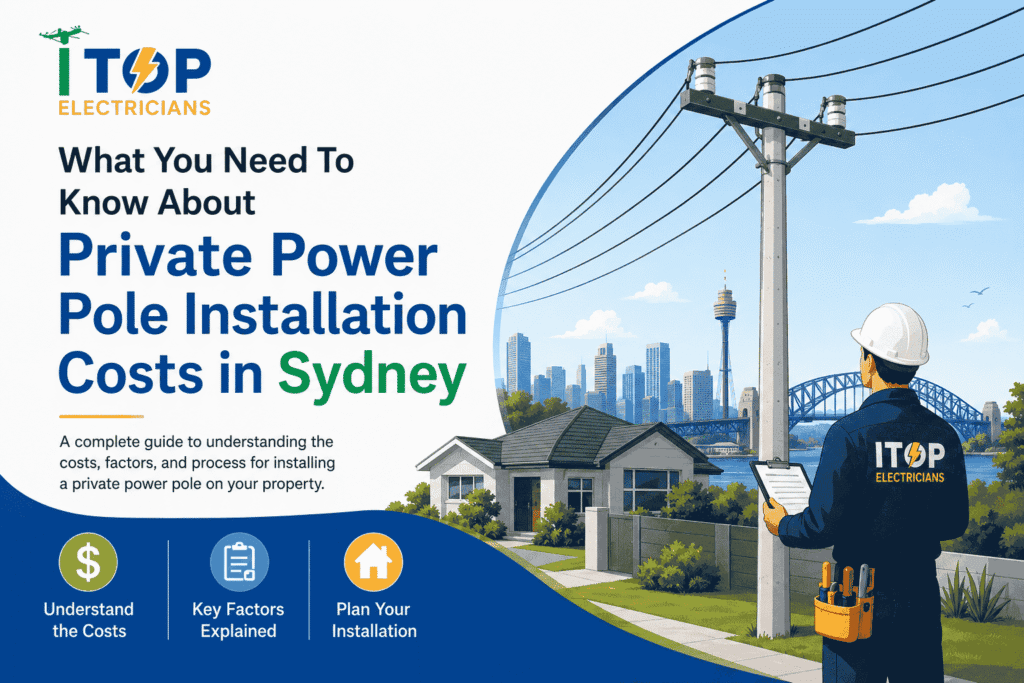
A defect notice about your power pole is one of the more expensive surprises a Sydney homeowner can open. Most people assume the pole belongs to the network, since it carries the same high-voltage lines running down the street. In reality, if that pole sits inside your property boundary and only feeds your own switchboard, it’s yours, and when it fails, you pay to fix it.
This catches out thousands of NSW property owners every year, often right after a storm or mid-renovation. This guide breaks down what a private power pole installation costs in Sydney in 2026, what drives the price, and how to spot a fair quote from an inflated one.
Top Electricians provides emergency electrical service across all of Sydney, so help is available the moment a leaning pole turns into an urgent problem.
Demystifying the Invoice: The Shock of Hidden Property Infrastructure Costs
The legal basis sits in the Electricity Supply Act 1995 (NSW). Any overhead line asset inside your boundary that only serves your own switchboard counts as private infrastructure, not network infrastructure, so the full cost of inspection, repair, and replacement falls on you.
It’s more complex too: a regular electrician can’t touch it, since the work involves live conductors connected to the street network. Only a Level 2 Accredited Service Provider, holding additional accreditation from Ausgrid or Endeavour Energy, is legally allowed to disconnect, replace, or reconnect this part of the network. A standard licence only covers the customer side of the switchboard.
That’s also why pricing differs from a normal callout: Level 2 ASP work means network coordination, mandatory isolations, specialised plant, and compliance certification, all reflected in the final invoice.
Sydney Private Power Pole Costs: The 2026 Core Pricing Benchmarks
As a general guide, a standard urban galvanised steel pole installation in Sydney typically runs $2,500 to $5,300, while larger structural timber installations in rural or access-restricted settings can run $7,500 to $14,500+, depending on site conditions and network connection requirements.
Baseline Infrastructure Cost Breakdown
| Project Scope | Raw Material Cost | Total Certified Installation Cost |
| Standard Urban Galvanised Steel Line | $799 – $1,800 | $2,500 – $5,300 |
| Standard Residential Treated Timber | $799 – $1,500 | $2,500 – $4,500 |
| Heavy-Duty Commercial/Rural Timber | $1,500 – $3,200 | $7,500 – $14,500+ |
| Premium Composite Pole Technology | $2,500 – $4,000 | $5,500 – $8,500+ |
These ranges explain why two quotes for what looks like the same job can differ so much. A straightforward suburban swap using a galvanised steel pole with clear vehicle access sits at the lower end. A job that involves clearing tree canopy, working a battle-axe block, or setting a heavier timber pole into difficult ground pushes hours and costs up quickly.
Keep in mind these figures cover the pole and its certified installation only. They don’t include network coordination fees, council permits, or any switchboard work that a new connection might trigger (more on that below).
Let’s get started!
Upfront Cash Flow vs. Long-Term Value: The Real Annualised Cost Matrix
It’s easy to choose a pole purely on the lowest number at the bottom of the quote. But the sticker price only tells half the story, what actually matters for your property’s long-term value is the cost per year of service, not the cost on installation day.
A composite pole costs more upfront than timber or steel, but manufacturers typically rate composite poles for 30 to 50+ years of service life, with no vulnerability to termites, coastal salt corrosion, or fire damage. Compare that to timber or steel, which need ongoing maintenance and have a shorter working life.
Annualised Cost Comparison
Galvanised Steel
- Upfront cost: $3,000 – $5,000
- Typical lifespan: 10–15 years
- Annualised cost: roughly $200–$500/year
- Maintenance profile: low upfront care, but carries a rust risk below the surface in Sydney’s heavy clay soils over time
Treated Timber
- Upfront cost: $2,500 – $4,500
- Typical lifespan: 15–25 years
- Annualised cost: roughly $100–$300/year
- Maintenance profile: benefits from periodic anti-termite ground treatment and visual safety checks
Composite Pole
- Upfront cost: $5,500 – $8,500+
- Typical lifespan: 30–50+ years
- Annualised cost: roughly $140–$280/year
- Maintenance profile: minimal ongoing maintenance, strong fire and corrosion resistance
Run the numbers and the expensive option often isn’t. A $3,500 timber pole that needs replacing in 20 years works out to about $175 a year. A $7,000 composite pole that lasts 40 years lands at almost exactly the same annual figure, but without the disruption of a second install, a second defect notice, or a second round of trenching your garden. The real question isn’t which is cheaper, it’s whether you can absorb the higher cash outlay now in exchange for not thinking about it again for decades.
The Urgency Premium: Planned Installation vs. Defect Notice Emergency Costs
A planned replacement gives you room to collect quotes, book off-peak, and choose materials without pressure. A formal defect notice from Ausgrid or Endeavour Energy changes that entirely.
Under the Electricity Supply Act 1995, you have 30 days to confirm rectification work is booked, and 60 days to complete it. Miss day 30 and Ausgrid follows up directly; miss day 60 and they can disconnect your supply or carry out the fix themselves and bill you.
That timeline kills your negotiating leverage. Level 2 ASP teams have to reprioritise, fast-track isolations, and sometimes add crew to hit the deadline, all of which adds a premium to the standard installation cost. Booking an assessment at the first sign of a lean or crack, before a notice arrives, is the best way to avoid that premium.
The Hidden Cascade: Why a New Pole Frequently Triggers Internal Switchboard Expenses
The biggest cost shock rarely comes from the pole itself, it’s what the replacement forces you to fix elsewhere. This is the compliance cascade, and it hits older Sydney homes hardest.
Altering your point of attachment triggers a fresh assessment of your whole connection against AS/NZS 3000 wiring rules. Many homes across the Inner West, Eastern Suburbs, and Northern Beaches still run on decades-old rubber or cloth-insulated mains, and a Level 2 ASP can’t legally reconnect non-compliant lines to a new pole as-is.
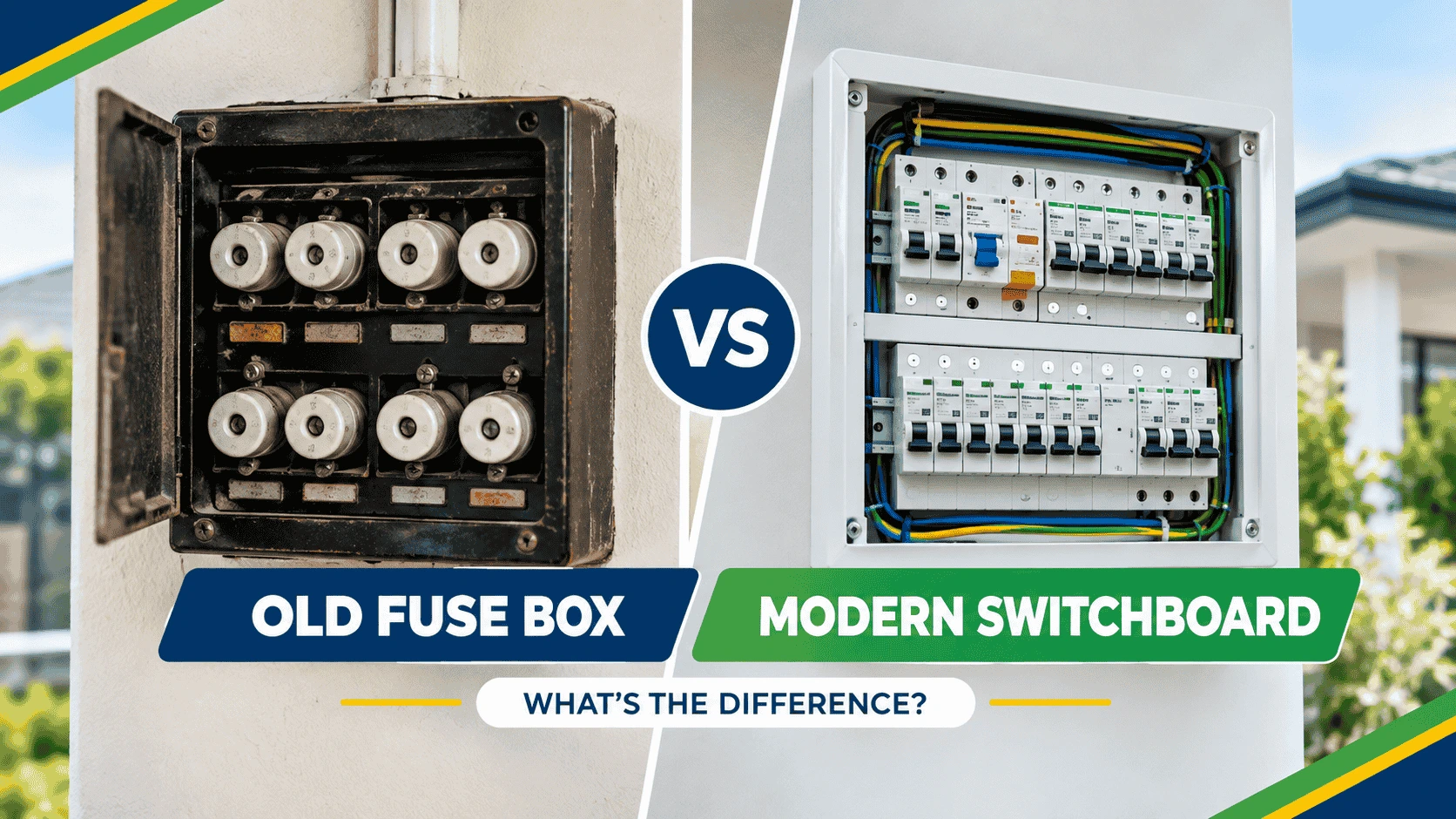
In practice, old porcelain fuses often need replacing with a modern switchboard fitted with breakers and RCDs, turning “replace one pole” into a broader upgrade under current NSW electrical rules.
Ask your contractor directly: Will this trigger a switchboard upgrade, and is that priced separately? A transparent Level 2 ASP will answer this after a site inspection, before work starts.
The Surcharge Checklist: What Is (and What Is NOT) Included in a Baseline Quote
Wildly different quotes for what seems like the same job usually don’t mean one tradesperson is padding their margin. More often it comes down to whether the contractor has actually priced your site’s real conditions or left them as surprises for the final invoice.
Generic online price guides assume a flat, easy-access block with soft soil. Here’s what commonly pushes a quote above the baseline range:
- Sandstone ground conditions. If your property sits on the Hawkesbury sandstone shelf common across the Lower North Shore and Hornsby Shire – a standard truck-mounted auger can’t dig through it. Rock-sawing equipment adds roughly $850–$2,100 in specialised plant hire.
- Restricted site access. Narrow terraces and battle-axe blocks often can’t fit a full-size borer truck. If the crew can’t get equipment to the whole site, expect hand excavation or micro-boring, which adds significant labour hours.
- Concrete around the existing base. If a previous owner poured concrete against the pole, expect an extra $450–$900 for core-cutting, clearing the required moisture barrier, wrapping the sub-surface section in protective tape, and backfilling with compliant material.
- Three-phase upgrades. Installing a pole to support EV fast-charging, ducted air conditioning, or a solar battery system often means moving from single-phase to three-phase supply thicker cabling, different metering, and upgraded pole-top connection hardware.
Before you sign anything, ask your contractor explicitly whether any of the above apply to your site, and get their answer in writing on the quote itself.
Spotting Fair Pricing vs. Price Gouging: A Quick Checklist
An unexpected pole failure, especially after a storm, puts families under pressure, and that pressure attracts opportunistic operators offering unlicensed “cash jobs” to skip the queue.
Don’t take the bait. Work done without proper network logging leaves you with no valid Certificate of Compliance, and insurers can deny a related claim if the work wasn’t done by an accredited provider.
Check any quote against this before you sign:
| # | Question | Why It Matters |
|---|---|---|
| 1 | Is the price fixed or just an estimate? | Avoids cost blowouts once work starts |
| 2 | Is pole material cost itemised? | Low-ball quotes often hide it |
| 3 | Does it cover old pole removal/disposal? | Treated timber has its own tipping fees |
| 4 | Is network coordination included? | Booking isolations takes real admin time |
| 5 | Are council permits/traffic control included? | Unpermitted road works risk big fines |
| 6 | Will they lodge the CCEW? | Your legal proof of compliant work |
| 7 | Is footing depth fully engineered? | Under-depth footings risk failing again |
| 8 | Is the electrician a verified Level 2 ASP? | Standard electricians can’t legally do this work |
| 9 | Will the timeline meet your defect deadline? | Confirm it in writing |
| 10 | What’s explicitly excluded? | Know if tree work or cutting is billed separately |
Frequently Asked Financial Questions
Is it cheaper to install a new private pole or go underground?
An overhead replacement typically runs $4,000–$10,000, while a full underground conversion runs $6,000–$15,000+ due to trenching and excavation. Underground removes ongoing pole inspection and decay costs, so it can pay off over a 20–30 year horizon despite the higher upfront spend.
Why does a cross-arm add to the cost?
It’s required where clearance heights over roads or structures can’t be met otherwise. A cross-arm with insulated fittings typically adds $1,800–$3,000 for the extra alignment work.
Will Ausgrid or Endeavour Energy pay if my pole is storm-damaged?
No. The distributor only makes the site safe and issues a defect notice. Restoring the pole is the owner’s cost, generally recoverable through home and contents insurance.
Do I need to pay for ongoing inspections?
No compulsory fee, but distributors run periodic audits that can trigger a defect notice. An independent Level 2 ASP inspection every few years ($150–$350) catches decay early.
Can council refuse a private pole installation?
Yes. Some heritage areas and new developments prohibit overhead infrastructure, and a knockdown-rebuild DA can require underground connection instead.
Do I need a Certificate of Compliance even for simple work?
Yes, always. Every piece of Level 2 ASP work needs a CCEW lodged with the distributor, or you have no legal proof it meets AS/NZS 3000, and insurers can treat it as unverified.
Navigating Your Infrastructure Investment with Total Financial Clarity
Private pole and boundary line work isn’t a job to hand to the cheapest bidder or the fastest cash-job offer. Non-itemised quotes and unaccredited labour expose you to compliance cascades you didn’t budget for voided insurance cover and the very real risk of losing power altogether while a defect notice runs down its clock.
The best protection is a transparent, itemised quote from a properly accredited team before any deadline pressure kicks in. If you’re currently sitting on a live defect notice, trying to make sense of a confusing invoice or planning ahead for a subdivision or knockdown-rebuild, get your site assessed properly before committing to a contract.
Get in touch with Top Electricians for a transparent, fixed-price site assessment. Our Level 2 ASP-accredited team handles the full scope, from sandstone core drilling and network coordination through to switchboard upgrades and Certificate of Compliance lodgment, so your project stays compliant, insured and on budget from the first site visit to final sign-off.