
| Quick Answer |
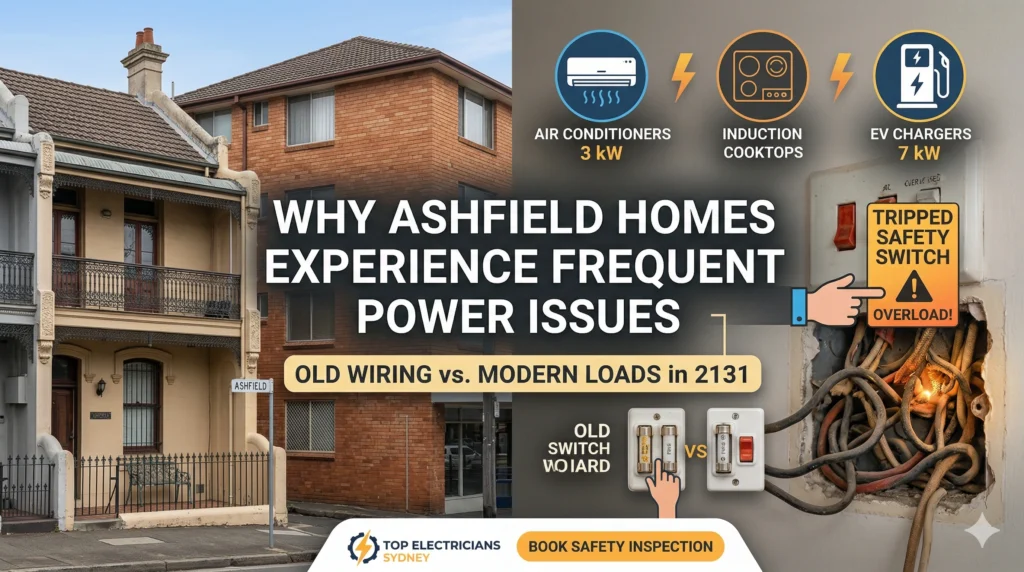
| Ashfield homes experience frequent power issues because the suburb’s Federation terraces, 1950s–1970s brick flats, and post-war apartments carry wiring and switchboards never designed for modern appliance loads. Running air conditioners, induction cooktops, and EV chargers simultaneously on these undersized circuits causes safety switches to trip, lights to flicker, and in the worst cases concealed wiring to overheat silently inside wall cavities. |
If you live in postcode 2131, the pattern is familiar. A hot January evening, two split-systems running, someone boils the kettle and the safety switch trips. You reset it. An hour later it trips again.
This is not a coincidence or a faulty appliance. It is the predictable result of running modern electrical loads through infrastructure installed decades before those loads existed. Understanding why it happens is the first step toward fixing it permanently and safely.
Ashfield’s Housing Stock: A Timeline of Electrical Infrastructure
Ashfield’s residential fabric spans almost 150 years of construction, and each era came with its own electrical standard. According to the 2021 Census, approximately 70 percent of Ashfield’s 23,000 residents live in apartments one of the highest proportions in the Inner West. That concentration of older multi-dwelling buildings is central to the suburb’s power problem.
Victorian and Federation-Era Homes (1880s–1920s)
The grand terraces and detached homes lining streets like Parramatta Road and Charlotte Street were built before residential electricity was standardised. Original wiring in these properties used rubber insulation and fabric-covered conductors materials that were adequate for low-load, low-voltage lighting circuits of the era.
| Critical Risk: Hidden Degraded Wiring |
| Rubber insulation that is 60+ years old loses flexibility, cracks, and can fail completely, leaving live conductors exposed inside wall cavities. Partial rewiring is common in Ashfield’s pre-1920 properties meaning original conductors frequently remain concealed behind heritage plasterwork. Under summer load conditions, these conductors can reach dangerous temperatures with no visible warning. |
Post-War Brick Flats (1950s–1960s)
This era produced the bulk of Ashfield’s apartment stock. These flats were wired for an assumed household load of just 4 to 6 kilowatts enough for a few lights, a single power circuit, and off-peak hot water. A ceramic fuse board with two or three circuits was standard.
Air conditioning did not exist in residential buildings. Induction cooktops, dishwashers, EV chargers, and home theatre systems were decades away. The wiring did its job for the era it was designed for.
The 1970s Apartment Wave
The development boom that reshaped Ashfield’s streetscape in the 1970s brought more robust wiring than the post-war flat era, but these buildings still fall well short of AS/NZS 3000:2018 (the current Wiring Rules). The most common deficiencies found in this era include:
• Undersized submains from the common-area switchboard to individual unit boards
• No RCD (residual current device) protection on power and lighting circuits
• Consumer main lines that have not been inspected since original installation
• Circuit breakers rated to the wiring of the era, not the loads applied today
| Construction Era | Typical Electrical Specification & Key Risks |
| 1880s–1920s (Victorian/Federation) | Rubber/fabric-insulated wiring; 2-wire systems; no earthing; heritage walls obscure faults |
| 1950s–1960s (Post-war flats) | Ceramic fuse boards; 4–6 kW total load design; no RCDs; asbestos-era wall penetrations |
| 1970s (Apartment boom) | Early circuit breakers; undersized submains; no RCD protection; 40–50 yr service life reached |
| 1980s–2000s (Modern renovations) | Often partially upgraded mixed old and new wiring creates compatibility and safety issues |
The Infrastructure Gap: What Your Ashfield Switchboard Was Built to Handle
To understand why circuits trip, it helps to quantify the gap between what the infrastructure was designed for and what Australians use in 2026.
Typical Modern Household Load in an Ashfield Flat
| Appliance | Approximate Draw |
| Reverse-cycle air conditioner (living area) | 1.5 – 4.0 kW |
| Reverse-cycle air conditioner (bedroom) | 1.0 – 2.5 kW |
| Induction cooktop (2 zones active) | 3.0 – 6.0 kW |
| Electric oven | 2.0 – 3.5 kW |
| Electric kettle | 2.0 – 2.4 kW (brief) |
| Washing machine (heating cycle) | 0.5 – 2.5 kW |
| Dishwasher | 1.2 – 1.8 kW |
| EV charger (7 kW AC wallbox) | 7.0 kW |
| Refrigerator (peak summer) | 0.3 – 0.5 kW |
| Home office + screens | 0.3 – 0.8 kW |
A 1960s flat’s 40-amp main switch provides approximately 9.2 kW of capacity at 230V. Running two air conditioners, a washing machine, and boiling the kettle simultaneously puts you at or above that threshold before accounting for the refrigerator, lighting, or any other background load.
The circuit breaker or fuse does not trip because it is faulty. It trips because it is doing exactly what it was designed to do: protecting wiring that cannot safely carry the current being asked of it.
The Ceramic Fuse Problem
Ceramic fuse boards, still present in many of Ashfield’s 1950s and 1960s properties, introduce a specific danger beyond simple overloading. When a ceramic fuse blows repeatedly under overload, some occupants or previous occupants rewire the fuse holder with
• heavier-gauge wire than the fuse is rated for, eliminating the protection entirely
• This allows wiring to heat to dangerous temperatures before eventual failure
• There is no visual indication this has occurred the switchboard looks normal
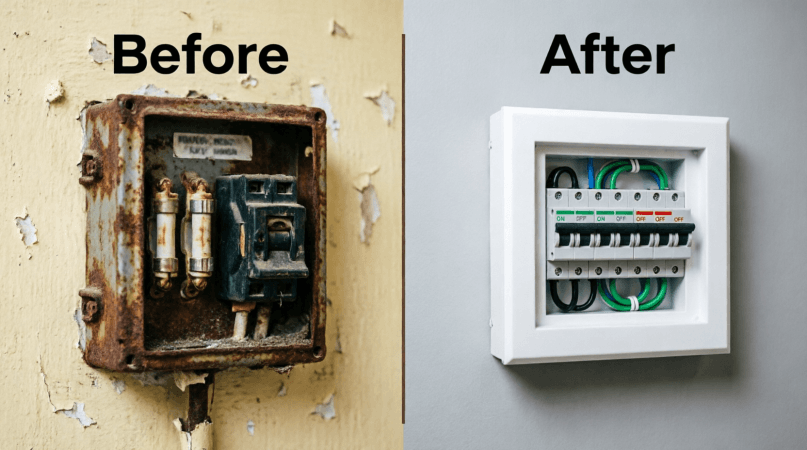
A switchboard assessment by a licensed electrician will identify this immediately. A modern circuit breaker panel with RCD protection eliminates the problem at source.
Why Summer Makes It Worse: Heat, Voltage Drop, and the Western Sydney Effect
Ashfield sits approximately eight kilometres inland from the coast, within the Western Sydney heat corridor. During heatwave conditions, it regularly records temperatures several degrees above Eastern Suburbs or Northern Beaches readings. That temperature difference has direct electrical consequences.
How Heat Compounds Electrical Stress
Electrical resistance in conductors increases with temperature. On a 38-degree day, a conductor running inside a wall cavity already warmed by ambient heat operates at higher resistance than on a 20-degree day. This means:
• More heat generated per ampere of current flowing through the same conductor
• Lower effective capacity before the conductor reaches its rated temperature limit
• Faster degradation of insulation and connection integrity over repeated hot seasons
Voltage Drop: The Hidden Problem in Older Apartment Blocks
When multiple air conditioners run simultaneously across an older apartment block, the voltage delivered to individual units falls below the nominal 230V supply. Compressors draw higher current to compensate accelerating wear, generating additional heat, and increasing the load on already-stressed circuits.
| Technical Insight: Voltage Drop in 1970s Submains |
| In Ashfield’s 1970s apartment buildings with long, undersized submains, voltage at the end of the submain can be 5–10 volts below supply at the main board before any tenant load is applied. AS/NZS 3000:2018 requires voltage drop from the point of supply to any final sub-circuit to remain within 5% (11.5V at 230V nominal). Under summer peak conditions, this margin disappears entirely, causing: |
| LED lights to flicker or dim intermittently |
| Electronics to malfunction or display error codes |
| Air conditioner compressors to cycle inefficiently or fail to start |
The Four Most Common Electrical Faults Found in Ashfield Properties
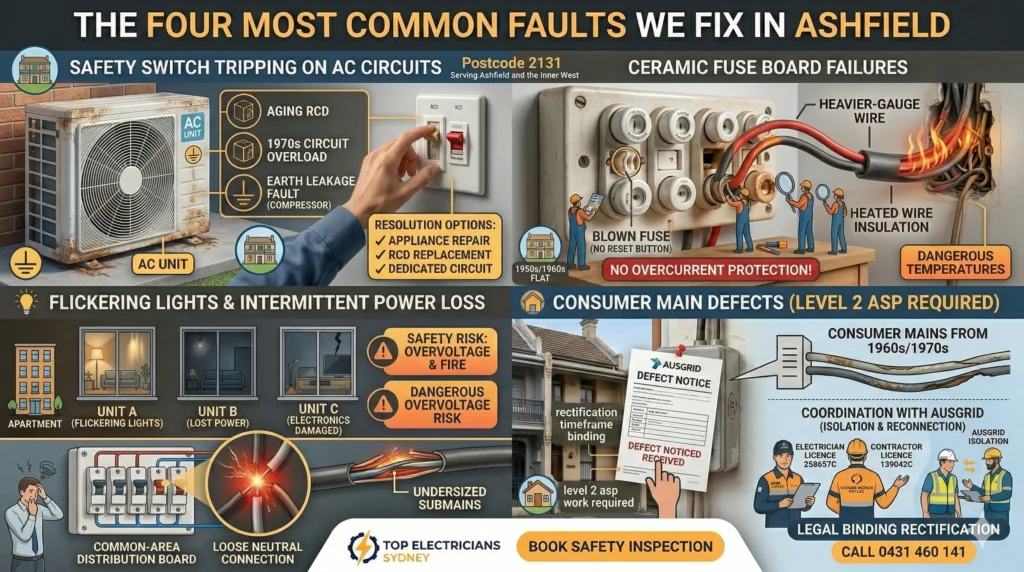
Based on service calls across postcode 2131, these are the issues that account for the majority of both emergency call-outs and scheduled repair work in Ashfield.
1. Safety Switch Tripping on Air Conditioner Circuits
This is the most frequent summer call-out from Ashfield residents. The cause is one of three things, and each has a different resolution:
| Cause | Resolution |
| Earth leakage fault in the AC compressor or wiring | Appliance inspection and repair; may require licensed refrigeration mechanic |
| Ageing RCD with degraded trip threshold | RCD replacement a straightforward licensed electrician task |
| 1970s-era circuit serving multiple power points over capacity | Dedicated air conditioner circuit from distribution board |
Important: Do not continue resetting a tripped safety switch. A persistent trip indicates a real fault. Continued resets can mask an active safety hazard.
2. Ceramic Fuse Board Failures
Common in Ashfield’s 1950s and 1960s flats. When a ceramic fuse holder has been rewired above its rated capacity often by previous occupants frustrated by repeated trips the board provides no effective overcurrent protection. The circuit runs hot, the wiring degrades, and the first sign of a problem may be a burning smell or a fire.
The correct solution is a full switchboard upgrade to a modern consumer mains unit with circuit breakers and RCD protection on all circuits, compliant with current AS/NZS 3000:2018 requirements.
3. Flickering Lights and Intermittent Power Loss in Apartments
These symptoms indicate one of two conditions, both requiring prompt professional attention:
• Voltage fluctuation on an undersized submain diagnosed with a clamp meter and submain assessment; resolved by upgrading the submain conductor
• Loose neutral connection in the common-area distribution board a serious safety risk that can cause dangerous overvoltage in some circuits while others lose power, capable of destroying electronics and starting fires
| A Loose Neutral Is an Emergency |
| A loose neutral connection is not a deferred maintenance item. Under certain conditions it causes dangerous overvoltage across some circuits while other circuits lose power. This can destroy electronics and, in extreme cases, ignite fires. If your lights are flickering and other residents in your building are experiencing simultaneous power issues, contact a licensed electrician immediately. |
4. Consumer Main Defects and Ausgrid Notices
Consumer main defects are more common in Ashfield’s older housing because original submains from the 1960s and 1970s are reaching or exceeding their service life. If you receive a defect notice from Ausgrid, be aware of the following:
• Rectification is Level 2 ASP work standard licensed electricians cannot legally carry it out
• The notice includes a legally binding rectification timeframe non-compliance can result in disconnection
• The work requires coordination with Ausgrid for isolation and reconnection, plus a Certificate of Compliance for Electrical Work lodged with NSW Fair Trading
Top Electricians holds Electrician Licence 258657C – Contractor Licence 139042C and is accredited to carry out consumer main and Level 2 ASP work across Ashfield and the Inner West.
What an Electrical Safety Inspection Covers and Why It Matters Before Summer
An electrical safety inspection is a systematic assessment of a property’s electrical system against current Australian standards and the specific risk profile of the property. It is not a certificate of compliance for sale purposes, it is a diagnostic tool that identifies conditions likely to cause problems before those problems occur.
What Our Ashfield Inspection Covers
1. Switchboard and Distribution Board Assessment
Visual inspection of the main switch rating, circuit breaker ratings, RCD coverage, bus bar condition, and verification of safety switch protection on all power and lighting circuits as required under AS/NZS 3000:2018.
2. Consumer’s Main Assessment
Visual inspection of the consumer main at the point of attachment, meter box, and submain where accessible. Assessment of insulation condition and conductor rating against the property’s current and anticipated load.
3. Wiring Type Identification
Identification of any rubber-insulated, fabric-covered, or aluminium branch circuit wiring remaining in the property. Each wiring type carries specific risk profiles under summer load conditions that inform remediation priority.
4. RCD Functional Testing
Testing of all residual current devices against AS/NZS 61008 requirements. RCDs that take longer than 40 milliseconds to trip at rated residual current do not provide the protection they appear to offer and this degradation is not visible without testing.
5. Thermal Imaging (Where Access Permits)
Infrared scanning of the switchboard and accessible wiring to identify hotspots indicating loose connections, overloaded circuits, or components running above safe operating temperature.
6. Load Assessment
Review of the property’s total connected load against the switchboard’s rated capacity, identifying circuits likely to trip under summer peak conditions and flagging circuits where additional loads (such as an EV charger) cannot be safely added without infrastructure upgrades.
| ✓ What You Receive After the Inspection |
| A written report identifying every defect found |
| Risk rating for each defect (urgent / high / routine) |
| Recommended remediation with approximate pricing |
| No obligation to proceed with any work |
| No manufactured urgency only genuine safety findings |
When to Call an Emergency Electrician in Ashfield
Some electrical conditions require immediate professional attention rather than a scheduled assessment. Do not attempt to diagnose or rectify any of the following yourself.
Call Immediately If You Notice:
• Burning smell from a power point, switchboard, or ceiling rose switch off the circuit at the distribution board and call immediately. This indicates an active fault generating heat.
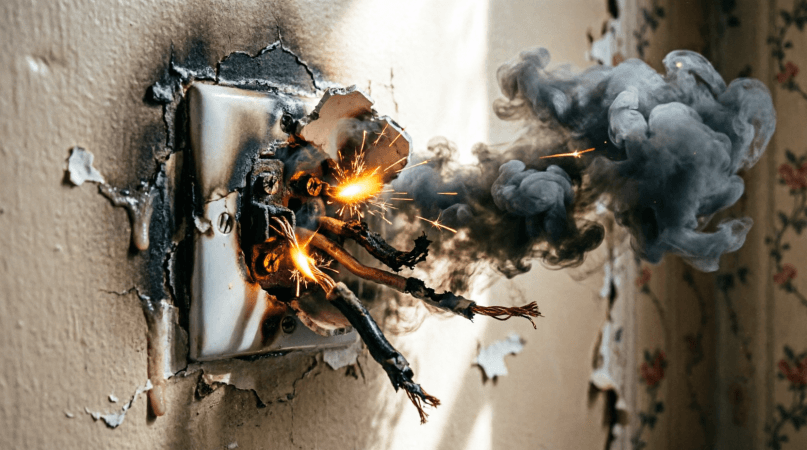
• Sparking at a power point or switch visible arcing means a conductor is contacting a surface it should not. Switch off and do not use until inspected.
• Safety switch that will not hold after resetting a persistent RCD trip means an active earth fault. Do not continue resetting it.
• Complete loss of power when the street has power may indicate consumer main failure, blown service fuse, or main switch failure. All require a licensed or Level 2 electrician.
• Hot power points or warm switchboard covers any fitting that is warm when no high-draw appliance is in use indicates an abnormal current path or loose connection generating heat.
Our emergency electrician service covers Ashfield and all surrounding Inner West postcodes, 24 hours a day, 7 days a week. From our Hurstville base, typical response time to Ashfield is 30 to 50 minutes
Ashfield Electrician FAQ
These questions reflect what Ashfield homeowners and strata managers ask most often when investigating power issues.
Why does my safety switch keep tripping in summer?
Summer tripping is almost always caused by one of three things: an overloaded circuit that was never designed for air conditioning loads; an earth leakage fault in an ageing air conditioner; or an RCD whose trip threshold has degraded over time. A licensed electrician can diagnose which cause applies and resolve it correctly.
Do I need to upgrade my switchboard if I get a new air conditioner?
Often, yes. If your switchboard does not have RCD protection on all circuits (required by AS/NZS 3000:2018 for all new circuits), or if adding an air conditioner would take your total load above the main switch rating, a switchboard upgrade is necessary before a compliant installation can proceed. A licensed electrician must assess this before installation.
What is a Level 2 ASP and why do I need one for my Ausgrid notice?
A Level 2 Accredited Service Provider (ASP) is a contractor accredited by the electricity distributor (Ausgrid in the Ashfield area) to carry out work on the network side of the meter including consumer mains, submains, and connection points. Standard licensed electricians are not authorised to perform this work. If you have received a defect notice, the rectification timeframe is legally binding.
Can old wiring cause a house fire?
Yes. Rubber-insulated wiring that has degraded to the point of insulation failure can allow current to arc or flow through unintended paths, generating heat inside wall cavities. This is the mechanism behind a significant proportion of residential electrical fires. In older Ashfield properties, this risk is not theoretical; it is an active concern for properties that have not been inspected in the last decade.
How much does a switchboard upgrade cost in Ashfield?
Switchboard upgrade costs vary depending on the number of circuits, the presence of a consumer main component, and whether the work requires Level 2 coordination with Ausgrid. We provide transparent written quotes following a site assessment. There is no call-out fee for Ashfield properties, and new clients receive 20% off their first service.
Are you licensed to work in Ashfield?
Yes. Top Electricians holds Electrician Licence 258657C – Contractor Licence 139042C, and is accredited for Level 2 ASP work with Ausgrid. All work is performed to Australian Standards and NSW Fair Trading requirements.
Transparent Pricing for Ashfield Residents
| Service / Discount | Detail |
| Call-out fee | $0 for all Ashfield properties |
| New client discount | 20% off your first service |
| Seniors & veterans discount | 15% off all services for life (50+ or with service history) |
| Emergency service | 24/7, 365 days 30–50 min response to Ashfield |
| Level 2 ASP work | Ausgrid-accredited; consumer main rectification available |
Book an Electrical Safety Inspection for Your Ashfield Home
Licensed Level 2 electricians. $0 call-out fee. 20% off your first service. Written report with no obligation to proceed.
Call 0431 460 141 – Same-Day Service Available