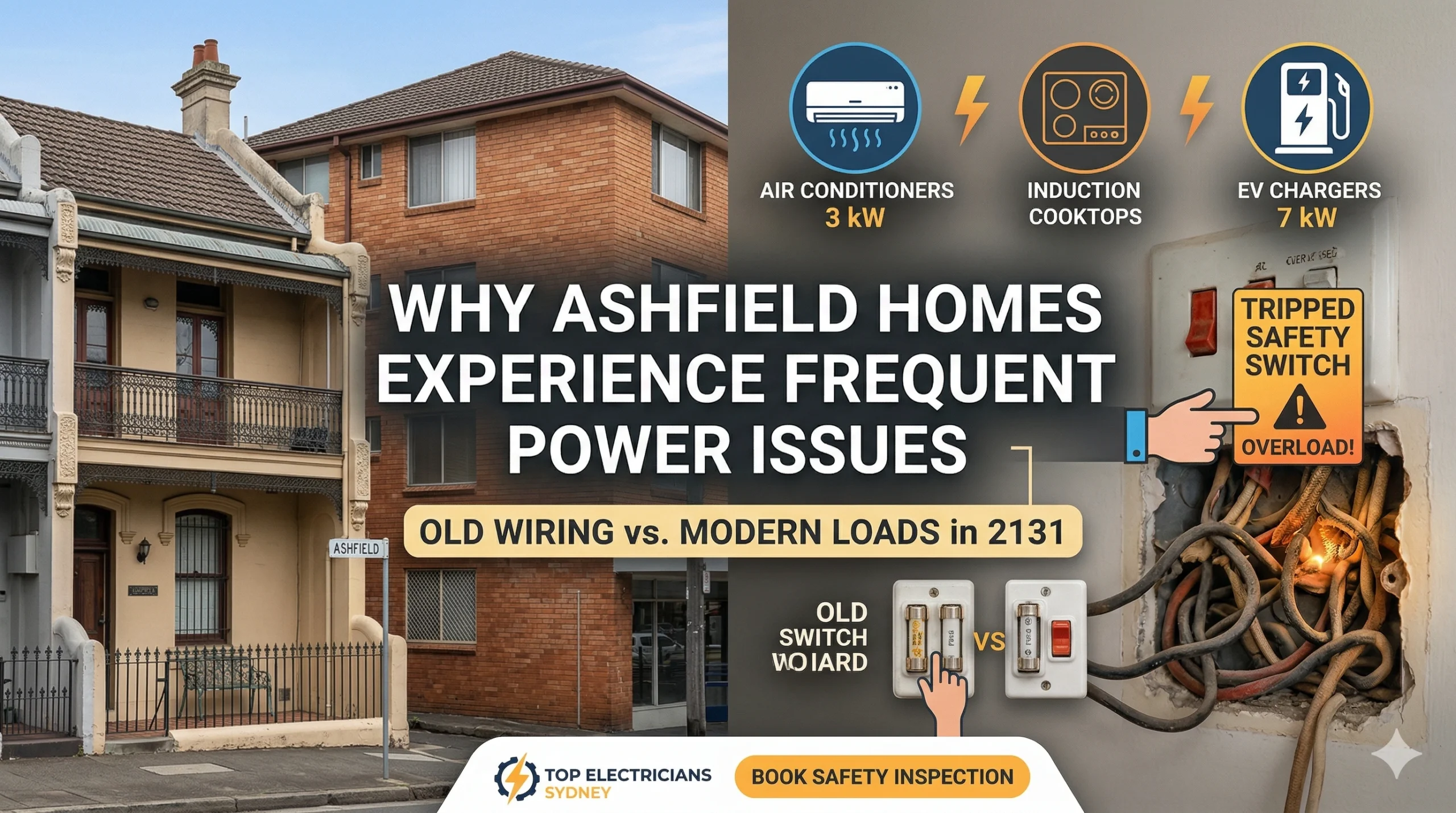

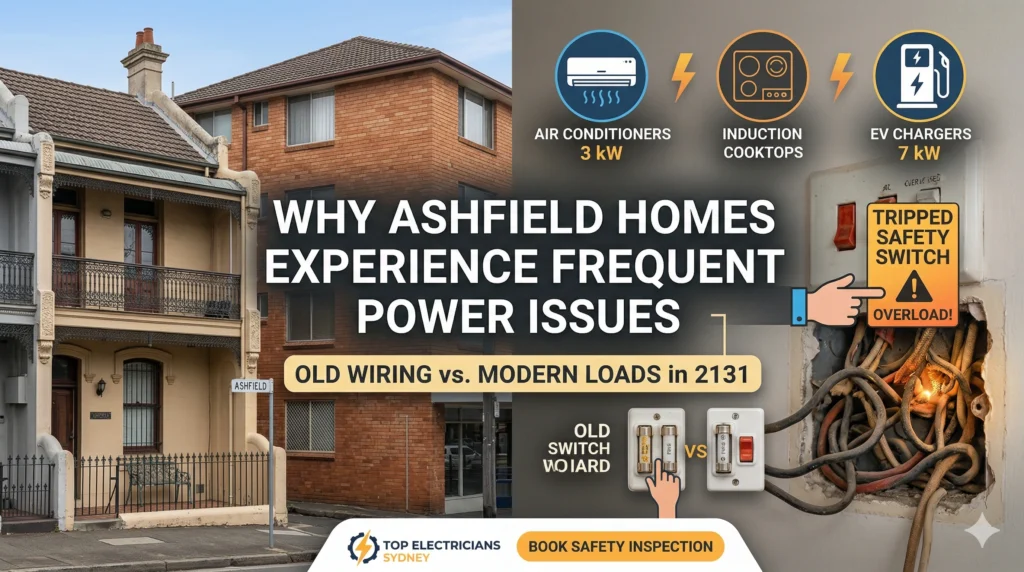
| Short answer: Ashfield homes experience frequent power issues because the suburb’s housing stock, Federation terraces, 1950s–1970s brick flats, and post-war low-rise apartments, carry wiring and switchboards never designed for modern appliance loads. Running air conditioners, induction cooktops, and EV chargers simultaneously on these undersized circuits causes safety switches to trip, lights to flicker, and in some cases, hidden wiring to overheat. |
If you live in postcode 2131, you already know the pattern. A hot January evening, two split-systems running, someone boils the kettle and the safety switch trips. You reset it. An hour later it trips again.
This is not a coincidence or a faulty appliance. It is the predictable result of running modern electrical loads through infrastructure installed decades before those loads existed. Ashfield’s housing stock spans Victorian mansions from the 1880s, Federation-era detached houses, Art Deco semis from the 1930s, post-war brick flats built in the 1950s and 1960s, and low-rise apartment blocks approved during the 1970s development boom. According to the 2021 Census, approximately 70 percent of Ashfield’s 23,000 residents live in apartments – one of the highest proportions in the Inner West.
Each era of construction brought its own electrical standard. None of those standards anticipated today’s household demand.
The Infrastructure Gap: What Ashfield’s Wiring Was Built For
Post-war brick flats built along Ashfield’s mid-street blocks in the 1950s and 1960s were wired for an assumed household load of 4 to 6 kilowatts. A ceramic fuse board with two or three circuits was standard. Air conditioning did not exist in residential buildings. Hot water was gas or off-peak electric.
Today, a single reverse-cycle air conditioner draws between 1.5 and 4 kilowatts. Add a second unit, an induction cooktop, a washing machine, and a dishwasher running simultaneously, and a 1960s flat is already at or above the capacity its switchboard was installed to protect. The fuse or breaker trips because it is doing exactly what it was designed to do, protecting wiring that cannot safely carry the current being asked of it.
| Key risk in Federation and Victorian homes Partial rewiring is common in Ashfield’s pre-1920 properties. Sections of original rubber-insulated or fabric-covered wiring frequently remain concealed behind heritage plasterwork. Rubber insulation that is 60 or more years old loses flexibility, cracks, and in some cases fails completely leaving live conductors inside wall cavities. Under summer load conditions, these conductors can reach dangerous temperatures without any visible warning. |
The 1970s apartment block wave that reshaped Ashfield’s streetscape brought more robust wiring than the post-war flat era, but still falls well short of AS/NZS 3000:2018 requirements for modern dwellings. The most common issues we find in these buildings are undersized submains from the common-area switchboard to individual unit boards, outdated circuit breakers without RCD protection, and consumer main lines that have not been inspected since installation.
Why Summer Makes It Worse: The High-Load Season
Ashfield sits approximately eight kilometres inland from the coast in the Western Sydney heat corridor. During heatwave conditions, it regularly records temperatures several degrees above Eastern Suburbs or Northern Beaches readings. That difference directly determines how hard residential electrical systems have to work.
A typical Ashfield household on a 38-degree day may be running simultaneously:
• Reverse-cycle air conditioner (living area): 1.5 to 4 kW
• Reverse-cycle air conditioner (bedroom): 1.0 to 2.5 kW
• Refrigerator working harder in ambient heat: 0.2 to 0.4 kW
• Electric kettle: 2.0 to 2.4 kW for three to four minutes
• Washing machine during heating cycle: 0.5 to 2.5 kW
On a ceramic fuse board or early circuit breaker panel with a 40 to 63 amp main switch, this combined draw will trigger a trip. A second issue that summer amplifies is voltage drop. When multiple air conditioners run simultaneously across an older apartment block, the voltage delivered to individual units falls below the nominal 230V supply. Compressors draw higher current to compensate, accelerating wear and generating additional heat. LED lights flicker. Electronics malfunction.
In Ashfield’s 1970s apartment buildings with long, undersized submains, voltage at the end of the submain can be five to ten volts below the supply at the main board before tenant loads are even applied. Under summer peak conditions, that margin disappears completely.
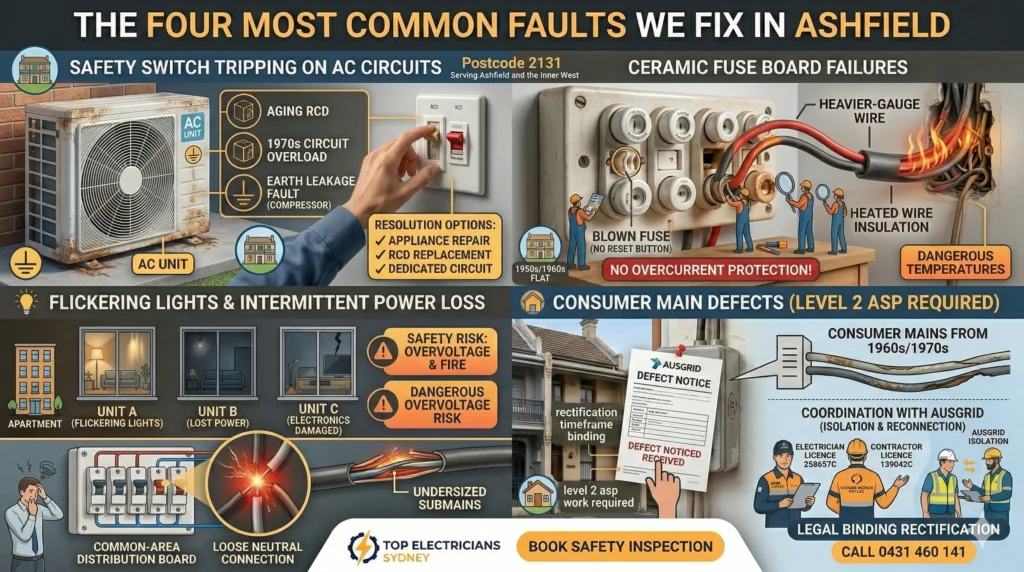
The Four Most Common Faults We Fix in Ashfield
Safety switch tripping on air conditioner circuits
Is the most frequent summer call-out from postcode 2131. The cause is one of three things: an earth leakage fault in the air conditioner’s compressor or wiring; an ageing RCD whose operating threshold has degraded; or a 1970s circuit serving multiple power points that cannot carry the combined load. Each cause has a different resolution, appliance repair, RCD replacement, or a dedicated air conditioner circuit run from the distribution board.
Ceramic fuse board failures
remain common in Ashfield’s 1950s and 1960s flats. When a ceramic fuse blows under overload, the resident cannot simply reset a button. More concerning: these fuse holders are frequently found to have been rewired with heavier-gauge wire than rated by previous occupants who found repeated blowing inconvenient. A fuse wired above its rated current provides no effective overcurrent protection, allowing wiring to heat to dangerous temperatures before eventual failure.
Flickering lights and intermittent power loss in apartments
Indicate either a voltage fluctuation on an undersized submain or a loose neutral connection in the common-area distribution board. A loose neutral is a safety risk, under certain conditions, it causes dangerous overvoltage in some circuits, while others lose power, capable of destroying electronics and, in extreme cases, causing fires. This requires urgent attention, not deferred maintenance.
Consumer main defects and Ausgrid notices
Are more common in Ashfield’s older housing because original submains from the 1960s and 1970s are reaching or exceeding service life. Rectification of a consumer’s main defect notice is Level 2 ASP work standard licensed electricians cannot legally carry out this work. It requires a contractor accredited by the distributor, coordination with Ausgrid for isolation and reconnection, and a Certificate of Compliance for Electrical Work lodged with NSW Fair Trading.
| If you have received a defect notice from Ausgrid, contact a Level 2 Accredited Service Provider immediately. The rectification timeframe in the notice is legally binding. Top Electricians Pty Ltd holds Electrician Licence 258657C and Contractor Licence 139042C and is accredited to carry out consumer main work across Ashfield and the Inner West. Call 0431 460 141. |
What an Electrical Safety Inspection Covers – and Why It Matters Before Summer
An electrical safety inspection is a systematic assessment of a property’s electrical system against current standards and the specific risk profile of the property. It is not a certificate of compliance for sale purposes, it is a diagnostic tool that identifies conditions likely to cause problems before those problems occur.
For an Ashfield home, a thorough inspection covers the following.
1. Visual inspection of the switchboard or distribution board. Assessment of the main switch rating, circuit breaker ratings, RCD coverage, bus bar condition, and the presence or absence of safety switches on all power and lighting circuits as required under AS/NZS 3000:2018.
2. Assessment of the consumer’s main. Visual inspection of the consumer main at the point of attachment, meter box, and submain, where accessible. Identification of insulation condition and conductor rating adequacy for the property’s current and anticipated load.
3. Wiring type identification. Determination of whether any rubber-insulated, fabric-covered, or aluminium branch circuit wiring remains in the property. Each of these wiring types carries specific risk profiles under summer load conditions.
4. RCD testing. Functional testing of all residual current devices to confirm trip time meets AS/NZS 61008 requirements. RCDs that take longer than 40 milliseconds to trip at rated residual current do not provide the protection they appear to offer.
5.Thermal imaging where access permits. Infrared scanning of the switchboard to identify hotspots indicating loose connections, overloaded circuits, or components running above safe operating temperature.
6. Load assessment. A review of the property’s total connected load against the switchboard’s rated capacity, identifying circuits that are likely to trip under summer peak conditions.
At the conclusion of the inspection, we provide a written report identifying any defects, the risk level associated with each, and recommended remediation with approximate cost. There is no obligation to proceed with any work, and we do not manufacture urgency where it does not exist.
| Transparent pricing. Top Electricians charges a $0 call-out fee for Ashfield properties. New clients receive 20% off their first service. Seniors and veterans (50 years and above, or with service history) receive 15% off all electrical services for life. Electrician Licence 258657C – Contractor Licence 139042C. |
Let’s get started!
When to Call an Emergency Electrician in Ashfield
Some electrical conditions in Ashfield homes require immediate professional attention rather than a scheduled assessment. Do not attempt to diagnose or rectify any of the following yourself.
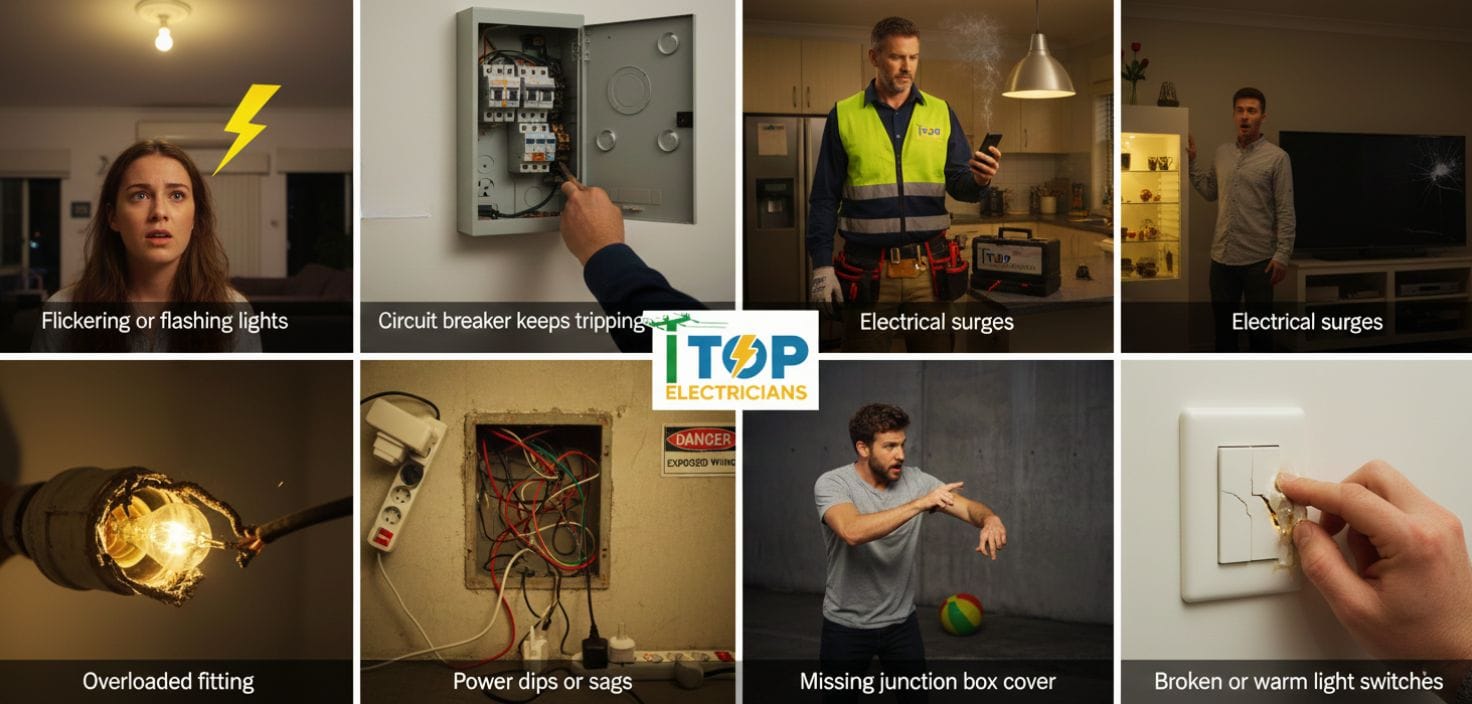
• Burning smell from a power point, switchboard, or ceiling rose – switch off the affected circuit at the distribution board and call immediately. A burning smell indicates an active fault generating heat inside the wiring or fitting.
• Sparking at a power point or switch – visible arcing means a conductor is contacting something it should not. Switch off the circuit and do not use the point until inspected.
• Safety switch that will not reset – if your RCD trips and will not hold after resetting, a persistent earth fault exists somewhere on the circuit. Do not continue attempting to reset it. The RCD is doing its job.
• Complete loss of power to the property when the street has power – this may indicate a consumer main failure, a blown service fuse at the meter box, or a main switch failure. All are Level 2 or licensed electrician work.
• Hot power points or warm switchboard covers – any fitting that is warm to the touch when no high-draw appliance is in use indicates an abnormal current path or a loose connection generating heat.
Our emergency electrician service covers Ashfield and all surrounding Inner West postcodes, 24 hours a day, seven days a week. From our Hurstville base, the typical response time to Ashfield is 30 to 50 minutes, depending on the time of day.
Ashfield Electrician FAQ
- Do you provide emergency electrical services in Ashfield?
Yes. We offer 24/7 emergency electrical support across Ashfield. Our team responds quickly to power outages, sparking outlets, or urgent safety hazards.
- How much does an electrical safety inspection cost?
Costs depend on the size of your property and the complexity of the wiring. We provide transparent quotes without hidden fees. A standard inspection covers all wiring, outlets, and your main switchboard.
- Why should I upgrade my switchboard?
Older switchboards often fail to handle the load of modern appliances. Frequent tripping or blown fuses indicate a safety risk. Upgrading ensures your home meets current safety standards and prevents electrical fires.
- Are you licensed and insured to work in Ashfield?
Yes. Every electrician on our team holds a full license and comprehensive insurance. We perform all work according to Australian standards and local building codes.
- Will installing LED lighting reduce my electricity bill?
Yes. LED lights consume up to 80 percent less energy than traditional halogen bulbs. Switching to LEDs provides a sustainable solution and significantly lowers your long-term energy costs.
Book an Electrical Safety Inspection for Your Ashfield Home
Licensed Level 2 electricians. $0 call-out fee. 20% off your first service. Written report with no obligation to proceed.
Call 0431 460 141 – Same-Day Service Available