
Imagine this: it’s a Saturday evening, the power cuts out, and your neighbours still have lights. You call your electricity distributor, only to be told the fault is on your property and not their responsibility.
For thousands of Sydney property owners, this is how they discover the reality of private electrical infrastructure. Once electricity crosses your property boundary, the poles, cables, and connection points become your legal and financial responsibility. This guide breaks down the ownership rules and clarifies exactly who is legally qualified to perform this work in NSW.
Understanding Power Line Responsibility in Sydney
In NSW, responsibility is determined by the point of supply, the physical boundary where the public network ends and your private infrastructure begins. Sydney’s three Distribution Network Service Providers (DNSPs) define this strictly:
- Ausgrid: Inner, eastern, northern, and parts of western Sydney.
- Endeavour Energy: Western, south-western Sydney, Blue Mountains, and Illawarra.
- Essential Energy: Regional NSW and outer fringes of Greater Sydney.
What the Distributor Owns and Maintains
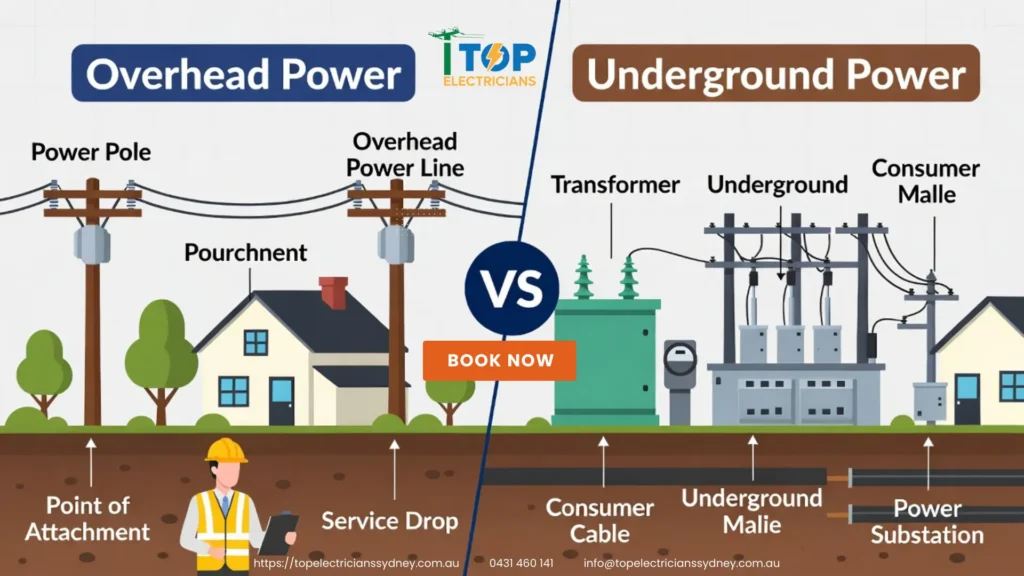
- Electricity poles on public road reserves or footpaths.
- Overhead service lines from the street pole up to (but not including) your point of attachment.
- Underground cables in public roads up to the property boundary.
- Metering equipment (depending on your connection type).
What the Property Owner Owns and Maintains
- Any pole located within your property boundary.
- All overhead or underground cables running across your land.
- The point of attachment (POA) on your building or private pole.
- Service lines connecting to sheds, granny flats, or other structures on your title.
What Is a Private Power Pole?
A private power pole is any pole within your property boundary carrying supply from the street to your building. They are common on long driveways, acreage properties (e.g., Hills District, Hawkesbury), subdivided lots, and properties with secondary dwellings. If unsure, request a free network boundary confirmation from your DNSP.
Who Can Replace a Private Power Pole?
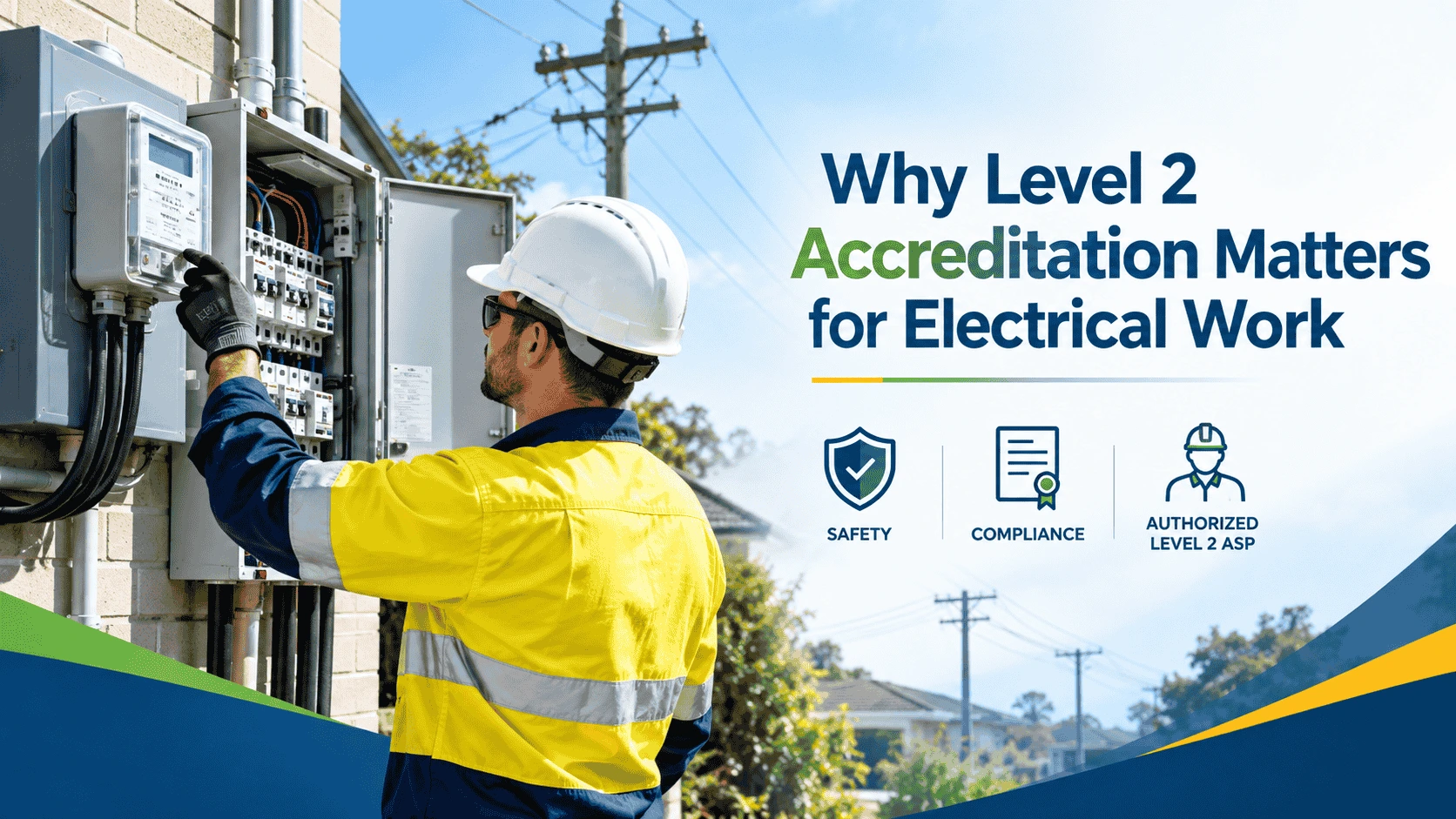
In NSW, private power pole replacement must be done exclusively by a licensed Level 2 Accredited Service Provider (ASP). This is not a job for a standard Level 1 electrician or a DIY project, as it involves live network infrastructure and strict distributor coordination.
Why Level 2 Accreditation Is Required
A Level 1 electrician is only authorised for internal, customer-side wiring. A Level 2 ASP holds specific accreditation to work on the connection between the street network and your property. Unauthorised work breaches the NSW Electricity (Consumer Safety) Act 2004, carrying penalties of up to $22,000 and severe liability for injury or damage.
The Full Pole Replacement Process Step by Step
- Isolation: The DNSP is notified, and supply is disconnected at the street by the Level 2 ASP.
- Assessment: The setup is evaluated against AS 4676 (Structural Design Requirements for Utility Services Poles).
- Installation: The new pole (timber, steel, or concrete) is installed to the correct embedment depth.
- Re-stringing: Conductors are tensioned and terminated, meeting AS/NZS 3000:2018 clearance rules.
- Certification: The ASP tests the work, issues a Certificate of Compliance for Electrical Work (CCEW), and coordinates reconnection.
Who Repairs Overhead Power Lines on Private Property?
Overhead lines on your property are your responsibility. The distributor will not repair them, even if damaged by a storm or falling tree. Ownership dictates the repair obligation.
Common Causes of Overhead Line Damage in Sydney
- Storms & High Winds: Especially in western suburbs, Blue Mountains, and Hawkesbury.
- Falling Trees/Branches: Common during Sydney’s severe thunderstorm season (Oct–Mar).
- Ageing Insulation: Cracking and failing over time, exposing live conductors.
- Vehicle Strikes & Corrosion: Low-hanging lines on driveways or salt-air corrosion in coastal areas.
What a Proper Overhead Line Repair Involves
A Level 2 ASP will isolate the network, inspect the entire span, replace the full conductor (no unsafe splicing), upgrade corroded hardware, check the building’s point of attachment, verify ground clearance, and issue a CCEW before reconnection.
What to Do Immediately After Storm Damage
- Do not approach the line. Keep people and pets away.
- Cordon off the area if the line is touching a structure or tree.
- Call your distributor’s emergency line, then call a Level 2 ASP for the private repair.
Who Maintains Power Lines Between the Street and My House?
Responsibility depends entirely on the physical path of the service line.
When the Distributor Is Responsible
If the line travels directly from the street pole to your building without crossing private land, the distributor owns and maintains it. This is common on standard suburban blocks.
When the Property Owner Is Responsible
If the service line enters your property boundary before reaching your building, that section is your responsibility, regardless of how short it is. This often happens on corner blocks or properties with deep setbacks.
The Point of Attachment: Always the Owner’s Responsibility
The point of attachment (POA), where the line connects to your building, is always your responsibility. Deteriorating POAs on older homes can cause arcing or fires. If your home was built before 1990, have it inspected.
How to Confirm Responsibility for Your Property
Contact your local DNSP and request a service boundary confirmation. For properties with long setbacks or private poles, get this in writing before arranging any work.
Underground Power Lines: Who Is Responsible?
Underground power follows the same rule: if it’s on your land, it’s yours.
What the Distributor Owns Underground
- Cables in public roads/footpaths.
- The service pit or boundary junction box at your property line.
What the Property Owner Owns Underground
- Any cable crossing your land.
- The service cable from the boundary pit to your switchboard.
- Conduits and pits within your boundary.
Always get a free Dial Before You Dig report at 1100.com.au before excavating.
Can a Level 2 Electrician Install Underground Power Cables?
Yes. Installing or upgrading underground cables on private property requires a Level 2 ASP, as it involves the critical connection to the street network.
Cost of Underground Cable Installation in Sydney
Expect to pay $80 to $180 per metre for standard residential underground installation, including trenching, conduit, cable, and surface reinstatement. Costs vary based on distance and ground conditions (e.g., rock vs. sand).
Who Handles Long-Distance Private Power Lines?
Rural-fringe properties (e.g., Penrith, Camden, Hawkesbury) often have supply lines running 100+ metres. These require specific engineering to ensure safety and compliance.
Voltage Drop: The Core Engineering Challenge
AS/NZS 3008 limits voltage drop to 5%. Long runs require heavier cable to prevent appliance damage and motor overheating. A Level 2 ASP must calculate this precisely.
Pole Spacing and Ground Clearance
Pole spacing must account for conductor sag in hot weather or high winds, ensuring minimum ground clearance mandated by AS 4676 is always maintained.
Bushfire Asset Protection Zone Compliance
In bushfire-prone areas (mapped by NSW RFS), overhead lines near Asset Protection Zones may require specific treatments or mandatory undergrounding.
Fault Protection on Long Supply Lines
Long runs can produce low fault currents that fail to trip standard breakers. Proper design includes coordinated protection devices to isolate faults quickly and safely.
Is It Safe to Touch a Fallen Power Line on Private Property?
No. Never approach or touch a fallen power line. Assume it is live and lethal, even if it appears inactive.
Why Fallen Lines Remain Dangerous Even When They Appear Dead
- Lethal Voltage: 230V or 415V can cause fatal cardiac arrest.
- Step Potential: Voltage spreads through the ground; walking toward a line can drive a fatal current through your body.
- Automatic Reclosers: The network may attempt to restore power, making a “dead” line live again in seconds.
After the Immediate Emergency: What Comes Next
Once a Level 2 ASP makes the area safe, they must assess the entire span. Replacing only the fallen section leaves ageing infrastructure in place, creating a recurring hazard.
Private Power Line and Pole Work: What to Expect in Sydney
Indicative estimates for Greater Sydney (2026, incl. GST):
| Work Type | Typical Low (AUD) | Typical High (AUD) |
|---|---|---|
| Private power pole replacement | $1,800 | $4,500 |
| Overhead service line repair | $400 | $1,200 |
| Underground cable install (per metre) | $80 | $180 |
| Long-distance supply line (full job) | $3,000 | $12,000+ |
| Point of attachment repair/replacement | $400 | $900 |
| Compliance certificate & lodgement | $300 | $600 |
For a full cost breakdown by pole type and job scope, see our private power pole installation guide.
Let’s get started!
How We Can Help
Top Electrician Pty Ltd is a Level 2 Accredited Service Provider operating across Greater Sydney, holding direct accreditation from Ausgrid, Endeavour Energy, and Essential Energy. We specialise in private power infrastructure work that standard electricians cannot legally perform.
Our Private Power Services
- Private power pole replacement and installation
- Overhead & underground service line repair
- Long-distance rural supply design
- Point of attachment repairs
- 24/7 Emergency callouts
Our Credentials
- NSW Electrical Contractor Licence 139042C & Electrician Licence 258657C
- Level 2 ASP accredited with all major Sydney DNSPs
- Fully compliant with AS/NZS 3000:2018
- CCEW issued for all work, with written quotes provided upfront.
Frequently Asked Questions
How do I know if a power pole on my property is private?
If it’s inside your fence line or on your title, it’s private. Confirm by requesting a free network boundary clarification from your DNSP.
Who is responsible for a pole on a shared driveway or common property?
In strata schemes, this is typically the owners corporation’s responsibility. Check with your strata manager before arranging work.
Can I underground my existing overhead supply?
Yes. It improves safety, aesthetics, and bushfire resilience. It requires a Level 2 ASP and must meet AS/NZS 3000:2018 burial standards.
How often should private power poles be inspected?
Industry best practice recommends a visual check after major storms and a formal Level 2 ASP inspection every 5 to 10 years. Timber poles typically last 25–40 years.
Conclusion
Private power infrastructure carries real responsibility, but it becomes straightforward when you know the rules and work with the right professionals. Infrastructure on your land is yours to maintain, and only a Level 2 ASP can legally perform this work in NSW. Proactive inspection is always cheaper than emergency repair.
Top Electrician Pty Ltd has the accreditation, expertise, and distributor relationships to handle your private power needs safely and correctly.
Contact us today on 0431 460 141 for a fast, professional response.