
Did you know most people say getting robbed is better than having a house fire? Your switchboard upgrade saves your property, your life, and your loved ones.
The only thing is, how much is the cost of the switchboard upgrade? The price varies depending on several factors, such as the condition of the switchboard, property size, and if there’s additional work required with the upgrade. Leave your switchboard to Top Electricians for peace of mind. Our skilled Level 2 ASP electricians are experts in improving home safety or business within the NSW standards.
Old Fuses, Toxic Backing Boards, and Unexpected Surcharges: The Reality of Modern Power
Why Cost Matters
Of course, electrical upgrades are investments for homeowners and businesses alike. Stop being caught unaware of fire and damage, but keep abreast of safety measures. Before learning the price for the electrical switchboard upgrade, it pays to know what is involved so that you won’t be taken by surprise at the amount you need to spend.
What Is a Switchboard Upgrade and Why Is It Needed?
A switchboard upgrade replaces a dangerous, obsolete fuse box with a modern circuit panel to safely handle heavy appliance loads from EV chargers, solar, or air conditioning. Upgrading eliminates hidden tracking arc fire hazards while ensuring strict compliance with updated NSW safety regulations. Pre-1990 homes often contain toxic Zelemite asbestos board panels, which require specialist remediation if disturbed during installation. Furthermore, standard electrical contractors cannot touch main grid infrastructure, meaning a licensed Level 2 ASP electrician must be engaged to safely manage utility lines and street connection points.
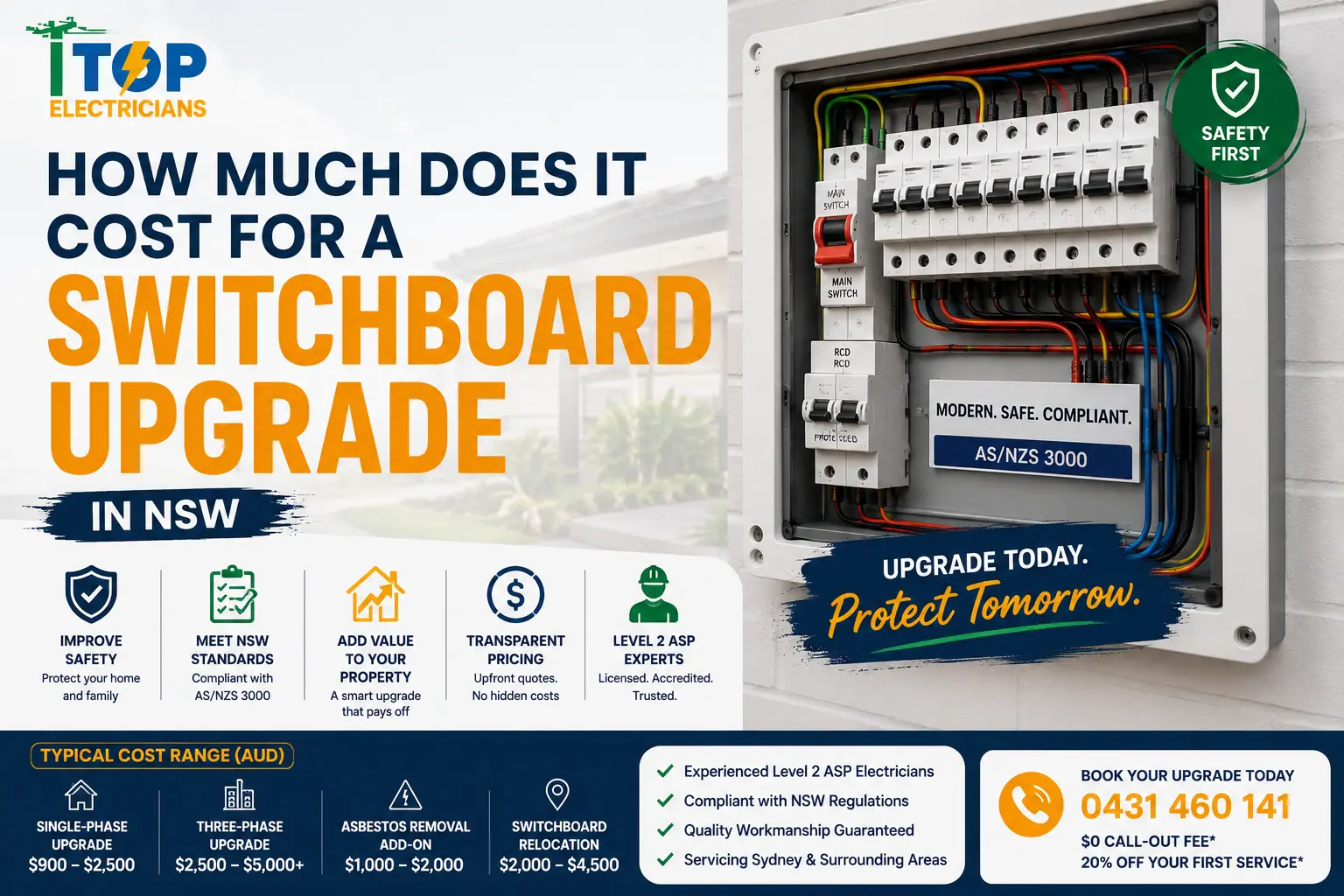
NSW Switchboard Upgrade Cost Breakdown: 2026 Price Matrix
The table below outlines realistic 2026 market rates for compliance work in New South Wales to help you avoid expensive billing surprises.
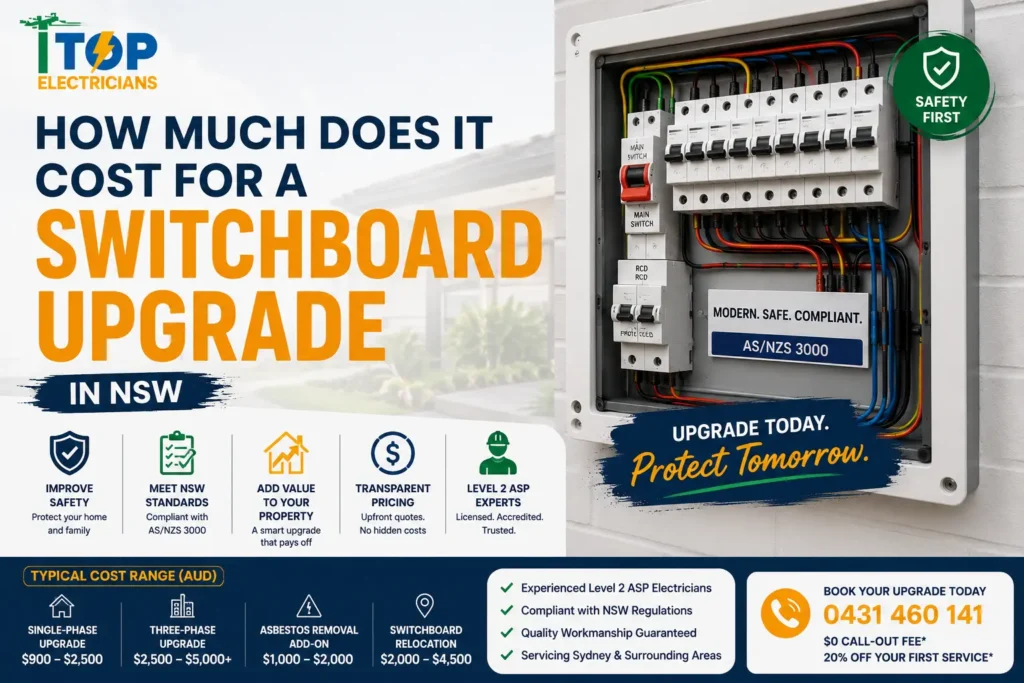
| Upgrade Type & Scope | Average Cost Range (AUD) | Typical On-Site Time | Ideal For |
| Standard Single-Phase Upgrade• Full enclosure replacement• Complete RCBO installation• Main isolation switch | $900 – $2,500 | 3 – 5 Hours | Small-to-medium standard homes replacing old ceramic fuse boxes without adding high-draw appliances. |
| Three-Phase Power Conversion• New 3-phase panel box• Level 2 ASP grid connection• High-load balanced circuits | $2,500 – $5,000+ | 6 – 10 Hours | Large modern homes with ducted air conditioning, rapid EV charging ports, or multi-kilowatt solar systems. |
| Asbestos Backing Board Removal Add-on• Specialized negative-pressure containment• Safe disposal at licensed facility | Add $1,000 – $2,000 | Adds 2 – 4 Hours | Homes built before 1990 featuring black Zelemite or fibrous millboard electrical mounting panels. |
| Switchboard Relocation• Extending consumer mains cabling• New exterior meter box cavity | $2,000 – $4,500 | 1 – 2 Days | Properties undergoing major extensions or renovations where the old internal panel violates modern clearance laws. |
Tax, Tenancy, and Tariffs: Who Actually Pays for the Upgrade?
Your legal and financial obligations under NSW law depend entirely on your property tenure:
- Property Investors (ATO Rules): A full replacement is classified as a capital improvement, not an immediate repair. Under Capital Works Deduction (Division 43) rules, it must be depreciated at 2.5% per year over 40 years. However, replacing a single broken breaker with a modern Type A RCD qualifies as an immediate deduction. Book these before the June 30 financial year deadline.
- Landlord Obligations: Under the NSW Residential Tenancies Act, it is illegal to lease a property without functioning RCD protection on all circuits. Landlords refusing to upgrade old fuse panels face strict compliance penalties from NSW Fair Trading ranging from $1,100 to $55,000.
- Tenant Protections: Tenants are not liable for structural electrical upgrades. If a landlord fails to fix severe panel faults within 48 hours, tenants can legally hire a licensed electrician like Top Electricians for emergency repairs up to $1,000 and claim mandatory reimbursement. If your rental needs an immediate safety assessment, visit our homepage for expert assistance.
The Hidden Surcharges That Double Your Initial Electrical Quote
Three local variables routinely drive final invoices far past initial retail estimates in New South Wales:
- Regional Distributor Infrastructure Tariffs: Fees for connection, isolation, and safety inspections vary heavily by location. Your boundary dictates whether you pay the specific utility rates of Ausgrid (Sydney, Central Coast), Endeavour Energy (Western Sydney, Illawarra), or Essential Energy (Regional NSW).
- Consumer Mains Capacity Upgrades: Old point-of-attachment wires cannot handle modern power demands. If street-to-property consumer lines are degraded or metered below 63 Amps, a specialist contractor must replace them, adding $1,500 to $3,500 in unquoted structural work.
- Mandatory Fault Rectification: Under statutory Australian wiring updates, an electrician cannot legally energize a new panel if pre-existing upstream system faults exist. If isolating the old board reveals cross-routed circuits or decaying rubber insulation inside the walls, the installer must pause and fix the safety violations, incurring unquoted emergency labor fees.
Finalizing Your Switchboard Investment Safely: The 2026 Mandates
Successfully navigating the final compliance stage of your project requires strict adherence to updated New South Wales digital logging workflows:
- Mandatory eCert Portal Submissions: All modern compliance recording is entirely digitized. Hand-written carbon copies and stand-alone PDF safety certificates are legally phased out. Your installer must log your installation data directly through the official digital Building Commission NSW eCert Portal to issue a legally binding Certificate of Compliance Electrical Work (CCEW) within 7 days of power restoration.
- Automated Smart Meter Transition: Altering a structural switchboard assembly automatically triggers a compulsory energy network meter upgrade. Your digital network provider will remove your obsolete spinning mechanical accumulation infrastructure and mount an advanced electronic Smart Meter, allowing for exact real-time demand tariff logging and seamless solar feeding.
To avoid hidden operational risks and secure a guaranteed, binding cost schedule that accounts for your regional utility grid rules, ensure your property is surveyed directly by licensed, network-accredited trade firms like Top Electricians. You can review our corporate credentials and learn more about our local service coverage by visiting our homepage.
Why Choose Top Electricians
Choosing Top Electricians means securing premium, affordable switchboard upgrades and expert electrical installations across Sydney. We are fully licensed and insured, dispatching only qualified specialists backed by extended parts and labor warranties. Call our team now at 0431 460 141 for a $0 call-out fee and a 20% discount on your first service.
Our active rapid-response service network covers Greater Sydney, Western Sydney, Northern Sydney, and the Southern Suburbs. Whether you need immediate emergency mitigation or a planned structural compliance audit, we operate around the clock to insulate your home or business premises from tracking arc electrical fire hazards.
Certified Expertise and Transparent Pricing
We deploy highly trained, certified technical specialists who hold full Level 2 ASP endorsements to guarantee your installation strictly meets all state wiring standards. Top Electricians operates on a strict upfront pricing policy, providing clear, fixed-price quotes with absolutely zero hidden fees or unexpected post-job surcharges.
Frequently Asked Questions
Q1: Is a switchboard upgrade legally required in NSW?
Ans: A full upgrade is legally mandatory under AS/NZS 3000 Wiring Rules the moment you execute any structural modification to your electrical layout, such as wiring an EV charger, solar inverter, or heavy ducted heating system, or if your current enclosure relies on old ceramic fuses that lack modern residual current protection.
Q2: How long does a standard residential switchboard upgrade take to finish?
Ans: A standard single-phase residential panel box swap takes between 3 to 5 hours of active on-site labor. Complex three-phase upgrades or configurations requiring consumer mains relocation will take 1 to 2 business days. Your property’s main incoming power line will be completely turned off during this timeline.
Q3: Can any standard domestic electrician complete a 3-phase switchboard upgrade?
Ans: No. A standard electrical contractor can hang the new enclosure and fit the internal circuit breakers. However, running new street drop lines, handling high-voltage service fuses, or physically reconnecting your infrastructure to the public network grid requires a specialized Level 2 ASP credential.
Q4: Is a residential switchboard upgrade immediately tax-deductible for NSW investors?
Ans: No. The ATO views a complete main electrical panel replacement as a permanent capital improvement rather than a rapid maintenance repair. The entire cost must be capitalized and depreciated over a 40-year window at a fixed 2.5% per annum rate using Capital Works Deduction (Division 43) parameters.
Q5: What happens if the electrician discovers hidden asbestos behind my old panel box?
Ans: All live tracking work must cease immediately to execute safe containment protocols. Pre-1990 NSW homes use hazardous Zelemite or fibrous millboard mounting panels. Safe containment, specialist extraction, and certified toxic material haulage add a fixed $1,000 to $2,000 hazardous cleanup surcharge to your project bill.