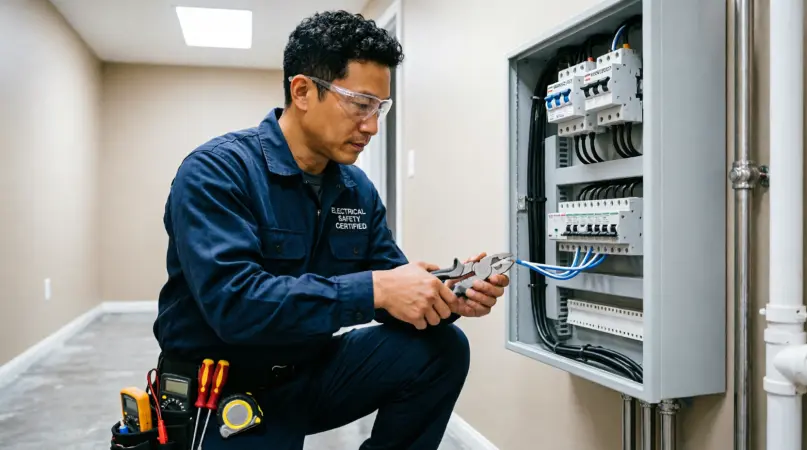


Why Your Meter Box Matters More Than You Think
Most homeowners walk past their meter box every day without giving it a second thought, until something goes wrong.
Your electricity bill spikes unexpectedly. A safety switch keeps tripping. An electrician asks about your meter setup, and you have no idea what they’re referring to. Sound familiar?
Understanding how your electric meter box works isn’t just useful trivia; it’s practical knowledge that helps you protect your home, manage energy costs, and make informed decisions when dealing with your electricity provider or a licensed electrician.
This guide breaks down everything you need to know: how the meter box works, what’s inside it, where to find it, who’s responsible for what, and what Australian regulations say about maintenance and upgrades. Whether you’re a first-time homeowner or you’ve lived in your property for years, this is the resource you didn’t know you needed.
What Is an Electric Meter Box?
An electric meter box (also called a meter board or meter enclosure) is the protective housing that contains your electricity meter and, in many setups, your main isolating switch. It sits at the connection point between the electricity network and your home’s internal wiring system.
Think of it as the entry point for all electrical power coming into your property. Everything from your lights and power outlets to your hot water system and air conditioning draws electricity that passes through, or is measured by, this single point.
The Difference Between a Meter Box and a Switchboard
These two are often confused, but they serve different purposes:
- Meter box – records electricity consumption and houses the service connection point. Owned and managed by your energy distributor (e.g., Ausgrid, Endeavour Energy, Essential Energy in NSW).
- Switchboard – distributes power throughout your home and contains circuit breakers and safety switches (RCDs). This is your responsibility as a homeowner.
In older Australian homes, the meter and switchboard were sometimes combined in a single enclosure. Modern installations separate the two for safety and regulatory compliance.
Who Actually Owns Your Meter Box?
In the Australian energy market, there is a distinct split in asset ownership that property owners must understand.
The network ownership framework consists of three separate regulatory boundaries:
The Meter: Usually owned by your energy retailer or the network distributor. They monitor it, but you are not legally allowed to alter or touch it.
The Enclosure (The Cabinet): This is your property. If the hinges rust, the backing board rots, or the door fails to seal, the property owner is legally responsible for structural maintenance.
The Service Fuse (Main Cutout): This is the master safety link to the street grid. In most states, only a licensed Level 2 Accredited Service Provider (ASP) is legally permitted to remove this fuse.
Comparing Meter Box Components: Who is Responsible?
The component matrix below details the exact asset ownership boundaries and repair responsibilities for residential electrical connections:
Component | What it Does | Who Owns/Fixes It? |
Smart Meter | Tracks $kWh$ for billing. | Energy Provider |
Meter Box (Cabinet) | Protects gear from the Aussie sun/rain. | The Homeowner |
Main Switch | Kills all power to the house. | The Homeowner |
Service Fuse | The “Master” safety link to the street. | Network Distributor |
Consumer Mains | Big cables feeding your switchboard. | The Homeowner |
How Your Electric Meter Box Works: Step by Step
The process of power delivery from the main distribution grid to your residential outlets follows a strict five-step sequence:
[Street Grid Supply] ──> [Consumer Mains Entry] ──> [Meter Consumption Tracking] ──> [Switchboard Distribution] ──> [End-User Consumption]
1. Street Supply Connection: Step 1.
High-voltage electricity from the local distribution network is stepped down via a localized transformer before reaching your property line.
2. Consumer Mains Entry: Step 2.
The service cables enter your meter box. The portion of wiring from the street grid up to the point of attachment is regulated by the Australian Energy Regulator (AER).
3. Consumption Tracking: Step 3.
As live current passes through, the meter records net usage in kilowatt-hours ($kWh$). This data is transmitted either manually or remotely via cellular smart meter networks.
4. Switchboard Distribution: Step 4.
Power moves past the meter directly into your central switchboard, where it is split into dedicated sub-circuits (lighting, heavy appliances, and power outlets).
5. Retail Billing Calculation: Step 5.
Your energy retailer reads the consumption differentials between billing cycles to calculate your absolute financial usage metrics.
What’s Inside an Electric Meter Box?
While configurations vary depending on the age of your home and your electricity distributor’s requirements, most Australian meter boxes contain some or all of the following:
Electricity Meter
The core component. Older homes may have an accumulation meter with analogue dials. Modern properties increasingly use digital interval meters (smart meters) that record usage in 30-minute intervals and support time-of-use tariffs. The Australian Energy Market Commission (AEMC) provides a helpful overview of smart meter rollout timelines and your rights as a consumer.
Main Isolating Switch
Often located inside or adjacent to the meter box, the main switch allows the entire power supply to be isolated, typically for safety during electrical work or emergencies. In some configurations, this sits on the switchboard rather than the meter box.
Service Fuse (Cut-Out Fuse)
A sealed fuse on the incoming supply, installed and maintained exclusively by your electricity distributor. You should never attempt to access or remove this component.
Consumer Mains (Service Cables)
The cables connect the street supply to your meter. These carry live current at all times, even when your main switch is off.
Meter Box Enclosure
The physical housing itself is typically made from metal or UV-stabilized polycarbonate. In Australia, meter box enclosures must comply with AS/NZS 3000 (the Australian Wiring Rules) and distributor-specific requirements.
Tariff Control Equipment (where applicable)
In homes with controlled load tariffs (e.g., off-peak hot water), there may be additional switching equipment inside the meter box to manage time-of-use loads.
Types of Electricity Meters Used in Australia
Accumulation Meters (Basic Meters)
The traditional dial or digital display meter records total energy use. It shows one number, your cumulative consumption since installation. Best suited for flat-rate tariffs.
Interval Meters (Smart Meters)
Records consumption every 30 minutes, enabling time-of-use (TOU) pricing. Mandatory for new connections and major upgrades in most Australian states. In Victoria, smart meters have been standard since 2009 under the Advanced Metering Infrastructure (AMI) rollout.
Solar Export Meters / Bi-Directional Meters
Required for homes with rooftop solar (PV systems). These meters measure both the electricity you consume from the grid and the excess solar energy you export back to it, which is critical for accurately calculating your solar feed-in tariff credits.
Where Is the Meter Box Located in Australian Homes?
Electricity distributors in Australia require meters to be easily accessible for reading and maintenance. Common locations include:
- On the front external wall of the property, near the main entry
- On a side boundary fence or wall closest to the street
- Near the driveway or garage
- In a shared meter room for apartment buildings and strata-titled units
Important for apartment residents: In multi-dwelling buildings, your individual meter is typically in a communal meter room managed by the building owner or strata manager. You’re still responsible for what happens on your side of the meter, but access may be controlled by body corporate rules. For strata-specific queries, NSW Fair Trading’s strata living guide outlines your rights and responsibilities.
Who Is Responsible for the Meter Box in Australia?
This is one of the most commonly misunderstood areas of homeownership, and it matters enormously when something needs repairing.
The Electricity Distributor’s Responsibility
Your electricity distributor (network operator) owns and is responsible for:
- The meter itself
- The service fuse
- The consumer mains up to the point of attachment at your property
Your Responsibility as the Homeowner
As the property owner, you are responsible for:
- The meter box enclosure (the physical housing)
- Keeping the enclosure weatherproof, structurally sound, and accessible
- The wiring and components on the customer side of the meter
- Arranging a licensed electrician for any repairs or upgrades to the enclosure or downstream wiring
This distinction matters when something goes wrong. If your meter malfunctions, contact your distributor. If the box itself is rusted, cracked, or unsafe, you’ll need to arrange repairs through a licensed Level 2 electrician.
Australian Electrical Standards and Regulations to Know
Any work on or near a meter box must comply with Australian regulations. Key standards include:
- AS/NZS 3000:2018 (Wiring Rules): the primary standard governing electrical installations in Australia and New Zealand
- AS/NZS 3439: standards for switchboards and distribution boards
- State-based legislation: each state has its own electrical safety legislation (e.g., Electricity Safety Act 2017 in Victoria, Work Health and Safety Act 2011 in NSW)
- Distributor-specific requirements: Ausgrid, Endeavour Energy, AusNet, SA Power Networks, Western Power, and Energex all publish their own metering and connection standards that licensed electricians must follow
Only a licensed electrician, and in many cases specifically a licensed Level 2 (ASP) electrician, can legally work on service connections, consumer mains, or meter box components in Australia. DIY electrical work in these areas is illegal and extremely dangerous.
Signs Your Meter Box Needs Attention
Don’t wait for a complete failure. Watch for these warning signs:
- Rust or corrosion on the enclosure, especially around cable entry points
- Water ingress: moisture inside the box, condensation, or visible water damage
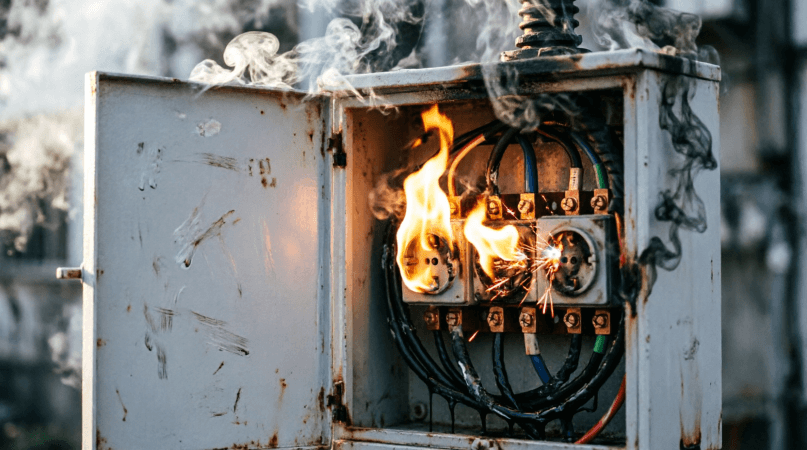
- Burn marks or scorch damage around wiring or switches
- Loose or damaged covers that no longer seal properly
- Flickering lights or tripping circuits may indicate wiring issues at the board
- Asbestos-backed meter boards: common in homes built before the 1990s; these require licensed asbestos removal before any electrical work can proceed. Check SafeWork NSW’s asbestos guidance for homeowner obligations.
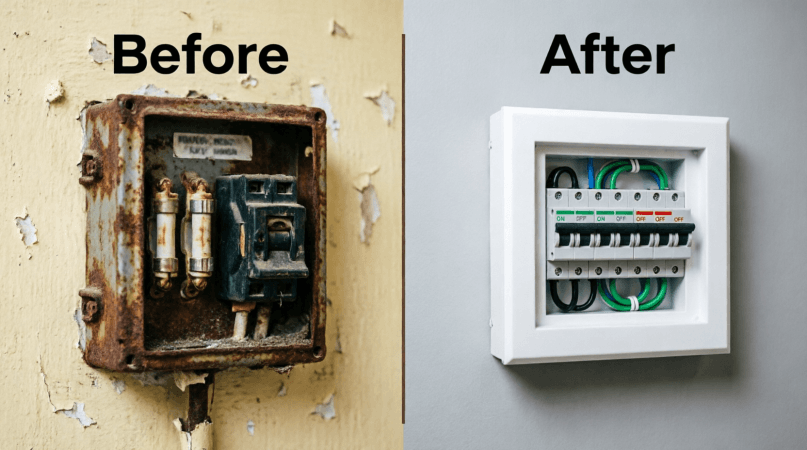
- Older ceramic fuse-based systems: if your home still uses rewirable fuses rather than circuit breakers, an upgrade is strongly recommended
How to Read Your Electricity Meter
Reading a Digital Meter
Most modern meters display a series of numbers on an LCD screen. Simply read the digits from left to right (ignoring any numbers displayed in red or after a decimal point). This gives you your current consumption in kWh.
Some smart meters cycle through multiple displays, including peak usage, off-peak usage, and export readings for solar homes.
Reading an Analogue Dial Meter
Read each dial from left to right. Each dial rotates in the opposite direction to the one before it. If the pointer is between two numbers, read the lower number. If it points directly at a number, check the next dial; if it’s past zero, read the number; if not, read the number below.
This can be tricky, which is why most Australian distributors now prefer digital or smart meters.
Checking Your Usage Against Your Bill
Your bill shows the meter readings used to calculate your charges. If the numbers don’t match what you see on your physical meter, contact your retailer immediately; you may have been estimated rather than actually read.
Meter Box Replacement and Upgrade: What It Involves in Australia
If your meter box enclosure is damaged, outdated, or needs to accommodate new equipment (like a solar inverter or EV charger), replacement is necessary.
Typical Process
- A licensed Level 2 electrician inspects the existing setup and confirms what’s required
- The electricity distributor is notified (required before any work on the service connection)
- A temporary supply isolation is arranged if necessary
- The new enclosure is installed to current Australian standards
- The distributor attends to reconnect the service and install or transfer the meter
Approximate Costs in Australia (2025–2026)
Costs vary significantly by state, property type, and complexity:
- Basic meter box enclosure replacement: $400–$900
- Meter box + switchboard combined upgrade: $1,500–$4,000+
- Additional costs for asbestos removal (older homes): $500–$1,500+
- Smart meter installation (if required): Usually arranged through your retailer at no direct cost, or rolled into upgrade costs
Always obtain at least two quotes from licensed electricians and confirm they hold a current electrical contractor licence in your state.
Planning a bigger upgrade? Read our full breakdown of switchboard upgrade costs in Sydney to understand what’s included and what to budget for.
Let’s get started!
FAQ: Electric Meter Box – Common Australian Homeowner Questions
Q: Can I open or work on my electric meter box myself?
No. In Australia, it is illegal for unlicensed individuals to carry out electrical work, including on or near a meter box. Even opening the enclosure to access the meter components can expose you to lethal voltages. Always use a licensed electrician for any work beyond reading the meter display.
Q: Who do I call if my electricity meter stops working?
Contact your electricity distributor (not your retailer). Your distributor is responsible for the meter itself. In NSW, this might be Ausgrid or Endeavour Energy; in Victoria, AusNet, Jemena, or CitiPower/Powercor; in QLD, Energex or Ergon Energy. Your electricity bill should include your distributor’s contact details.
Q: My bill seems too high, but my usage hasn’t changed. Could it be a meter fault?
It’s possible but uncommon. First, rule out other causes: new appliances, seasonal heating/cooling, rate changes, or an estimated read that’s being corrected. If you still suspect a fault, ask your distributor for a meter accuracy test. There’s sometimes a fee for this, which is waived if the meter is found to be faulty.
Q: Does my meter box need to be upgraded for solar panels?
Quite possibly. Solar systems require a bi-directional meter capable of measuring both import and export. If your current meter box enclosure is too small or non-compliant, it may need upgrading before your solar system can be connected. Your Level 2 electrician and solar installer will assess this during the design phase.
Q: What is a Level 2 electrician, and do I need one for meter box work?
A Level 2 Authorised Service Provider (ASP) is a specially licensed electrician authorised to work on the service connection between the electricity network and your property, including consumer mains, meter connections, and service fuse enclosures. Any work involving the connection point between the street supply and your meter box requires a Level 2 ASP.
Q: How often should a meter box be inspected?
There’s no fixed legal interval for homeowner-initiated inspections, but most electricians recommend having your meter box and switchboard checked every 10 years, or whenever you’re doing significant electrical upgrades, buying or selling a property, or notice any of the warning signs listed above.
Conclusion: Don’t Ignore the “Heart” of Your Home
Your electric meter box is the silent guardian of your home’s energy supply. By keeping the area clear, ensuring the enclosure is weatherproof, and monitoring for unusual sounds or smells (like burning plastic), you protect both your wallet and your family.
If you’ve noticed rust, heard buzzing, or received a “Defect Notice” from your energy provider, don’t wait for a total power failure.
Need a Professional Inspection?
The team at Top Electricians specializes in Level 2 electrical services, meter box upgrades, and switchboard modernizations. We ensure your home meets the latest Australian safety standards.
[Contact Top Electricians today for a safety audit or a free quote on your meter box upgrade.]