
Navigating the High-Stakes Reality of Australian Earthing Compliance
Every licensed electrical contractor understands that Earthing Testing & Earthing Installation are not just basic safety measures. They are strict legal requirements. Failing an audit or miscalculating a fault path puts your operating license at risk and directly violates the Electricity Safety Regulations 2009. The liability rests entirely on the certified professional signing the final paperwork. Securing the proper regulatory sign-off requires absolute precision and an unwavering commitment to current national codes.
What is the standard for Australian earthing systems?
Earthing installation in Australia must strictly comply with the AS/NZS 3000 Wiring Rules to ensure life safety and functional system integrity. Compliance testing validates that the fault current path meets statutory resistance levels and protects both people and property from catastrophic electrical failures.
Defining the Framework: Protective vs. Functional Earthing
Before breaking ground on a new site, technicians must identify the exact system requirements. The regulations separate grounding into two highly specific categories. Professionals must distinguish between protective earthing designed for human safety and functional earthing required for equipment performance. This distinction becomes critical when dealing with sensitive telecommunications cabling where stray electrical noise can completely disrupt data networks governed by the Australian Communications and Media Authority (ACMA).
| System Type | Primary Objective | Target Asset Protection | Regulatory Focus |
| Protective System | Prevent electric shock and fire hazards | Human life and physical property | Rapid fault current clearance times |
| Functional System | Mitigate electrical noise and interference | Telecommunications and IT infrastructure | Signal reference stability and data integrity |
AS/NZS 3000 Mandates for Earthing System Design and Installation
The foundational blueprint for any compliant Australian site is AS/NZS 3000. This standard dictates every metric of your installation process from the ground up. A proper high-voltage design requires meticulous planning regarding the exact placement, depth, and material of the earth electrode.
When managing complex commercial projects or seeking expert validation, consulting with established industry leaders like Top Electricians ensures your project meets every legal benchmark. For teams needing external support, reviewing professional Earthing System Installation Services provides a reliable pathway to secure full regulatory approval without project delays.
To maintain compliance during the installation phase, electricians must follow these specific mandates:
- Electrode Placement: You must drive electrodes deep enough into the soil to reach permanent moisture levels.
- Conductor Sizing: You must size the main earthing conductor according to the maximum prospective fault current of the specific switchboard.
- Switchboard Integration: All earth connections at the main switchboard require permanent, secure, and easily accessible labeling for future compliance inspections.
- Corrosion Protection: You must apply approved anti-corrosive compounds to all underground mechanical joints to prevent long term degradation of the fault path.
Precision Execution: AS/NZS 3017 Compliance Testing Protocols
Once the physical components are in place, electricians must validate the system. This requires strict adherence to AS/NZS 3017 testing procedures. The primary goal is to verify that the ground loop impedance is low enough to trigger protective devices instantly. A compromised fault current path will fail a regulatory audit and present an immediate danger to property occupants.
Follow this workflow for accurate validation:
- Visual Inspection: Verify all mechanical connections are secure, free of corrosion, and correctly labeled at the main switchboard.
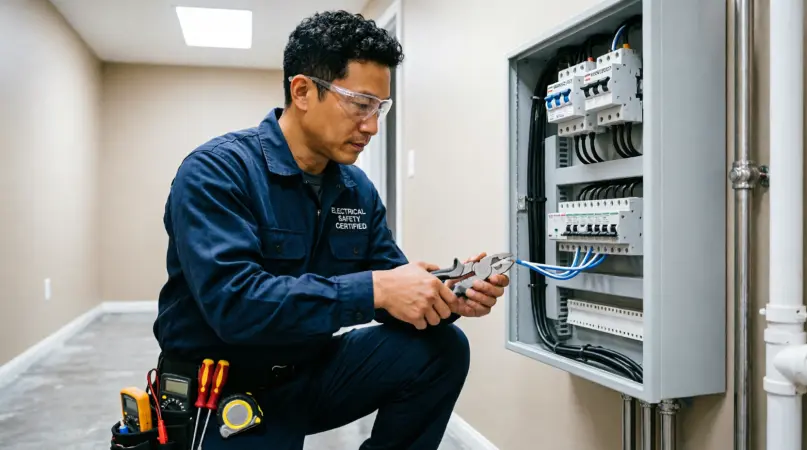
- Continuity Testing: Use a calibrated multimeter to confirm the continuous path of the main earthing conductor from the electrode to the distribution board.
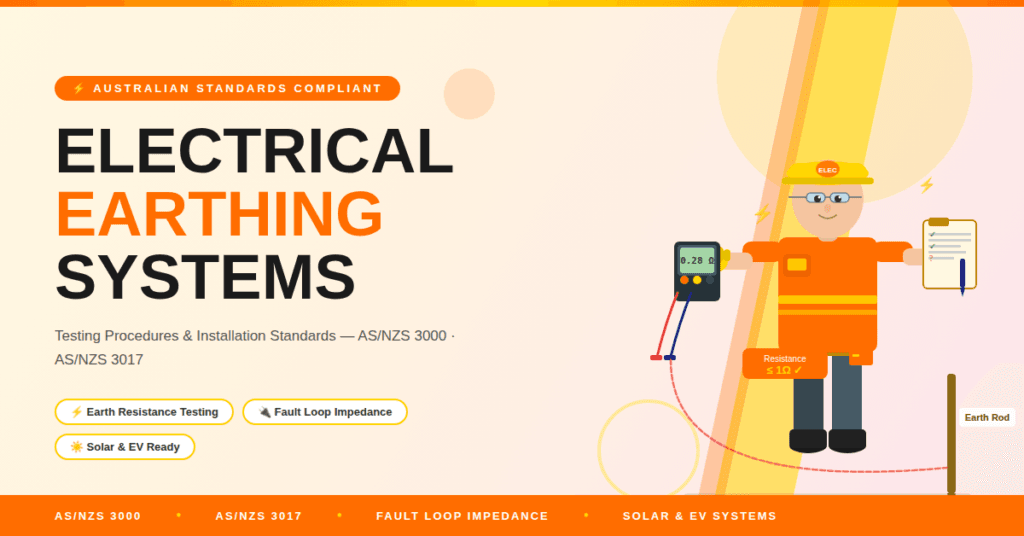
- Earth Resistance Measurement: Deploy an earth megger to measure the exact resistance of the installed electrode against the surrounding soil.
- Fault Loop Impedance Testing: Conduct live testing to ensure the safety switches and circuit breakers will trip within the mandated timeframes.
The Modern Load Gap: Compliance for Solar Integrations and EV Infrastructure
A major failure point in the 2026 electrical landscape involves upgrading existing properties. Standard residential and commercial earthing systems designed decades ago cannot handle modern high capacity loads. Integrating commercial solar arrays or electric vehicle charging stations frequently triggers a mandatory switchboard upgrade.
Why do solar and EV installations require earthing upgrades?
Modern electrical upgrades require extensive earthing modifications because increased load capacities overwhelm older systems. High voltage infrastructure requires engineers to implement advanced solar inverter earthing protocols and adhere strictly to AS 2067 guidelines to prevent dangerous electrical leakage and ensure network stability.
Overcoming High Soil Resistivity in Extreme Australian Terrains
Geographic location heavily impacts installation success. Australia features notoriously dry and rocky terrain. This creates an environment with high soil resistivity. A standard copper earthing rod often fails to achieve the required minimum resistance levels in these conditions. This failure forces engineers to account for dangerous step and touch voltage risks across the ground surface. Installers must utilize chemical earth enhancing compounds or drill deep-driven electrode arrays to achieve compliance in these arid zones.
Final words
The physical installation is only the first half of the project. The final requirement is securing official compliance certification. This process demands meticulous statutory reporting to prove that all completed work meets national standards. Comprehensive installation auditing protects the contractor from liability and ensures the client receives a legally sound electrical system.
Ensure you compile the following documentation for final sign off:
- Detailed schematics of the earthing system design and exact electrode locations.
- Calibrated test results showing the precise ground loop impedance measurements.
- Photographic evidence of underground mechanical connections prior to backfilling the trenches.
- A signed Certificate of Compliance for Electrical Work to lodge with the local regulatory authority.
Need Expert Assistance?
Our earthing testing and installation services are offered to all of Sydney, including Greater Western Sydney and the Eastern Suburbs. We also offer reliable Level 2 Electrician services where our workers will safely handle more advanced types of electrical compliance work. For professional earthing installation and earthing testing services in Sydney, contact The Top Electricians now on 0431460141 to secure your regulatory sign-off today.
Expert FAQ: Technical Compliance & Earthing Procedures
What is the acceptable earth fault loop impedance under AS/NZS 3000?
The acceptable limit depends on the specific circuit breaker rating and the type of electrical supply. Professionals must consult the maximum values listed in the AS/NZS 3000 tables to ensure protective devices operate within the required 0.4 seconds for final sub-circuits.
How often should commercial earthing systems undergo compliance testing?
Commercial and industrial environments require routine periodic testing. The frequency varies by industry type, but safety regulations generally mandate comprehensive testing every 12 to 24 months to account for soil degradation and mechanical wear.
Can a single earth electrode serve both protective and functional purposes?
Yes, a single electrode can serve both purposes provided the installation meets the most stringent requirements of both systems. The combined system must safely dissipate fault currents while maintaining the low noise reference required for telecommunications.
What role does soil moisture play in earthing testing results?
Moisture drastically lowers soil resistance. Testing during wet seasons can yield falsely compliant readings. Technicians must account for seasonal variations and dry periods to ensure the system remains safe and functional year-round.
Are chemical earth rods legal for use in Australian installations?
Chemical earth rods are completely legal and often strictly necessary in highly resistive soils. Installers must ensure the specific chemical compounds used comply with environmental regulations and do not aggressively corrode the primary copper electrode over time.