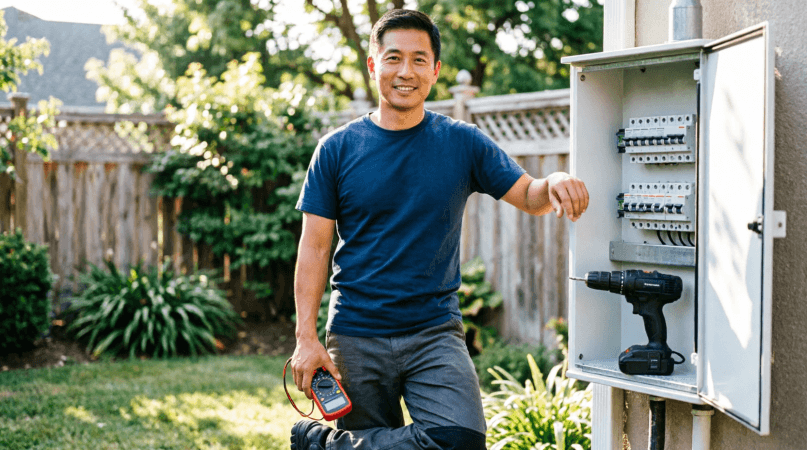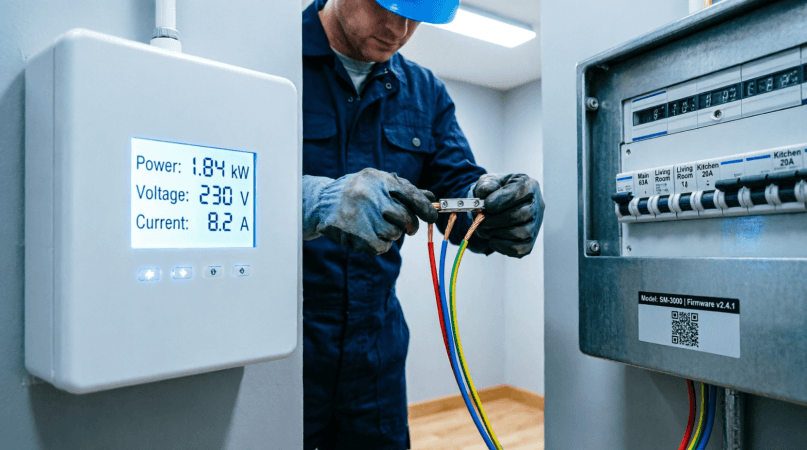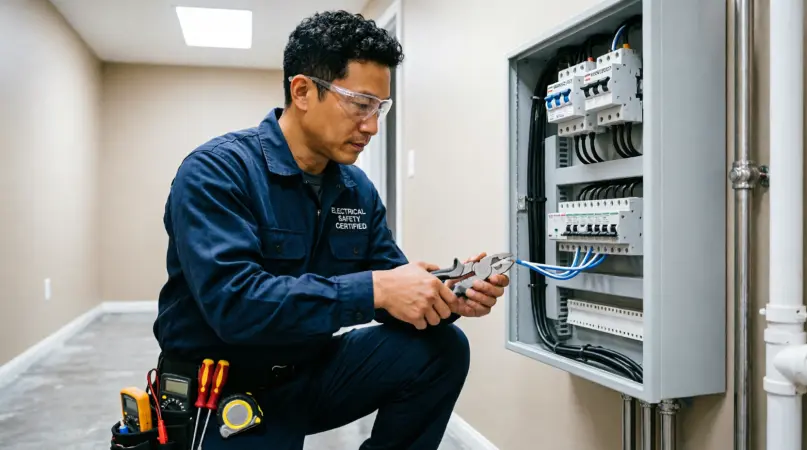

A Level 2 Electrician is an Accredited Service Provider (ASP) authorised to work on the “service lines” connecting your property to the street’s electrical grid. A standard electrician works inside your home. A Level 2 professional is legally required for grid-side tasks like 3-phase power upgrades, EV charger installs, and reconnecting power to the network.
Most property owners assume any licensed sparky can handle every electrical task. That’s a common misunderstanding, and it gets expensive fast. A standard electrician handles everything past your switchboard, but they’re legally barred from touching the street connection. If you need more power for a renovation or a new grid connection, you need a Level 2 specialist.
Beyond the Switchboard: Why Your Property Demands a Level 2 ASP
The Australian electrical grid has two clear zones:
- Zone 1: your internal wiring
- Zone 2: the overhead or underground lines connecting your building to the street network
Working in Zone 2 is high-risk and requires an Accredited Service Provider. A Level 2 Electrician has the advanced training and specific insurance to work on these live network assets.
Use a standard electrician for grid-side work and you risk heavy fines and immediate disconnection. Distributors like Ausgrid, Endeavour Energy and Essential Energy strictly enforce these boundaries. We regularly see owners hit with “Red Stickers” for hiring the wrong tier of professional. Getting this distinction right matters for a successful project.
Can a Level 2 Electrician Upgrade My Power Supply Capacity?
Yes. A Level 2 electrician is the only professional authorised to increase how much electricity your property can draw from the street.
What is a power capacity upgrade?
Replacing existing service fuses and upgrading consumer mains to handle a higher electrical load, so your property can run modern, high-demand appliances without tripping the main breaker or damaging your wiring.
You likely need one if you’re installing:
- Ducted air conditioning
- Fast-charging EV stations
- Large induction cooktops or double ovens
- Heated pools or high-capacity electric hot water units
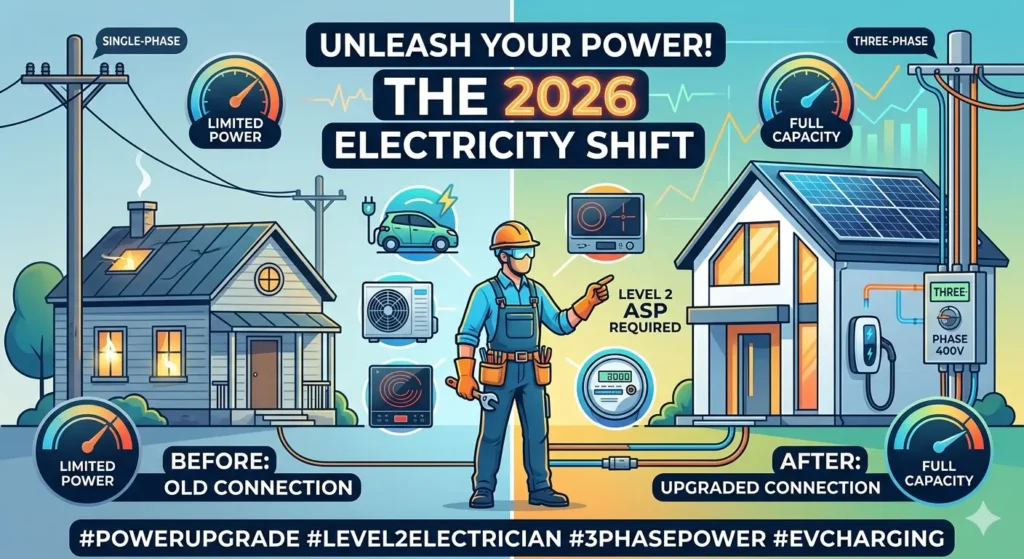
The 2026 Shift: Upgrading Single-Phase to Three-Phase Power
Demand on the Australian residential grid is reaching a breaking point. Most older homes run on a single-phase supply, often limited to 63 Amps, and that’s no longer enough given rapid EV adoption and the move away from gas.
| Feature | Single-Phase Power | Three-Phase Power |
| Voltage | 230 Volts | 400 Volts |
| Current Delivery | One active wire | Three active wires |
| Load Capacity | Limited (up to ~15kW) | High (up to ~45kW+) |
| Best For | Small apartments | Modern homes, EVs, and business |
| Stability | Occasional voltage drops | Consistent, balanced load |
Moving to a 400V three-phase supply balances your load across three wires. Lights stop flickering when the AC kicks in, and you get the heavy-duty current needed for rapid EV charging. It’s now standard for most commercial operations and large-scale renovations. See our full 3-phase power upgrade cost guide for a detailed breakdown of pricing and the five-step connection process.
Comprehensive Service Classification: When Do You Need a Level 2 ASP?
| Project Type | Required ASP Class | Key Technical Requirements | Benefit to Property Owner |
| Disconnect & Reconnect | Class 2A | Proper isolation of the Point of Attachment | Safe renovation and hazard-free demolition |
| Underground Service Lines | Class 2B | Trenching, armoured cables, pit connections | Aesthetic improvement, storm-damage protection |
| Overhead Service Lines | Class 2C | Service fuses and aerial conductors | Reliable street-to-house power for older suburbs |
| Metering & Energising | Class 2D | Smart meter installation, switchboard linking | Accurate billing, solar net-metering readiness |
| 3-Phase Power Upgrade | Class 2A, 2C/D | 400V supply with new consumer mains | Supports EV chargers, industrial AC, high-load machinery |
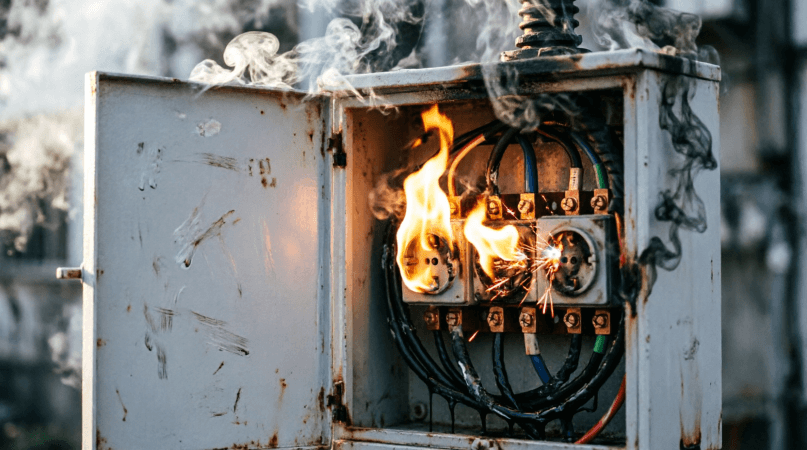
| Defect Rectification | Varies (A-D) | Immediate repair of “Red Sticker” faults | Prevents total disconnection by distributor |
| Private Power Pole | Class 2C | Deep-set timber or steel pole installation | Safe overhead line support for rural/large blocks |
The Paperwork Trail: Navigating Compliance Without the Headaches
A Level 2 job is as much administrative as it is technical. This is the part most guides skip, even though it causes the most frustrating delays.
The Legal Sequence Every ASP Job Must Follow
- Site inspection and load assessment.
We assess your infrastructure and calculate the load required, which determines the correct service fuse rating and consumer mains spec. - Application for connection.
A formal Connection Application goes to your network distributor (Ausgrid, Endeavour Energy or Essential Energy in NSW; other states have their own DNSPs). - Network application fees.
These are charged directly by the distributor, separate from labour costs. We provide a realistic estimate, but the final fee is set by the distributor. - Physical work execution.
Underground cabling, overhead line upgrades, three-phase connections, or metering changes, completed to the relevant Australian Standard. - Compliance documentation.
We submit a Notice of Service Work (NOSW) and a Certificate of Compliance for Electrical Work (CCEW) confirming the installation meets AS/NZS 3000:2018.
If the NOSW or CCEW is missing or rejected, your power won’t be energised, no matter how good the physical work is. Managing this paperwork is one of our core services.
Level 2 Electrician for New Home Builds
For a new build, the Level 2 ASP handles the most important connection: bringing power from the street to your switchboard for the first time.
- The builder’s standard electrician wires the internal circuits and installs the switchboard.
- The Level 2 ASP coordinates the connection application with the distributor.
- The ASP installs the consumer mains, point of attachment, and service fuse.
- The meter is installed (often coordinated by your energy retailer).
- The NOSW and CCEW are filed, and the property is energised.
Delays here usually come from builders not engaging an ASP early enough, and they’re one of the most common causes of settlement delays. Bring your Level 2 ASP in at pre-DA or early construction to avoid last-minute bottlenecks. Our guide to the cost of wiring a new build house covers the full scope and timeline in more detail.
Level 2 Electrician for Renovations
Renovations expose hidden problems. In homes built before 1980, the existing infrastructure was often designed for a fraction of today’s load. Common issues that surface during renovation:
- Undersized consumer mains (older 16mm² cables where modern loads need 25mm² or 35mm²)
- Outdated meter boxes that can’t accommodate modern RCDs and circuit breakers
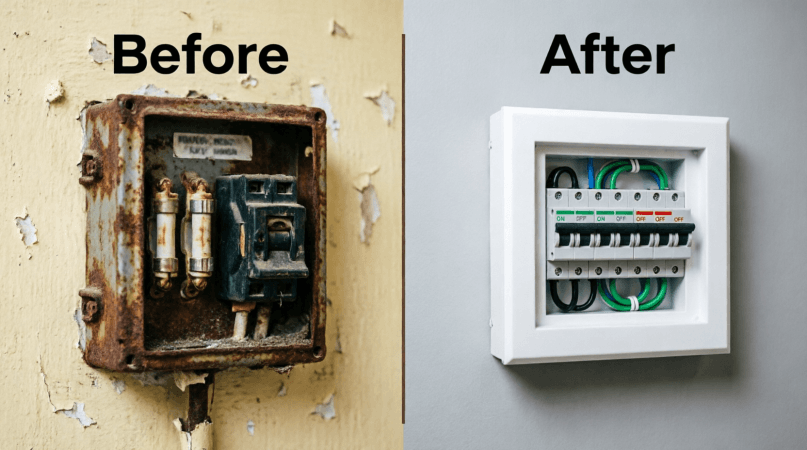
- Obsolete service fuses needing replacement to meet current distributor standards
- Overhead service lines flagged as deteriorated during building inspections
A Level 2 ASP handles all of it, including:
- Relocating a meter box to comply with new building setbacks
- Upgrading consumer mains for additional circuits
- Safe disconnect/reconnect so other trades can work without live cable risk
- Replacing deteriorated overhead service lines
If your renovation also involves an outdated fuse box, it’s worth reading our switchboard upgrade cost guide alongside this one, since the two jobs are frequently bundled together.
Commercial & Industrial Power Upgrades
For businesses, power isn’t an amenity. It’s the foundation of operations, and a single unexpected outage or undersized supply can cost more in lost productivity than the upgrade itself.
What Commercial Operations Typically Require
Most commercial premises need supply well above the standard residential 100A. Common scenarios:
- Hospitality venues adding commercial kitchen equipment or EV charging
- Medical and dental practices running imaging equipment or autoclaves
- Warehouses and light industrial adding CNC machinery or forklift charging
- Retail fitouts with significant HVAC loads
- Server rooms needing stable, uninterrupted three-phase supply
We manage the full coordination with your DNSP, including metering upgrades, dedicated circuit protection, and private substation arrangements for very high-demand sites where required. See our commercial electrician services for how we plan larger fit-out and upgrade projects around business continuity.
Level 2 Electrician for Rural Properties
Rural and semi-rural blocks bring their own challenges.
The Private Power Pole Question
If your property boundary sits well back from the street network, the overhead line between the distributor’s pole and your home needs support. That support is a private power pole, sometimes called an A-Pole or P-Pole.
Key facts for rural property owners:
- You own and maintain the private power pole. It’s your infrastructure, not the distributor’s.
- Poles need regular inspection and replacement when deterioration is found. Distributors issue defect notices when a pole becomes a safety hazard.
- Replacement poles must be deep-set to the relevant Australian Standard, based on soil conditions and pole height.
- Class 2C accreditation is required for all private pole work.
Red Sticker notices are disproportionately common on rural properties, mostly because private poles are out of sight and easy to neglect until an inspection flags them.
Cost Breakdown: What to Expect for Level 2 Work in Australia
Exact costs depend on location, distributor, infrastructure condition and scope. These ranges reflect current market rates across Sydney and regional NSW:
| Service | Approximate Cost Range | Key Variables |
| Standard Disconnect & Reconnect | $400-$900 | Overhead vs underground, access difficulty |
| Underground Service Line (new) | $3,500-$9,000+ | Trench length, road crossing requirements |
| Overhead Service Line (new/replace) | $1,200-$3,500 | Span length, pole requirements |
| Three-Phase Power Upgrade | $4,000-$12,000+ | Consumer mains length, switchboard upgrade, distributor fees |
| Meter Relocation | $1,500-$3,500 | Mains rerouting complexity |
| Private Power Pole Replacement | $2,500-$6,000+ | Pole type, depth, line length |
| Red Sticker Rectification | $800-$5,000+ | Nature and extent of defect |
Network distributor fees aren’t included above. These are paid directly to the DNSP and range from a few hundred dollars for simple reconnections to several thousand for new or upgraded supply applications.
Conclusion: Securing Your Property’s Energy Future
Your connection to the electricity grid is the single most critical piece of infrastructure your property relies on. Whether you are building new, renovating an older home, scaling a business, or managing a rural property with aging overhead lines, getting the right professional for the right scope of work is not optional.
A Level 2 Accredited Service Provider brings the technical skill, the distributor relationships, and the compliance expertise to complete the job correctly the first time. At Top Electricians, we manage every stage, from the initial load assessment and distributor application through to the final NOSW and CCEW filing.
To discuss your project and get a clear, transparent quote, visit topelectricianssydney.com.au.
Frequently Asked Question
1.How long does a three-phase power upgrade take from start to finish?
The physical installation typically takes one full working day. However, the distributor approval process, submitting and receiving sign-off on the Connection Application, adds two to four weeks depending on your DNSP and current processing backlogs. In some cases, particularly with Ausgrid during peak periods, this can extend further. Engaging your Level 2 ASP early in the planning stage is the most effective way to avoid project delays.
2.What is the difference between a Level 1 and Level 2 ASP?
Level 1 ASPs work on the street-level high-voltage network, the poles, transformers, and main distribution lines that serve entire suburbs. Level 2 ASPs work on the specific connection between that high-voltage street infrastructure and an individual property. For almost all residential and commercial property needs, a Level 2 ASP is required.
3.Can my single-phase supply support two EV chargers simultaneously?
In most cases, no, not if those chargers are operating at their rated capacity. A single 7.2kW EV charger already draws around 31A on a single-phase circuit. Two chargers running simultaneously would push 60A or more, which exceeds the typical 63A single-phase service limit before accounting for any other household load. A three-phase upgrade is the practical solution for multi-EV households.
4.What happens if I ignore a Red Sticker defect notice?
A Red Sticker indicates that your network distributor has identified a safety hazard, most commonly a deteriorating private power pole, vegetation interference, or exposed/damaged conductors. Ignoring the notice does not make the deadline go away. Distributors will disconnect your supply if rectification work is not completed and a NOSW filed within their specified timeframe. The cost of unplanned disconnection, lost food, business downtime, emergency accommodation, far exceeds the cost of timely rectification.
5.Do I need a Level 2 electrician just to install solar panels?
For the solar panels and inverter themselves, a standard grid-connect electrician (with Clean Energy Council accreditation) handles the installation. However, if your solar system is large enough to require a metering reconfiguration, a new point of connection, or an upgraded supply to accommodate export capacity, a Level 2 ASP involvement may be required. Battery systems above certain export capacities can also trigger a distributor application process.
6.Is a Level 2 ASP licence valid across all Australian states?
No. ASP accreditation is state-specific. A Level 2 ASP licensed in NSW is accredited under the requirements of Ausgrid, Endeavour Energy, and Essential Energy. To work in Victoria, Queensland, or other states, separate accreditation through the relevant DNSP is required. Always verify that your ASP holds accreditation in your specific state and with your specific distributor.