Private Power Poles, Overhead & Underground Power Lines – Who Is Responsible?

Private Power Poles, Overhead & Underground Power Lines

A power outage hits on a Saturday evening. You check the street and notice your neighbours still have power. The fault is somewhere on your property. You call your electricity provider expecting them to send someone, and they tell you it is not their responsibility.

For thousands of Sydney property owners, this is exactly how they first learn about private electrical infrastructure. Once power crosses your land boundary, the poles, cables, and connection points that carry it become your legal and financial responsibility. The electricity distributor has no obligation to maintain, repair, or replace any of it.

This guide explains the ownership rules in full, covers every major scenario faced by Sydney and Greater Sydney property owners, and tells you exactly who is legally qualified to perform this work in NSW.

Understanding Power Line Responsibility in Sydney

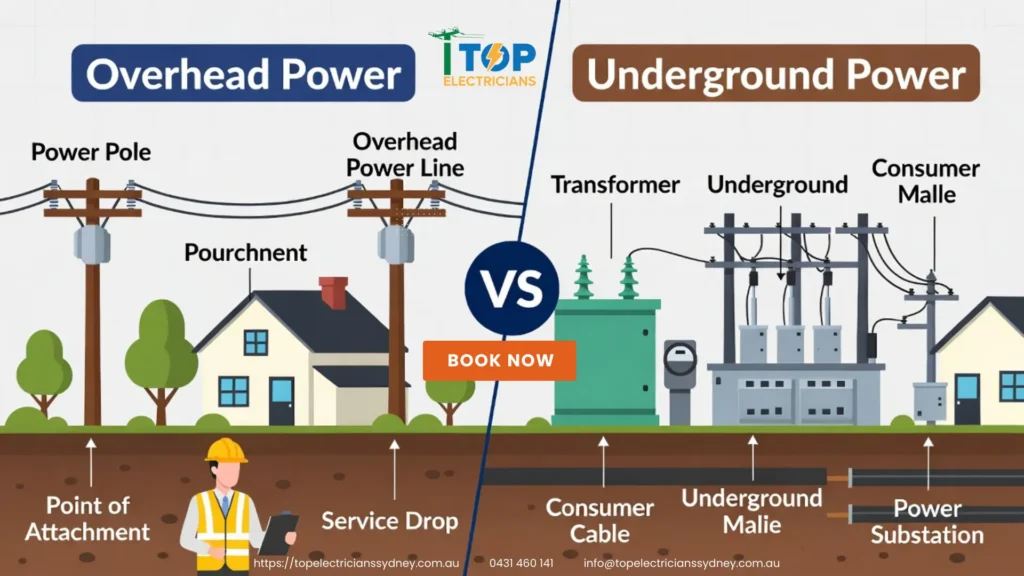
In NSW, responsibility for electrical infrastructure is determined by the point of supply. This is the physical connection point where the distributor’s network ends and your private infrastructure begins. Everything from that point onward, every pole, every cable, every fitting, belongs to you as the property owner.

Sydney’s three distribution network service providers (DNSPs) each publish service and installation rules that define this boundary precisely:

  •     Ausgrid covers inner, eastern, northern, and parts of western Sydney.
  •     Endeavour Energy covers western, south-western Sydney, the Blue Mountains, and the Illawarra.
  •     Essential Energy covers regional NSW including the outer fringes of Greater Sydney.

What the Distributor Owns and Maintains

  •       The electricity pole located on the public road reserve or footpath
  •       The overhead service line from that street pole up to, but not including, your point of attachment
  •       Underground cable running through the public road or footpath up to the property boundary
  •       The metering equipment in some configurations, depending on your connection type

What the Property Owner Owns and Maintains

  •       Any pole located within your property boundary, regardless of when it was installed
  •       All overhead or underground cables that run across or within your land
  •       The point of attachment on your building or private pole
  •       All service lines connecting from a private pole to sheds, granny flats, or other structures on the same land
  •       All conduit, pits, and junction boxes located within your land boundary for underground installations


This rule applies regardless of how old the infrastructure is, how long you have owned the property, or whether anyone told you about it at settlement. Private means your responsibility, full stop. 

What Is a Private Power Pole?

A private power pole is any electricity pole located within your property boundary that carries supply from the street network to your building or to another structure on your land. Unlike street poles owned by Ausgrid, Endeavour Energy, or Essential Energy, private poles are your asset from the day they are installed.

Private poles are most commonly found on long driveways, acreage properties in the Hills District and Hawkesbury region, subdivided lots where supply now crosses a separate title, granny flat and secondary dwelling setups, and properties with sheds, workshops, or outbuildings that required a dedicated supply run.

If you are unsure whether a pole on your property is private, contact your local distributor and request a network boundary confirmation for your address. This is a free service and will give you a definitive answer before you spend money on anything.

Who Can Replace a Private Power Pole?

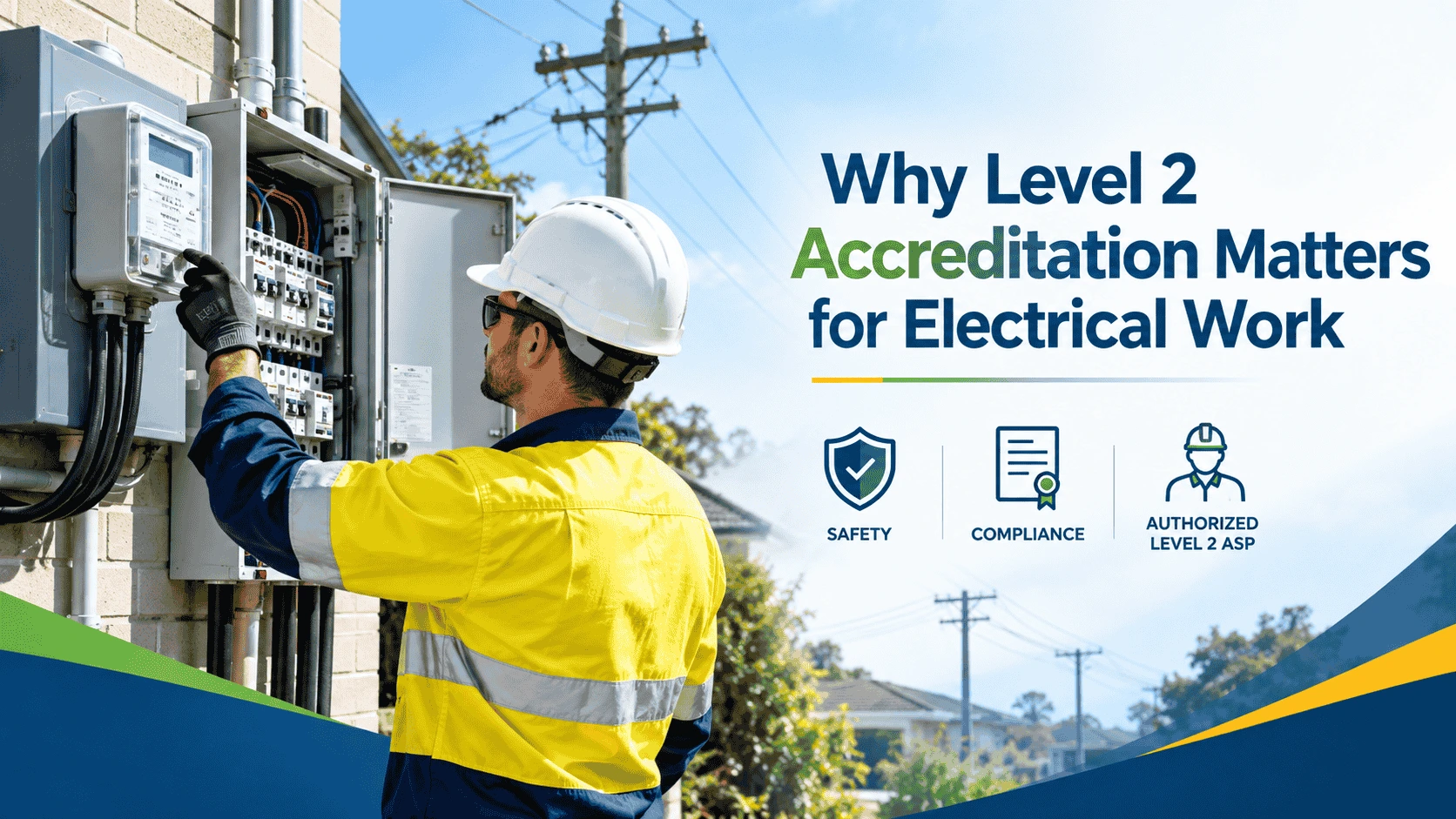
In NSW, private power pole replacement must be carried out by a licensed Level 2 Accredited Service Provider (ASP). This is not work a standard licensed electrician is authorised to perform, and it is not a DIY task under any circumstances. The requirement exists because pole replacement involves live network infrastructure, structural engineering, and distributor coordination, none of which falls within a Level 1 electrician’s scope.

Why Level 2 Accreditation Is Required

A standard licensed electrician in NSW holds a Level 1 licence, which authorises work on customer-side internal wiring only. A Level 2 ASP holds additional accreditation from the relevant network distributor, authorising them to work on the connection between the street network and your property. Private pole replacement sits squarely in that zone.

Attempting to replace a private pole using an unaccredited tradesperson or as a DIY job is a breach of the NSW Electricity (Consumer Safety) Act 2004. Penalties of up to $22,000 apply for unlicensed electrical work. Any unauthorised work on network infrastructure also carries additional liability for damage or injury caused.

The Full Pole Replacement Process Step by Step

  1. Distributor notification and network isolation. Before any pole work begins, the relevant distributor must be notified and supply must be disconnected and isolated at the street. Only a Level 2 ASP can coordinate and execute this step. Work done on a live network connection is illegal and potentially fatal.
  2.     Structural assessment of the existing pole. The pole is assessed against AS 4676 (Structural Design Requirements for Utility Services Poles). Span length, conductor weight, wind loading, and any additional equipment attached to the pole all affect the specification of the replacement.
  3.     Replacement pole selection and procurement. The replacement must be the correct height, structural class, and material for the load it carries. Timber, steel, and concrete poles each suit different applications. The Level 2 ASP specifies the correct pole type for your site conditions.
  4. Excavation and installation to correct embedment depth. Minimum embedment depths are specified in AS 4676 and vary by pole height and class. Correct embedment is what allows the pole to withstand years of wind loading and conductor tension without movement.
  5.   Re-stringing and re-terminating the overhead service line. Conductors are re-attached, correctly tensioned, and terminated at both the new pole and the point of attachment. Sag and ground clearance must meet distributor requirements and AS/NZS 3000:2018.
  6.   Testing and certification. All work is tested before supply is restored. A Certificate of Compliance for Electrical Work (CCEW) is issued by the Level 2 ASP and lodged with NSW Fair Trading.
  7.   Distributor reconnection. The Level 2 ASP coordinates reconnection of supply with Ausgrid, Endeavour Energy, or Essential Energy once certification is complete. The distributor will not reconnect supply until the CCEW is in place.

 Who Repairs Overhead Power Lines on Private Property?

Overhead power lines running across your property are your responsibility to repair and maintain. The electricity distributor will not attend to these lines, even if the damage was caused by a storm, a falling tree, or another event outside your control. Once the line is on your land, the repair obligation follows ownership.

Many Sydney property owners only discover this when a storm has brought down a line and left them without power. Knowing the rules in advance means no wasted time arguing with the distributor and no delay getting the right tradesperson to site.

Common Causes of Overhead Line Damage in Sydney

  •       Storm damage and high winds, particularly in exposed western suburbs, the Blue Mountains foothills, and areas along the Nepean and Hawkesbury river corridors where wind events regularly exceed 90 km/h
  •       Falling trees and large branches, especially following the severe thunderstorm events Greater Sydney experiences between October and March each year. A single branch contact can sever a conductor or strip insulation along several metres of span
  •       Ageing insulation that hardens, cracks, and fails over time, eventually exposing live conductors to contact with vegetation or structures. On properties with older infrastructure, this is one of the most common causes of electrical faults
  •       Vehicle strike on private driveways where service lines are strung at lower heights than street infrastructure. A truck or high-sided vehicle clipping a line can bring down the entire span
  •       Branch contact causing ongoing abrasion to insulation over months or years before the underlying conductor is exposed. This type of damage is often invisible from the ground until a fault occurs
  •       Corrosion at termination points and connection fittings, particularly on coastal properties in the Eastern Suburbs, Northern Beaches, and Sutherland Shire where salt air accelerates metal corrosion

What a Proper Overhead Line Repair Involves

A licensed Level 2 ASP carries out the following for an overhead line repair on private property:

  1.     Full visual inspection of the entire span, from the street connection or private pole to the point of attachment. Every section of conductor, every termination fitting, and every point where the line passes vegetation or structures is assessed. Partial repairs that address visible damage but miss related issues will fail again.
  2.     Notification to the relevant distributor and coordination of network isolation before any physical work begins. No licensed electrician will work on a private overhead line without confirmed isolation. Anyone who does is creating a lethal hazard.
  3. Conductor replacement where damaged. In most cases, the full span of conductor between termination points is replaced rather than joining and splicing, which introduces additional failure points and does not comply with distributor requirements.
  4. Replacement of damaged insulation, termination fittings, and any hardware that shows corrosion or mechanical damage.
  5. Check and, where necessary, repair or replacement of the point of attachment on the building. Overhead line repairs frequently reveal deteriorated POA fittings that must be replaced at the same time.
  6. Sag and clearance check after re-stringing to confirm the repaired span meets minimum ground clearance requirements under load.
  7. Testing, including continuity and insulation resistance testing of the repaired conductors, before supply is restored.
  8. Issuance of a CCEW and distributor reconnection coordination.

What to Do Immediately After Storm Damage

If a storm has damaged an overhead line on your property, do not approach the line. Keep children and animals well away. If the damaged line is in contact with a structure, vehicle, or tree that someone might touch, cordon off the area. Call your distributor’s emergency line to report the damage (they will check whether the street-side connection is involved) and then call a Level 2 ASP to arrange repair of the private section.

Our 24/7 emergency electrician service covers all of Greater Sydney and responds to storm damage callouts around the clock.

Who Maintains Power Lines Between the Street and My House?

This is one of the most frequently misunderstood questions in residential electrical responsibility. The answer is not always straightforward, and it depends on the physical path the service line takes between the street and your building.

When the Distributor Is Responsible

If the overhead service line travels directly from the street pole to your building without crossing any private land, the distributor typically owns and maintains that cable up to your point of attachment. In this situation, if the cable is damaged or deteriorated, you report it to Ausgrid, Endeavour Energy, or Essential Energy and they will arrange repair at no cost to you.

This arrangement is common on standard suburban blocks where the building sits close to the street boundary and the connection is a short, direct span from the pole to the eave.

When the Property Owner Is Responsible

If the service line enters your property boundary before reaching your building, the section of cable within your boundary is your responsibility. This applies regardless of whether the cable is overhead or underground, and regardless of how short that section is.

This situation is common on corner blocks where the service connection enters the side boundary, properties with setback buildings where the cable travels across the front yard, rural and semi-rural properties where the distance from street to building is significant, and any property where a private pole exists within the boundary.

The Point of Attachment: Always the Owner’s Responsibility

The point of attachment (POA) is the physical fixing point where the service line connects to your building or private pole. This includes the insulator, the fixing bracket, and the connection between the service line and your internal wiring. The POA and everything from it to your switchboard is always your responsibility, regardless of who owns the service line running to it.

Deteriorating points of attachment are among the most common findings during electrical inspections on older Sydney properties. A corroded or mechanically failing POA can cause arcing, voltage instability, and in serious cases, electrical fires. If your home was built before 1990 and the POA has never been inspected, it should be assessed.

Our electrical safety inspection service includes a full assessment of your point of attachment, service line condition, and switchboard as part of a comprehensive property inspection.

How to Confirm Responsibility for Your Property

The fastest way to confirm exactly where distributor responsibility ends on your specific property is to contact your local DNSP and request a service boundary confirmation. Ausgrid, Endeavour Energy, and Essential Energy all provide this. For a property with an unusual layout, a long setback, or any private poles, this confirmation is worth obtaining in writing before arranging any electrical work.

Underground Power Lines: Who Is Responsible?

Underground power is increasingly common in newer Sydney developments and in properties that have chosen to have underground their supply for safety, aesthetics, or bushfire risk reduction. The ownership and responsibility rules for underground cables mirror those for overhead lines: location determines responsibility. If it is on your land, it is yours.

What the Distributor Owns Underground

  •       Underground cable running through the public road or footpath
  •       The service pit or boundary junction box located at or near your property boundary (confirm with your DNSP for your specific connection)


What the Property Owner Owns Underground

  •       Any underground cable that crosses your land, regardless of depth or conduit type
  •       The service cable from the boundary pit to your meter box or main switchboard
  •       Underground supply lines to any secondary structure on the property
  •       Conduit, pits, and junction boxes located within your land boundary

Underground cable damage is less visible than overhead line damage, which is why it is often discovered only when a fault causes a power outage or a tripped protection device. Common causes include excavation work that severs a cable, tree root intrusion that crushes or pierces conduit and cable over time, soil movement in areas with reactive clay, and cable ageing in installations that are 20 or more years old.

Before any excavation on your property, always obtain a Dial Before You Dig report at www.1100.com.au. This free service identifies the location of all underground services and prevents accidental damage that can injure workers and leave you liable for repair costs.

Can a Level 2 Electrician Install Underground Power Cables?

Yes. Underground cable installation on private property in NSW requires a Level 2 Accredited Service Provider. A standard licensed electrician cannot legally perform this work because it involves the service connection between the street network and your property, which falls outside the Level 1 scope of work.

Level 2 ASP accreditation is required for all of the following underground cable work: new service connections from the street, replacement of existing underground supply cables, capacity upgrades that require a new or larger cable, undergrounding of an existing overhead supply, and underground supply to secondary structures such as granny flats and outbuildings.

Cost of Underground Cable Installation in Sydney

Underground cable installation typically costs between $80 and $180 per metre for standard residential supply cables, including trenching, conduit, cable, backfill, and reinstatement of the surface. The total cost of a full underground connection depends heavily on the length of the run, ground conditions (sandy soil is faster to trench than clay or rock), and whether any concrete or paving must be cut and reinstated.

Who Handles Long-Distance Private Power Lines?

Properties on Sydney’s rural fringe, including areas around Windsor, Richmond, Penrith, Camden, Campbelltown, and the Hawkesbury and Macarthur regions, frequently have supply lines that travel 100 metres or more from the street connection to the main building. These installations are significantly more complex than a standard suburban supply connection and require specific engineering expertise.

Long-distance private supply lines are not simply a longer version of a standard connection. They involve engineering decisions that determine safety, reliability, and regulatory compliance for the life of the installation, which can be 30 to 50 years or more.

Voltage Drop: The Core Engineering Challenge

Every metre of cable adds resistance to the circuit. Resistance causes voltage to drop between the source and the load. Australian Standard AS/NZS 3008 sets maximum permissible voltage drop limits: 5% for most installations, which equates to no more than 11.5 volts drop on a 230 volt single-phase supply.

On a long run, staying within this limit may require significantly heavier cable than a short run to the same load would need. Getting this wrong has real consequences: appliances at the end of a high-resistance supply run experience lower voltage than they are designed for, leading to overheating in motors, reduced performance in lighting and heating equipment, and potential damage to sensitive electronics.

A Level 2 ASP carries out voltage drop calculations for every long-distance installation to confirm the cable specification is correct for the run length and the expected load.

Pole Spacing and Ground Clearance

For long overhead supply runs, the spacing between poles determines the sag of the conductors spanning between them. Conductors sag more in hot weather as the aluminium or copper expands, and sag further still under ice or wind loading. Australian Standard AS 4676 and distributor requirements set minimum ground clearance heights that must be maintained under all loading conditions.

Getting pole spacing wrong means either conductors that sag too close to the ground in summer heat, creating a safety hazard, or unnecessarily close pole spacing that increases installation cost. Both outcomes are avoidable with correct design.

Bushfire Asset Protection Zone Compliance

In areas designated as bushfire-prone under NSW Rural Fire Service mapping, long-distance overhead supply lines may require specific treatment. The NSW Planning for Bush Fire Protection guidelines and local council development controls set out requirements for overhead lines within or near Asset Protection Zones, and in some cases, undergrounding of the supply is required or strongly recommended.

Properties in the Hills District, Hawkesbury, Blue Mountains, and outer Western Sydney that are classified as bushfire-prone should obtain specific advice on this before installing or replacing a long-distance supply line. Your Level 2 ASP should be familiar with the requirements that apply in your area.

Fault Protection on Long Supply Lines

A long private supply line presents a greater challenge for fault detection and protection than a short suburban connection. A fault at the far end of a 200-metre run may produce a fault current that is not high enough to trip a standard circuit breaker quickly, particularly if the cable is undersized or the earthing at the far end is poor.

Correctly designed long-distance installations include protection devices sized and coordinated to detect and isolate faults anywhere on the run quickly, protecting both people and equipment. This is part of the engineering design process, not an afterthought.

Is It Safe to Touch a Fallen Power Line on Private Property?

No. Never approach or touch a fallen power line on your property under any circumstances. This applies even if you believe the power has been cut, even during daylight hours, and even if the line appears to be inactive. A fallen line that looks dead may still be live. A line that was dead a moment ago may become live again without any warning.

Each year in Australia, people are seriously injured or killed by fallen power lines, including on private property. The risk does not depend on whether the line is sparking, glowing, or making noise. A live conductor lying silently on the ground is just as dangerous as one that is visibly arcing.

Why Fallen Lines Remain Dangerous Even When They Appear Dead

  •       A line that has fallen but remains connected to the network at one end can carry 230 volts (single-phase) or 415 volts (three-phase). Both voltages are potentially fatal. Current as low as 50 milliamps passing through the chest can cause cardiac arrest.
  •       Ground voltage gradients: when a live conductor lies on the ground, voltage spreads outward through the soil in concentric rings. The voltage decreases with distance from the conductor, but the difference in voltage between your two feet as you walk toward the line (called step potential) can be enough to drive a fatal current through your body before you come anywhere near the wire itself.
  •       Automatic reclosers: the electricity network uses automatic reclosing devices that attempt to restore supply after a fault is detected. A line that appeared dead after the initial fault may become live again within seconds or minutes when the recloser operates. This has killed people who assumed a fallen line was permanently de-energised.
  • Private line sections: even if your distributor has isolated the street-side connection, a long private supply line may have enough stored charge or capacitance to deliver a dangerous shock immediately after isolation. Always wait for confirmation from a qualified electrician before treating any conductor as safe to approach.

After the Immediate Emergency: What Comes Next

Once the line has been made safe by a qualified Level 2 ASP, a full assessment of the remaining line is carried out. A fallen line often indicates that other sections of the same span are also deteriorated. Replacing only the section that fell and leaving ageing conductors and terminations in place is a short-term fix that creates the same risk again.

A thorough repair addresses the cause of the failure, not just the visible damage. If the fall was caused by a corroded termination, all terminations on the span are inspected. If it was caused by branch contact, vegetation management along the full span is addressed at the same time 

Private Power Line and Pole Work: What to Expect in Sydney

Costs for private power infrastructure work vary significantly depending on work type, distance involved, ground conditions, distributor coordination requirements, and site access. The following are realistic, indicative estimates for Sydney and Greater Sydney in 2025 to 2026.


Work Type

Typical Low (AUD)

Typical High (AUD)

Private power pole replacement

$1,800

$4,500

Overhead service line repair

$400

$1,200

Underground cable install (per metre)

$80

$180

Long-distance supply line (full job)

$3,000

$12,000+

Point of attachment repair or replacement

$400

$900

Emergency callout after-hours surcharge

+$150

+$300

Compliance certificate and distributor lodgement

$300

$600


These are indicative ranges only. Underground installations vary most due to soil conditions, surface reinstatement requirements, and distance. All prices include GST. A formal written quote is always provided before any work begins.

For an accurate quote for your specific situation, contact Top Electricians Sydney today.

We’re just a call away.
Let’s get started!
0431 460 141

How We Can Help

Top Electrician Pty Ltd is a Level 2 Accredited Service Provider operating across Sydney and Greater Sydney, holding direct accreditation from Ausgrid, Endeavour Energy, and Essential Energy. We specialise in private power infrastructure work that standard electricians are not authorised to perform.

Our Private Power Services

  •       Private power pole replacement and installation. See our power pole replacement service.
  •       Overhead service line repair and full replacement
  •       Underground cable installation, capacity upgrades, and fault repair. Learn more about our underground power line services.
  •       Long-distance rural supply design and installation with voltage drop engineering
  •       Point of attachment repairs and replacements. See our point of attachment service.
  •       Emergency callouts 24 hours a day, 7 days a week. Visit our emergency electrician page.
  •       Compliance documentation, CCEW issuance, and distributor lodgement

Our Credentials

  •       NSW Electrical Contractor Licence 139042C issued by NSW Fair Trading
  •       Electrician Licence 258657C
  •       Level 2 ASP accreditation with Ausgrid, Endeavour Energy, and Essential Energy
  •       More than 10 years operating across Greater Sydney
  •       All work compliant with AS/NZS 3000:2018 and distributor technical requirements
  •       CCEW issued for all qualifying work
  •       Written quotes before work begins with no surprise charges 

Dealing with a damaged pole, a fallen line, or a supply fault on your property? Call Top Electricians on 0431 460 141 or contact us online for a fast response. 

Frequently Asked Questions

How do I know if a power pole on my property is private?

If a pole is located within your land boundary, inside your fence line or on your title, it is almost certainly a private asset. The fastest way to confirm is to contact your electricity distributor and request a network boundary clarification for your address. This is free. You can also check your property’s electrical diagram if one was provided at settlement. When purchasing a property with any rural characteristics, always ask your conveyancer to confirm whether private electrical infrastructure is present.

Who is responsible for a power pole on a shared driveway or common property?

In strata and community title schemes, power poles and supply lines on common property are typically the responsibility of the owners corporation or body corporate. The specific rules are set out in the NSW strata scheme management legislation and the scheme’s by-laws. Seek clarification from your strata manager before arranging any work, as cost recovery processes vary between schemes.

Can I choose to underground my existing overhead supply?

Yes. Many Sydney property owners choose to underground their overhead supply for improved safety, reduced storm damage risk, bushfire risk reduction, and better aesthetics. The work requires a Level 2 ASP and must comply with AS/NZS 3000:2018 burial depth and conduit requirements. In bushfire-prone areas, undergrounding may be required by council or the NSW RFS. See our underground power line service for more information.

What happens if I do not maintain my private power pole and it falls?

If a neglected private pole fails and causes damage or injury, the property owner carries legal liability. This can include liability for damage to neighbouring properties, injury claims from anyone harmed, and costs associated with supply restoration and emergency response. Home insurance policies may also exclude claims arising from unmaintained private electrical infrastructure. Regular inspection, particularly after major storms, is the most cost-effective risk management approach.

How often should private power poles be inspected?

There is no fixed mandatory inspection interval for private power poles in NSW, but industry practice and insurer expectations point to a visual inspection after every significant storm event and a formal inspection by a qualified Level 2 ASP every 5 to 10 years depending on the age and condition of the infrastructure. Timber poles have a finite service life, typically 25 to 40 years depending on species and treatment, after which replacement becomes necessary regardless of visible condition.

Do I need council approval to replace a private power pole?

In most cases, like-for-like replacement of an existing private pole does not require development approval from your local council. However, if the replacement involves a change to the pole location, height, or structural type, or if the property is in a heritage conservation area, you may need to check with your local council before proceeding. Your Level 2 ASP should advise on any approval requirements specific to your situation and location.

 Conclusion

Private power poles and supply lines carry real responsibility, but that responsibility becomes straightforward when you understand the rules and work with the right people. The essential points are these: infrastructure on your land is yours to maintain; only a Level 2 ASP can legally perform this work in NSW; and proactive inspection is far cheaper than emergency repair.

Top Electrician Pty Ltd provides complete private power infrastructure services across Sydney and Greater Sydney. Whether you have a failing pole, storm-damaged overhead lines, an underground fault, or a long-distance rural supply that needs upgrading, we have the Level 2 accreditation, technical expertise, and distributor relationships to handle it correctly. Contact us today on 0431 460 141.